UpNano Unveils 3DAR

Austrian nanoscale 3D printing firm UpNano can make very precise 3D printers that can achieve accurate results at the sub-micron level. The company’s 2PP printers have helped it secure a $7 million venture round in 2024 to finance its continual upgrades and improvements. The firm is able to make prototypes, series, and full-on production of parts with 100 nm resolution from the sub-micrometer to centimeter scale.

3DAR explanation. Image courtesy of UpNano.
Now the company has pushed its technology forward even more by developing 3DAR. Based on Grayscale lithography, the company now has 3D Adaptive Resolution (3DAR), which lets it control each voxel in three dimensions during printing. This voxel-level control means that each voxel can be adapted during printing to a specific shape. The effect is smoother parts. It’s kind of like how meshes with more triangles can better describe geometry, but now made physical. Furthermore, by changing the voxel shape and size as needed, it can focus the laser at a specific resolution. This means it can deliver both speed and precision by keeping thicker layers while still making the right geometry. Rather than switching between different voxel sizes, 3DAR now shapes all voxels on the fly.
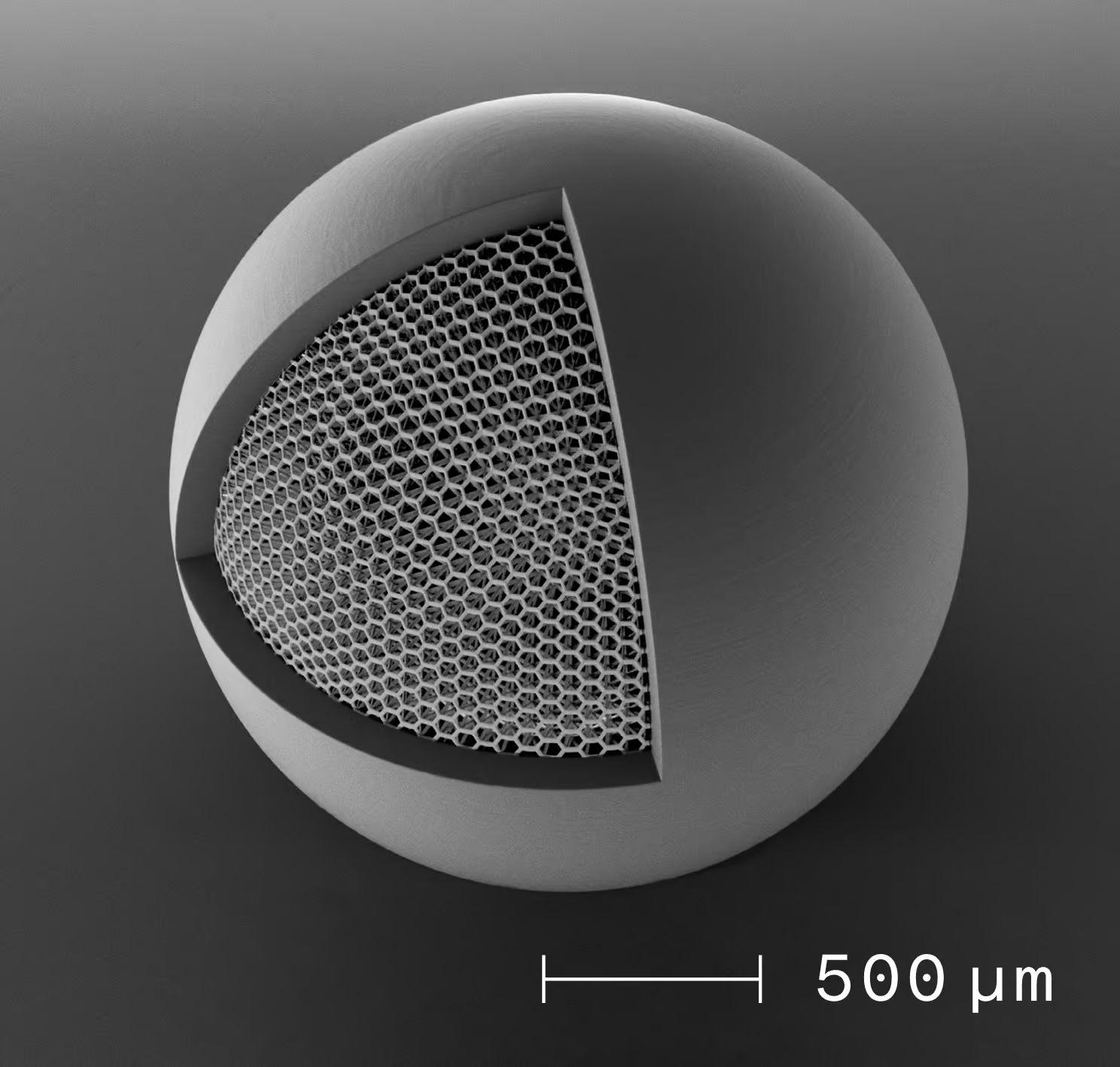
New Fusion Target with Lattice Cutout. Image courtesy of UpNano.
Eventually, true voxel-level control over multi-material prints is where we want to end up because then we can mix, match, and combine lots of different materials and properties into one assembly with precision. 3DAR doesn’t do all of that, but they’re closer to this than anyone else, with any technology, so congrats to the UpNano team. The company believes it will find customers for this in photonics and semiconductors, which is good because those guys are drowning in money right now. They also believe in micro optics, which could, with more complex consumer devices, perhaps grow with more VR applications (are we still doing that?), be used more extensively in Lidar for liveness checks and scanning, and be used in growing areas in data centers and robotics. Micro optics is little followed at the moment but could be poised for considerable growth in the coming years.
UpNano CEO Bernhard Küenburg stated,
“3D Adaptive Resolution gives us dynamic control over the voxel in all three spatial dimensions. We can continuously adapt its shape to the geometry we want to create. This allows us to combine printing speed with the surface quality required particularly for optical and photonic applications.”
The familiar staircases of 3D printed parts have been eliminated through the creation of more precise geometries. This will be especially useful in optics where making all manner of lenses has been traditionally difficult with additive. This instantly could make UpNano a takeover target for the likes of Apple or Samsung. Yes, the firm could supply the emerging optics market, but keeping it mostly in-house could give a large firm an edge in Lidar, phone cameras, or 3D scanning using phones. If we continue to see the intersection of the digital world and the physical, these optical components could become a much-needed bridge between them. More accurate face detection, photo illumination, or object recognition could become very valuable to firms like Meta, Google, and Apple.
On the other hand, after Meta spent perhaps $100 billion on AR without anything to show for it, investment interest in phygital bridges between these worlds could have waned. But recent investments by Apple in Q.ai (a silent speech technology) and Sonera Magnets (chip-based biomagnetic sensors) show that some believe in pursuing the space. With Q the company can let its customers mouth words and take in these inputs while Sonera lets you measure very weak magnetic signals of the brain and muscles. This interest reflects a deep focus on health monitoring and user authentication through more advanced means. Perhaps UpNano may play a part in such a future as well.
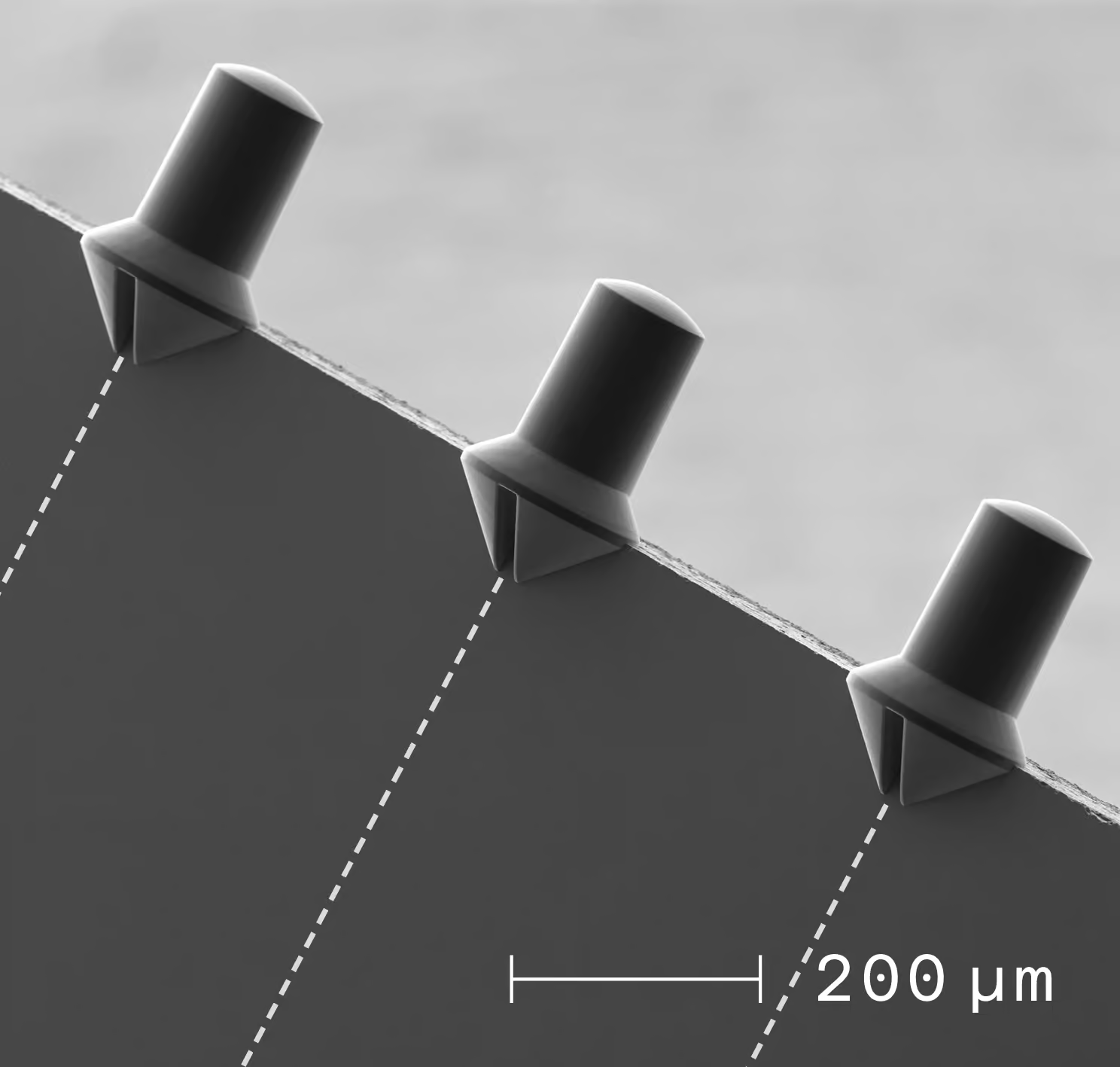
Facet Attached Lenses-Waveguide Markers. Image courtesy of UpNano.
Even if it isn’t UpNano, it is positioning itself as a useful tool for some truly high-potential, high-growth industries. The company now has Sq 3 nm surface roughness and can make a 125 µm spiral part in under ten seconds. Printing in place and on existing assemblies is also a forte. One particular customer is said to be very interested in purchasing more systems after having bought four.
Subscribe to Our Email Newsletter
Stay up-to-date on all the latest news from the 3D printing industry and receive information and offers from third party vendors.
Print Services
Upload your 3D Models and get them printed quickly and efficiently.













You May Also Like
10 Years of Multi Jet Fusion: Onsite at HP’s Vancouver, Washington Facility
At this year’s RAPID event in Boston, HP Additive Manufacturing Solutions celebrated ten years in the additive manufacturing (AM) market. The company ushered in the milestone with several innovations, including...
These 3D Printed Lattices Can Sense Damage Before Failure
A new paper, “Full-Field Damage Monitoring in Architected Lattices Using In situ Electrical Impedance Tomography,” points to lattices being able to detect damage. This could really help composites in critical...
3D Printing News Briefs, October 3, 2026: Hypersonics, Hotends, & More
We’re starting off with defense in this weekend’s 3D Printing News Briefs, as Titomic was awarded a $5 million U.S. defense contract, and VulcanForms announced a partnership with Specter Aerospace...
3D Printing News Briefs, October 1, 2026: Defense, Enclosures, & More
In today’s 3D Printing News Briefs, we’re starting with defense news, first from Massivit and then from AML3D. Then we’ll move on to U.S. manufacturing of a new large-format LPBF...