Mosquito Dreams Part 5: Bakelite With a Bird Strike


The De Havilland Mosquito was a remarkably successful aircraft. Though not as lauded as the Spitfire, it still played an important role in special missions, taking the fight to the Nazis and serving as a true multirole aircraft suited to the myriad roles assigned to it. Built across England in a distributed way, using available wood and small woodworking firms, it also pointed to a path of industrializing aviation that we see today in how Boeing, Airbus, and others operate. By using locally available resources, the Mosquito pointed to a way towards supply chain resilience that we should be taking but are not.
The Mosquito was created and produced at scale because it was a solution built around available resources. Rather than trying to stimulate the resources needed for the current manufacturing processes. Piano firms bent and brought together composite wood structures. The De Havilland was made of plywood and glue sandwiched together. If you look at an IKEA Billy bookcase today, its resin, pressed wood, and laminate construction is remarkably similar. The composite heavy A350 and 787 are made of very different composites, but the development that led to them was kickstarted by the success of the Mosquito.
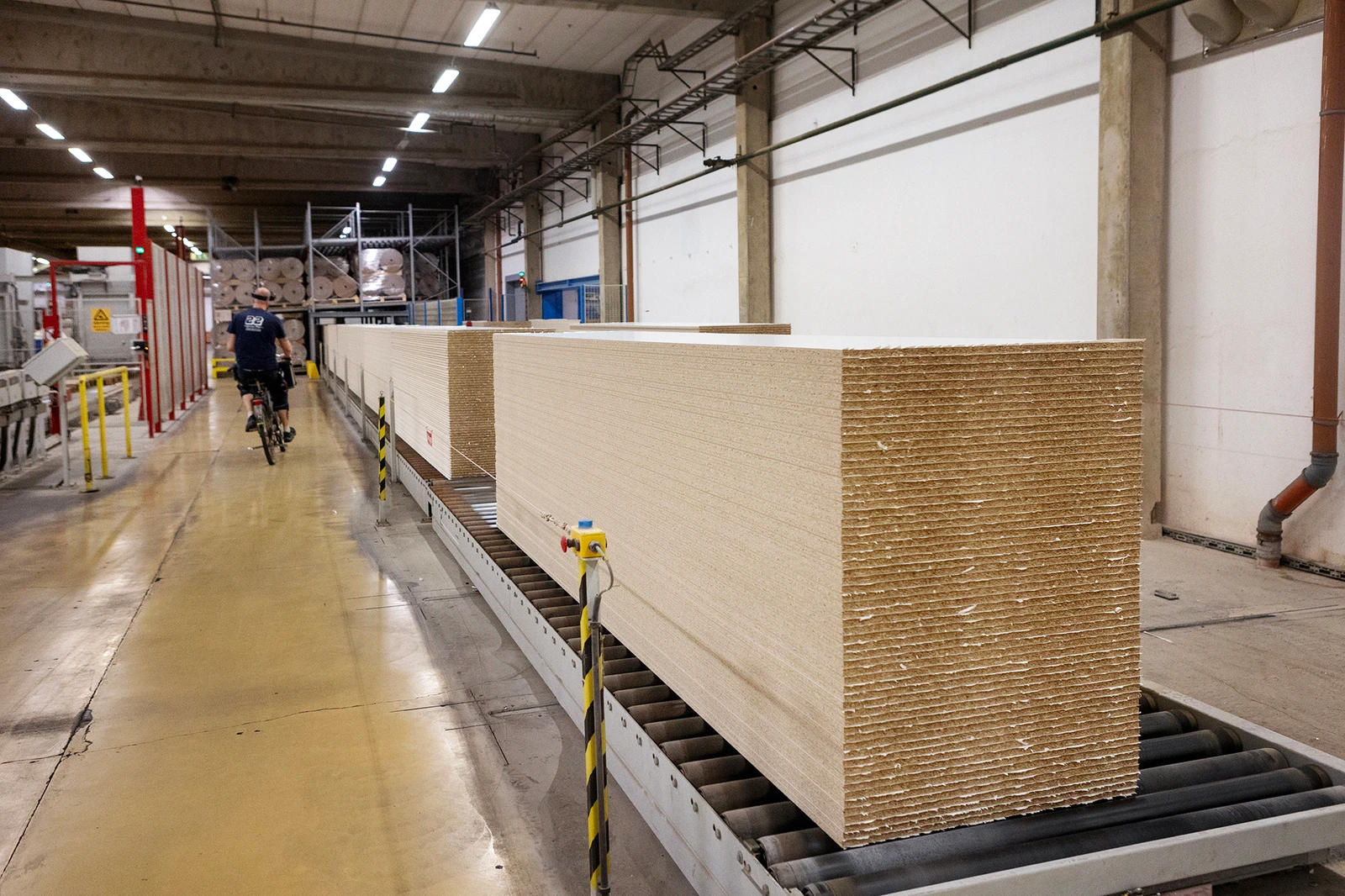
Image of Billy production process by IKEA
In some cases, contemporary honeycomb sandwich panels are made with additive manufacturing. And the next time that you’re taking a flight, know that almost all you see is composite honeycomb panels. Wing components and many structural parts are honeycomb too. Aramid Nomex is inherently flame-retardant and is used for protective clothing like firefighter suits and other flame-resistant protective clothing. That same material, submerged in phenolic resin, starts as a paper, is cut and folded into shape, and then sandwiched between fiberglass or another material. It makes up the floor you walk on in the plane but also HAL’s cargo bay doors, enclosures for EV batteries, speedboats, snowboards, radomes, and more. Sandwiched air is everywhere.
As much as I’d love to trace everything back to the Mosquito, other spiritual ancestors shaped contemporary aircraft. Leo Baekeland invented Bakelite in 1907. Baekeland’s invention and its success should have cemented him as a famous person, or at least the most famous Belgian ever, but alas, all the famous Belgians are fictional. Except for Audrey Hepburn, of course, but no one knows she’s Belgian. Bakelite was the first industrial synthetic plastic and was used in electronics, telephones, and distributor caps. Bakelite was also phenolic, made through condensation polymerization of phenol and formaldehyde. Reinforced with GF, paper, and cotton, the resin matrix became stronger and more resistant to heat and impacts. Bakelite was molded in place through compression molding and heat, which caused the material to crosslink. Used in many industries, this non-conductive, low-cost material was tough and resistant to many solvents. Much of the Bakelite used in industry & automotive contained Asbestos as a reinforcing agent; combined with the phenol and formaldehyde ingredients and the fact that it’s a thermoset, it became a recycling nightmare. Bakelite was a perfect material for many uses, but environmentally, it’s hard to think of how you could make it worse. PVC was one of many more vibrantly colored alternatives to Bakelite. It is difficult to consider PVC a sustainable option. Eventually, injection-molded thermoplastics replaced Bakelite, along with color, because of cost.
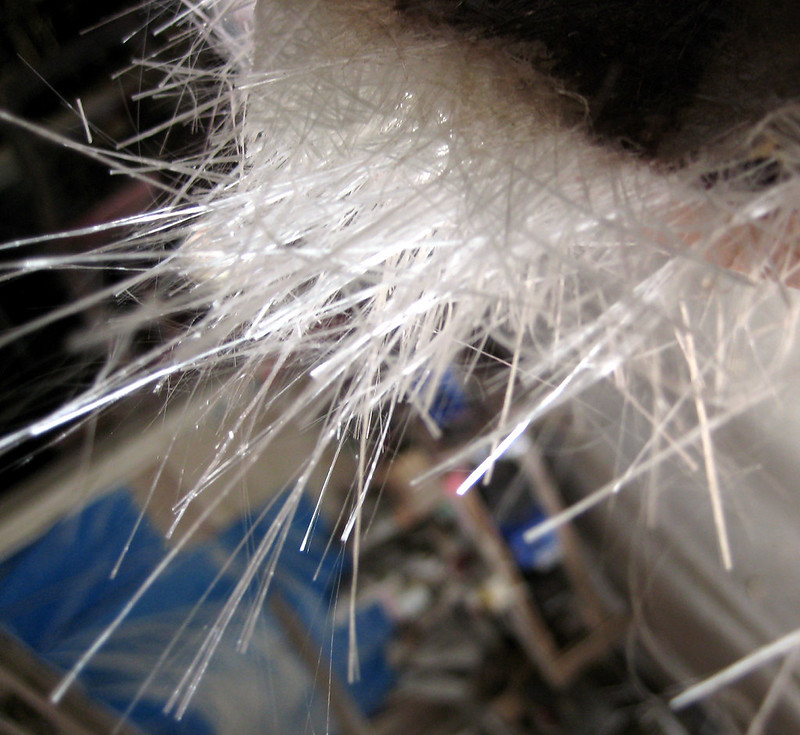
Glass fibers used to reinforce composite materials.
In 1935, Owens-Illinois and Corning Glass began working together on continuous glass fiber development, a key ingredient to modern composites, and FIberglass was the result. Discovered when compressed air accidentally blew through molten glass, the material is made by melting glass, pushing it through holes, and then coating it. Fiberglass, with the added “s” as it is now mostly known, has many uses, most prominently in home insulation. Also used in radomes, like many cutting-edge lightweight materials, it is used in water tanks, and many sport boats are still made of the material today. GF is also widely used to reinforce 3D printing materials, especially in LFAM. Known as glass-fiber-reinforced plastics (GFRP), they remain an important part of sporting goods, turbine blades & electronics.
In 1860, Joseph Swan used pyrolysis to make filaments that were later used in lightbulbs before tungsten filaments supplanted them. More useful, carbon fiber was made in 1958 by Roger Bacon at Union Carbide; like Fiberglas, the discovery was accidental. Akio Shindo used polyacrylonitrile (PAN) to make fibers into strong carbon fiber after seven years of trying. Toray industrialized the process and brought carbon fiber to the world as we know it today. Incredibly influential researcher Stephanie Kwolek invented Kevlar in 1965. Throughout her career, her work on low-temperature polymerization also helped lay the groundwork for commercial materials including Lycra, Nomex, and Kapton. She also helped establish the broader liquid crystalline polymer category of materials and, by feeding Kevlar through a spinneret, broadened the appeal of this technique for other aramids and fibers.
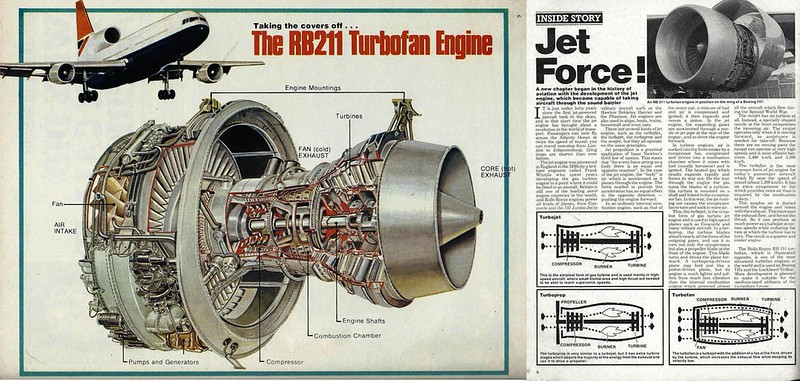
Rolls-Royce developed the RB211 using its own composite material, Hyfill, for the turbine blades. The lightweight engine catapulted the company to a leading role in passenger aircraft. But then came the chicken gun. A standard test for jet engines, where a frozen chicken or turkey is shot from a cannon at high speed at the engine to simulate a bird strike, was catastrophic. The engines shattered, and Rolls-Royce turned to titanium to solve the problem. The engineering about-face bankrupted the venerable company in 1971.
Rolls-Royce split off its automaking division, which eventually became part of a complicated deal involving Volkswagen and BMW. Volkswagen acquired Rolls-Royce Motors in 1998, while BMW secured the rights to the Rolls-Royce name and marque for automobiles. Delays in the aircraft for which the RB211 was destined for the Tri Star nearly drove Lockheed bankrupt before the US Government saved it.
The RB211 has evolved since then, culminating in the RB211-524L, more popularly known as the Trent, which could power your next transatlantic sojourn aboard an A350 or 787. And the Trent, of course, uses something Rolls-Royce (and only Rolls-Royce) calls Additive Layer Manufacturing. Rolls-Royce has tested 3D printed components on development versions of the Trent XWB-97, including ALM vanes and a 1.5-meter-diameter front bearing housing, and future engines will have bigger components such as compressors and bearing housings. Let’s be sure to fear the chicken gun when that happens.
Images courtesy of Niels van Reijmersdal and Get Right Down, Ausdew
Subscribe to Our Email Newsletter
Stay up-to-date on all the latest news from the 3D printing industry and receive information and offers from third party vendors.
Print Services
Upload your 3D Models and get them printed quickly and efficiently.












You May Also Like
Two Farsoon Machine Launches & How Chinese AM OEMs Are Shifting Focus
In posts last month about Eplus3D and how it’s scaling production for the AI infrastructure market, I focused on how the Chinese additive manufacturing (AM) landscape looks poised to intensify...
3D Printing News Briefs, November 5, 2026: Tungsten, Color Mixing, Prosthetic Socket, & More
We’re starting with business from Xact Metal, 3D Systems, and Freemelt, and moving on to materials from Snapmaker and hybrid manufacturing with Eplus3D. We’ll end with a custom prosthetic socket,...
3D Printing Financials: 6K Additive’s Orders Surge as Revenue Climbs 61%
6K Additive (ASX: 6KA) reported higher revenue and a record order backlog in its latest quarterly results, as growing demand for metal powders continues to push the company to expand...
China’s Additive Manufacturing Market is About to Get Even More Competitive
Last month I wrote about the Chinese laser brand HG Laser and how its increasing focus on metal additive manufacturing (AM) demonstrates that Chinese AM companies benefit from having to...