QTREX Takes Nano Dimension’s AME Technology Into Israeli Defense

A 3D printing technology that Nano Dimension sold just five months ago is now being installed inside one of Israel’s largest defense companies.
QTREX Quantum (Nasdaq: QTEX) bought Nano Dimension’s Additively Manufactured Electronics (AME) business in April. Now, one of its new customers, an unnamed Israeli aerospace and defense manufacturer, has begun deploying the technology. QTREX said on September 2 that the first AME system is being installed at the customer’s facilities as part of a joint development program.
While the customer’s name has not been disclosed, it is being described as one of Israel’s three largest defense companies and a major global aerospace and defense manufacturer.
QTREX noted that: “The first QTREX AME system is now being installed at the partner’s facilities. The agreement includes exclusivity provisions that underscore the strategic importance the partner places on QTREX’s technology. It also outlines a potential phased commercial pathway toward broader AME system rollouts, with aggregate revenue for QTREX in the tens of millions of dollars. The partner’s identity is not being disclosed at this stage pursuant to contractual confidentiality obligations.”
The announcement also provides a look at what is happening to Nano Dimension’s former AM businesses under their new owner. In April, Nano Dimension sold AME, along with its Fabrica micro-3D printing operation, as part of a broader effort to cut costs and sell assets it no longer considered central to its plans. QTREX bought both businesses. Now, just five months after the sale, one of those technologies is moving into a major defense manufacturer.

Image courtesy of QTREX Quantum.
From Nano Dimension to QTREX
QTREX was still called Inspira Technologies when it agreed to buy the AME and Fabrica assets on April 1. The transaction closed on April 6. It paid $2 million upfront, with additional payments that could bring the total purchase price to $12.5 million depending on the businesses’ performance over the following year. What’s more, QTREX acquired intellectual property, proprietary software, equipment, tooling, inventory, customer contracts, accounts receivable, and other assets related to the businesses. That included Nano Dimension’s DragonFly IV AME technology, which prints conductive and insulating materials to create electronic devices and circuitry.
QTREX also acquired Fabrica, Nano Dimension’s micro-additive manufacturing business. Its Fabrica 2.0 systems use a light-based process to produce very small polymer and composite parts at micron-level resolution. Interestingly, Nano Dimension had already discontinued Fabrica before the sale.
Together, AME and Fabrica generated $5.5 million in revenue in 2025 for Nano, but their direct expenses were much higher, pointing to the fact that QTREX acquired businesses with existing technology and customers but also high costs.
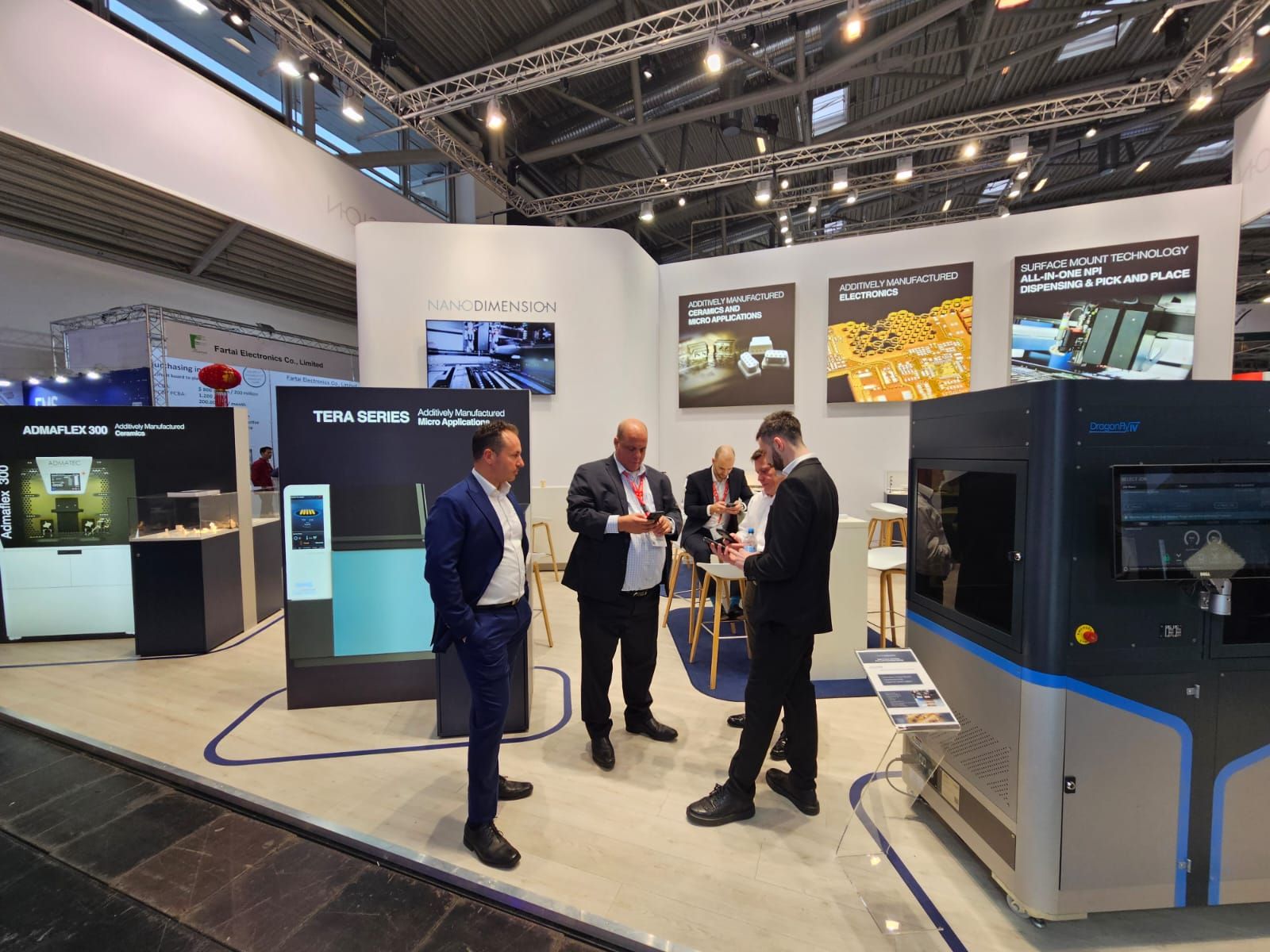
Nano Dimension booth at the Electronica Fair 2024 in Munich, Germany. Image courtesy of Nano Dimension via LinkedIn.
AME is basically a way of 3D printing electronics, using conductive and insulating materials to create circuitry inside complex 3D structures. For the Israeli defense company, this could make it easier to produce complex electronics in-house and reduce its reliance on outside suppliers. QTREX will also work with the customer on materials and processes to adapt the technology to its specific engineering and reliability needs.
One System Is Real. But the “Tens of Millions” Are Not Yet Booked.
For now, only the first AME system is being installed. QTREX says the program could later expand to more systems and eventually bring in tens of millions of dollars, but those future sales have not been signed yet. Any additional systems would require new agreements between QTREX and the customer. In fact, QTREX has not disclosed yet how many additional printers that would mean, when those purchases could happen, or how much revenue they could bring in.
So, for now, one system is being deployed under the joint program, with consumables providing an additional source of revenue. More systems could follow.
Is this an early test for Nano Dimension’s former AM business? The Israeli defense project is not QTREX’s only sign of activity since taking over Nano Dimension’s AME operation. In June, the company announced a purchase order from a U.S.-based Fortune 500 company for an AME system and materials. Later that month, QTREX said an AME system at a large U.S. interconnect manufacturer had moved from development work onto its production floor after a validation program. Then in July, QTREX also announced an order from an international government-owned company for customized 3D printed radio-frequency components.
QTREX is also taking the former Nano Dimension technology into quantum computing. The company recently announced a new 3D printed interconnect system for quantum computers, made using its AME technology, which it plans to unveil at IEEE Quantum Week later this month.
QTREX itself is still a small company. In August, it raised about $10 million in gross proceeds through a registered direct stock offering as it continues building the new business. Still, this latest defense deployment does not yet prove that QTREX can turn Nano Dimension’s former AM operations into a sustainable business.
Subscribe to Our Email Newsletter
Stay up-to-date on all the latest news from the 3D printing industry and receive information and offers from third party vendors.
Print Services
Upload your 3D Models and get them printed quickly and efficiently.













You May Also Like
Creality K3 Opens for Pre-Order at $849, Advancing Multi-Color 3D Printing
Creality has officially opened pre-orders for the Creality K3, its latest flagship K Series 3D printer, starting at $849 in the United States. Recognized as an IFA Innovation Awards 2026...
Beyond the Printer: HP and DyeMansion Tackle the Future of Prosthetics
Making a custom orthotic or prosthetic device involves much more than producing the final part. Patients need to be measured, devices must be designed to fit their bodies, and finished...
3D Printing News Briefs, October 14, 2026: Bolus, Aerospace Tooling, Water Filter, & More
In today’s 3D Printing News Briefs, we’re starting with medical news, as Myrava has received FDA 510(k) clearance for its 3D printed bolus. Moving on to aerospace and metals, AML3D...
Can India’s AM Push Help Make it a Viable Supplement to China?
Diversifying manufacturing supply chains to locales outside of China has nothing to do with actually cultivating “substitutes” to the Chinese economy. The real stakes are these: China is an irreplaceable...