At This 3D Printed Petting Zoo, the Mistakes Are Part of the Fun

Pip the Rabbit has a glowing belly and ears that wiggle when you press his paw. Inchy the Caterpillar crawls when you clap. Plate the Armadillo can curl himself into a ball, although getting him to do that took 11 prints. These are just a few of the residents of a very unusual petting zoo being built by a group of kids ages 7 to 13 for this month’s Maker Faire Bay Area in Vallejo, California.
There won’t be any real animals at the 3D Printed Robot Petting Zoo. Instead, there will be more than 20 creatures made with 3D printers, LEDs, motors, buttons, gears, and plenty of trial and error. And yes, visitors are supposed to touch them. In fact, the young makers want people to press the buttons, turn the switches, and watch the animals move. Many of the creatures can also be opened up so visitors can see the wires, gears, and electronics inside.
But the kids are bringing something else to Maker Faire too: all the stuff that didn’t work. Broken prints, melted parts, and earlier versions will be on display next to the finished animals. Visitors can ask the young makers what went wrong, how they fixed it, and what they would do differently next time. And that may be one of the most interesting parts of this zoo.
From a 3D Print to a Robot Pet
The idea behind the project is to make sure each young maker chooses an animal, either real, mythical, or completely made up, and decides what it should do. Then they have to figure out how to make it happen.
Some design their creatures from scratch. Others start with an existing 3D model and change it. They may cut it apart so it can open, redesign sections to make room for electronics, or print the same piece again and again until it works. Then, once the body is ready, they add a trick. That could be an LED, a servo, a motor, a button, or a set of gears. The goal isn’t to build an advanced robot. It’s to take something that would normally be a static 3D print and make it do something.
The beauty of this exhibit is the wonderfully different results the students created. The zoo has eight creatures, including Ember the Dragon with its articulated spine and two LED eyes that turn on with a button on its chest. Glow Jelly is a translucent blue jellyfish with a ring of LEDs inside. Lumi the Duck doubles as a nightlight, with a tap on the head changing the brightness. Cog the Owl doesn’t need batteries at all, as visitors turn a hand crank to make the gears inside his chest move. Then there’s Inchy, a caterpillar made from 12 printed sections, powered by an Arduino Nano, a small servo, and a sound sensor. Clap your hands and Inchy inches forward. Pip the Rabbit has a print-in-place body, an LED belly, and ears controlled by a servo. Press his paw and the ears wiggle.

Lumi the Duck. Image courtesy of 3D Zoo.
Skipper the Turtle hides wheels and a small geared motor under his shell and moves with a wired remote. And Plate the Armadillo uses a hidden cam-and-lever mechanism to curl into a ball and open again. Plate apparently wasn’t an easy animal to build; it took 11 prints to get him there.
Print. Fail. Fix. Print Again.
That number, 11, says a lot about what the kids are doing. Some of them are working on projects like this for the first time. The official Maker Faire listing describes the group as fourth- and fifth-grade young makers exploring how simple electronics and mechanical movement can bring a 3D printed object to life.
It’s really great to see that nobody is pretending everything works on the first try. The zoo’s website makes that clear. The kids pick an animal, design and print it, and then add lights, motors, gears, or other parts to make it move or react. If something doesn’t work, they fix it and try again. That might mean sanding a part, changing the design, or simply printing it again.
Anyone who uses a 3D printer knows how much trial and error can go into a print. And these kids are making things even harder for themselves. They aren’t just printing animals to put on a shelf. Their animals have to move, light up, or respond to people, which means the printed parts also have to work with motors, wires, gears, and electronics.
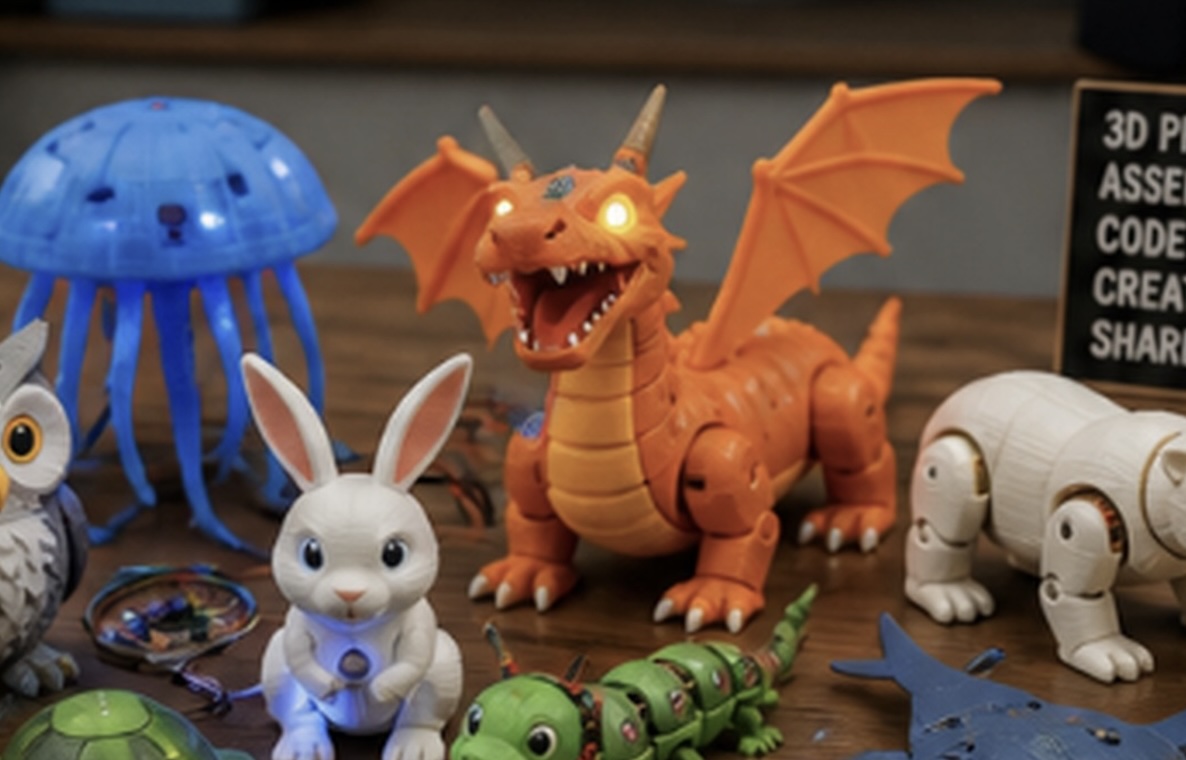
Ember the Dragon, Glow Jelly and more. Image courtesy of 3D Zoo.
Please Touch the Animals
Maker Faire Bay Area takes place September 25 through 27 at Mare Island in Vallejo, California, and the Robot Petting Zoo is being built as a hands-on exhibit. That means there won’t be much standing behind a rope and looking at the finished prints. Visitors will be able to push buttons and test moving parts. And they can talk directly to the kids who made them. The makers are expected to explain not only what their creatures do, but what went wrong while they were building them.
It’s truly a great way to introduce kids to 3D printing and robotics. There are no perfect parts required and no need to understand everything before starting.
By the time Maker Faire opens later this month, the 3D Printed Robot Petting Zoo should have more than 20 of the cutest residents ready for visitors.
Subscribe to Our Email Newsletter
Stay up-to-date on all the latest news from the 3D printing industry and receive information and offers from third party vendors.
Print Services
Upload your 3D Models and get them printed quickly and efficiently.













You May Also Like
Solukon Goes Big with New SFM-AT850 Depowdering System
Solukon has released the SFM-AT850 depowdering system. The German depowdering specialist has updated its product line, and this machine replaces the SFM-AT800-S and SFM-AT1000-S. Rather than many small parts, this...
The Hidden Economics of Powder Bed 3D Printing: Closing the Loop in Powder Management
Automation is a very topical thing in additive manufacturing at the moment. With renewed scale, some clients are fervently looking to automate production. Other business cases only make sense with...
Oerlikon Adds ATLIX’s xBUILD 5000, Plans More for 2027
Oerlikon has installed a new ATLIX xBUILD 5000 metal 3D printer at its facility in Huntersville, North Carolina, marking the first production deployment of the system worldwide. The machine will...
The Science Lab You Can 3D Print
Researchers at Sweden’s Umeå University have shown how desktop 3D printers can be used to make lab equipment, giving scientists a cheaper way to build tools for their research. The...