XTPL Calls Shareholder Meeting to Vote on Strategic Investment from Taiwanese Fund


Nothing else in the global economy quite compares to Taiwan’s share of the global semiconductor market. There are other cases of geographic concentration, involving critical materials and components, where certain countries (almost always China) may hold even higher percentages of worldwide market share, but at least two things make Taiwan’s chip dominance rather unique.
One of those things is simply the significance of semiconductors to every other economic sector. The other is Taiwan’s relative lack of control over its own strategic position, given that its size is directly inverse to how economically indispensable it is. Around 24 million people live in Taiwan, in an area slightly larger than Maryland, yet it controls more than 90 percent of the global market for the most advanced chips.
This is of course the primary reason why the topic of Chinese-Taiwanese relations is always somewhere in the mix of the geopolitical news cycle, and that, in turn, is why Taiwanese companies have increased their overseas investments by nearly 60 percent between 2021 and 2025, compared to the previous five-year period. On a much smaller scale, this is the primary reason why I’ve paid close attention to Polish electronics 3D printing microcap XTPL ever since the company announced a strategic partnership with Taiwanese advanced packaging specialist Manz Asia at the beginning of this year.
After a series of other similar announcements this year surrounding companies in the US, Japan, and China, XTPL has now announced that it is calling an extraordinary shareholder meeting on September 29 to vote on securing a strategic investment by “a specialized investment fund from Taiwan focused on deep-tech technologies.” Under the plan, XTPL would issue nearly 200,000 new shares to the undisclosed investor, at a price of around PLN 65.00 per share, representing an investment of around $3.5 million.
While the investor may not have been named, there are plenty of possibilities in the Taiwanese market that would be good matches for XTPL, including the NTHU Future Fund that was announced earlier in the summer. This is a collaboration between Taiwan’s prestigious National Tsing Hua University and Top Taiwan Venture Capital — one of the nation’s first VC funds — which will invest $34 million in seed and early-stage startups. While the Future Fund plans to prioritize homegrown Taiwanese startups, it will also consider startups from around the world that participate in the University Science Park (USP) innovation ecosystem that NTHU just opened.
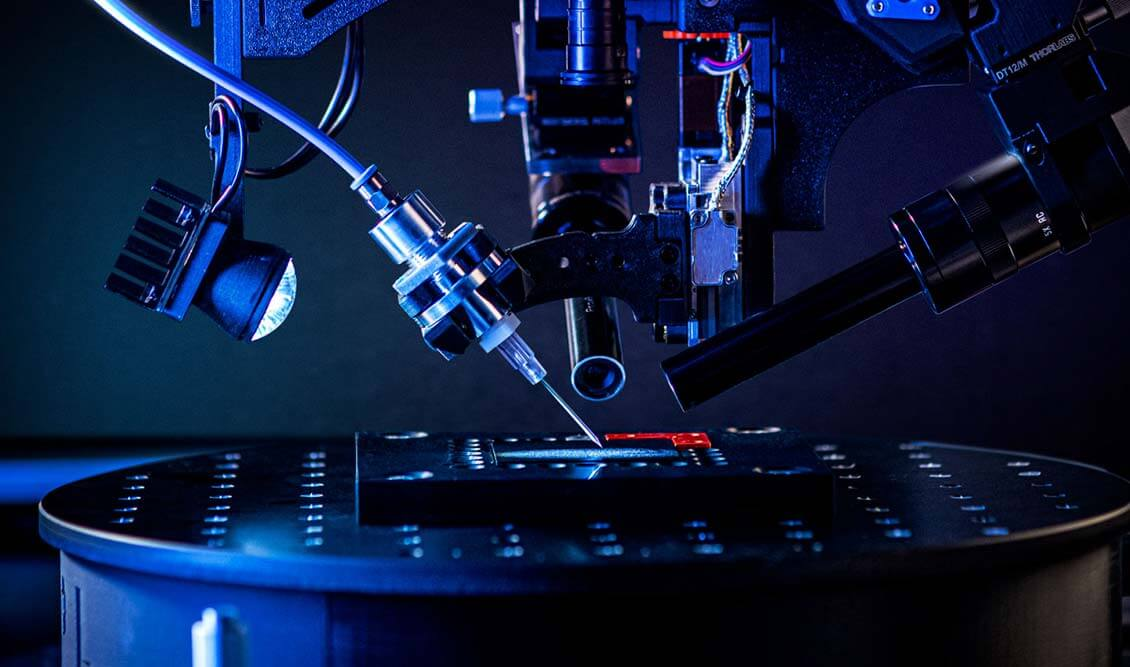
Ultra-Precise Dispensing System.
Whoever the investor is, XTPL noted in its announcement of the shareholder vote that the funding isn’t necessarily what’s most attractive about the investment. More valuable is the experience and access that XTPL hopes to gain as a result of a relationship with an entity local to Taiwan’s semiconductor industry. This is another aspect of XTPL that has made me pay attention: its prioritization of maximizing intangible gains in the partnerships it seeks.
Regarding the funding, it’s noteworthy too that the company indicates it hopes to have the money in the event of a future order where the ability to “respond quickly” might sway a customer’s decision. The very fact that a company like XTPL views that as a likely scenario in the next couple of years aligns perfectly with the dynamics currently shaping the chip market, especially those dynamics driving interest in advanced packaging.
As I’ve noted before when writing about XTPL, I feel like the ideal path for the company is to increase its scale with its strategic Asian customers and then use that positioning to help those same customers build out their own supply chains in Western markets. This is precisely what makes the Taiwanese chip ecosystem such a logical fit for a company doing what XTPL does: the Taiwanese chip ecosystem needs to spread itself out internationally.
Images courtesy of XTPL
Subscribe to Our Email Newsletter
Stay up-to-date on all the latest news from the 3D printing industry and receive information and offers from third party vendors.
Print Services
Upload your 3D Models and get them printed quickly and efficiently.













You May Also Like
AM Pulse Asia: Consumer Metal AM, Nuclear Parts and Rockets Push New Ground
The second half of August produced financing milestones, facility openings, and qualification results across Asia-Pacific additive manufacturing. Rongsu Technology closed a CNY 100 million Series A+ and launched a consumer...
HeyGears G1 Passes $14M on Kickstarter with Full-Color 3D Printing
HeyGears was started in 2015 and has been making value-driven Vat Polymerization systems for dental and home use. The company is marketing savvy and very driven. Now the firm has...
One Machine, Three Worlds of Creation: Inside the HeyGears G1 Series
Turning a digital idea into a finished full-color physical product often requires several machines, multiple software tools, manual coloring, repeated positioning, and outsourced production. For creators and small businesses, this...
AMPulse Asia: India’s Orbital Launch Headlines a Busy Second Half of July
The second half of July brought major developments across Asia’s additive manufacturing sector. Highlights included India’s first private orbital launch powered by 3D printed engines, a billion-yuan ownership change at...