Savannah River National Laboratory & 3D Systems Sign Nuclear CRADA

Cooperative Research and Development Agreements (CRADAs) are deals between US federal organizations and other entities. The latter group most often includes private companies, as the primary purpose of CRADAs is to speed up commercialization via tech transfer. Once a CRADA has been established between a company and a government entity, the parties to the contract can share IP, staff, equipment, and facilities, and the companies involved can file patents based on the results from the joint research.
CRADAs in the Department of Energy’s (DOE) national laboratories system saw a drastic decline in the first couple decades of the 21st century, but they seem to be making a comeback. In 2024, Sandia National Laboratories signed the second-highest number of CRADAs in a single year in its history. Aside from persistent work by the DOE to streamline the contracting process, one of the explanations may be the rebounding interest in nuclear energy. 3D Systems, for instance, just announced a CRADA with Savannah River National Laboratory (SRNL) surrounding the use of additive manufacturing (AM) for nuclear reactor components.
3D Systems will work with SRNL’s Advanced Manufacturing Collaborative (AMC), a 60,000 square foot, $50 million facility opened about a year ago on the University of South Carolina (USC) Aiken campus. Along with demonstrating AM’s potential for enhancing the design of parts used in conventional nuclear systems, such as valves, pumps, and heat exchangers, 3D Systems and SRNL also plan to explore AM’s synergy with newer technologies like small modular reactors (SMRs).
Additionally, 3D Systems plans to capitalize on the AMC’s relevance to workforce development, and the fact that the company is also headquartered in South Carolina should give it ample opportunity to do so. 3D Systems notes that it is focused on maximizing the CRADA’s ability to deliver results directly applicable to real-world commercialization.
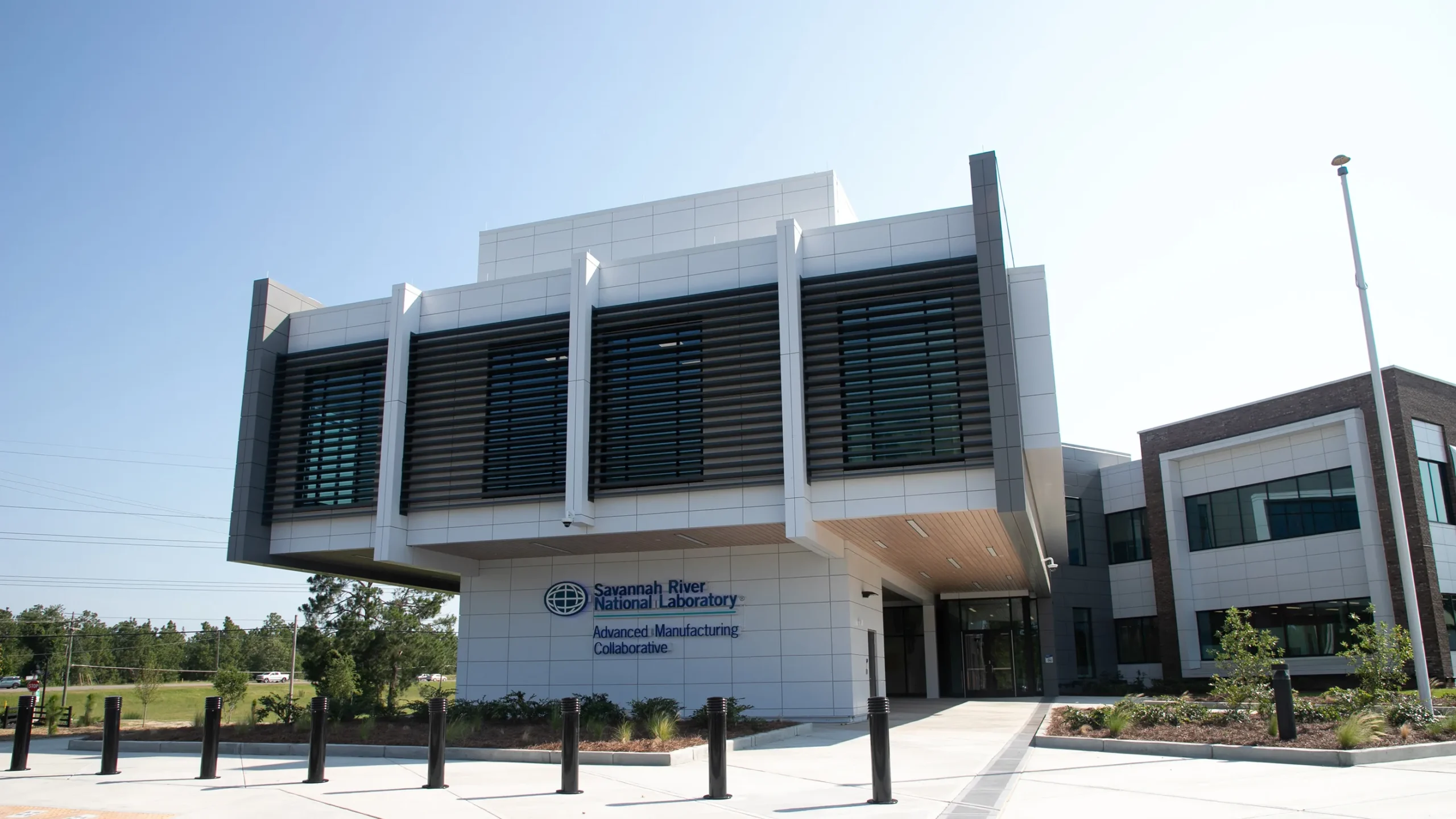
Image courtesy of SRNL
3D Systems has good reason to feel like it can hit the ground running in its partnership with SRNL. One of the company’s greatest assets is its aptitude in leveraging DfAM for thermal management solutions, which is indispensable both for nuclear and for the downstream infrastructure anticipated to be most dependent on nuclear in years ahead: data center cooling hardware.
Thanks to its longtime presence in the defense market, 3D Systems also has a solid track record with building up its R&D work into commercially-viable technologies. In the context of nuclear energy, moreover, there is more than the typical overlap between what works for defense and what works in most strategic sectors. Aside from the fact that 3D Systems mentions defense applications as within the purview of its anticipated activity with SRNL, the US Army just announced a $2.2 billion deal to build SMRs on five domestic US Army bases.
If SMRs ever indeed gain widespread traction, co-location of production capacity enabled by AM adoption could end up being integral to SMR maintenance strategies, especially given the involvement of the US Army, which appears to be aiming to heavily expand its organic industrial capabilities. Even if SMRs don’t represent the future of nuclear, meanwhile, progress on AM applications for nuclear energy could still pave the way for co-location of AM MRO infrastructure with nuclear reactor sites.
Finally, it’s nice to see 3D Systems identify workforce development as a specific advantage of the SRNL deal. This is one of the main reasons why I think that more private companies need to be pursuing CRADAs with national laboratories. But, as I mentioned, SRNL’s location on a university campus in 3D Systems’ home state makes that incentive particularly attractive here.
Featured image courtesy of SRNL & 3D Systems
Subscribe to Our Email Newsletter
Stay up-to-date on all the latest news from the 3D printing industry and receive information and offers from third party vendors.
Print Services
Upload your 3D Models and get them printed quickly and efficiently.













You May Also Like
3D Printing Financials: $28M in China, U.S. Deals and a Metal AM Comeback
Money continues to go into additive manufacturing (AM). From a $30 million raise for a Chinese metal 3D printing company to new funding for naval AM and a European company...
Let the Games Begin! Xi Throws Down the Advanced Manufacturing Gauntlet
Sangmin Lee went to TCT Asia back in March and reported on the event for 3DPrint.com. He wrote two articles arguing that China’s AM industry looks “ready to scale.” This...
TCT Shenzhen 2026 Preview: What 80+ Side Events Reveal About China’s AM Market
Exhibitor lists tell you who is investing in floor space. Conference programs can tell you something different: what the market is ready to talk about. That makes TCT Shenzhen 2026...
3D Printing Market Hits $4.48B After Six Straight Quarters of Growth
The additive manufacturing market continued to grow in the second quarter of 2026, adding another quarter to what is becoming a much more consistent expansion for the industry. Worldwide revenue...