
3D Printing Financials: Creality Posts H1 Loss, Plans $80M AM Headquarters

Creality (HKG: 3388) sold more products in the first half of 2026, but lower margins and higher spending pushed the consumer 3D printing company into the red. At the same time, the newly public company is preparing another major investment: a new additive manufacturing (AM) headquarters and innovation center in Shenzhen.
As 3DPrint.com reported earlier this month, Creality had already warned investors that it expected to post a first-half loss. The final results now show where that loss came from. For the six months ended June 30, Creality reported revenue of RMB 1.63 billion ($242 million), up 12.9% from RMB 1.44 billion ($214 million) a year earlier. But the company posted a net loss of RMB 59.1 million ($8.8 million), compared with a profit of RMB 107.5 million ($16 million) in the first half of 2025.
Gross profit barely moved, rising just 0.9% to RMB 500.4 million ($74 million). That pushed Creality’s gross margin down to 30.8% from 34.4% a year earlier.
Even after excluding share-based compensation and listing expenses, Creality recorded an adjusted net loss of RMB 15.7 million ($2.3 million). A year earlier, it had adjusted net income of RMB 111.1 million ($16.5 million).
Sales Grew, but Printer Revenue Barely Moved
Revenue grew by nearly RMB 185 million ($27.5 million) during the period. But the company’s main 3D printer business was nearly flat. Printer revenue reached RMB 842.4 million ($125.3 million), compared with RMB 841.2 million ($125.1 million) a year earlier, an increase of just 0.1%.
Instead, much of the growth came from Creality’s broader 3D printing ecosystem. Revenue from 3D printing materials jumped 48.3% to RMB 276.6 million ($41.1 million). Scanner and laser engraver revenue increased 16.7% to RMB 325.9 million ($48.5 million). Accessories and other revenue also grew.
Sales grew a lot in America. Revenue there increased to RMB 662.4 million ($98.5 million) from RMB 529.6 million ($78.8 million), while Europe rose to RMB 404.1 million ($60.1 million) from RMB 372.7 million ($55.4 million).
Why Creality Lost Money
Creality said its gross margin fell partly because newer products were priced at slightly lower margins than previous products. Promotions and the clearance of older product lines also reduced profitability. At the same time, the cost of sales increased 19.1%, faster than revenue. Creality said higher prices for key components, including printed circuit board assemblies, memory and chips, added pressure.
As far as spending goes, selling and marketing expenses increased 29.3%. Marketing and advertising costs rose as Creality spent more on e-commerce platforms and social media. Employee costs also increased as the company expanded its sales and marketing teams for overseas growth and e-commerce. What’s more, commissions paid to e-commerce platforms went up, driven partly by growing business through Amazon and TikTok.
R&D expenses increased 37.6% to RMB 143.4 million ($21.3 million), or 8.8% of revenue. Creality said it expanded its R&D team as it increased investment in new technology. General and administrative expenses were also up 51.2% to RMB 108.6 million ($16.2 million), partly because of costs related to Creality’s stock-market listing and share-based compensation. So overall, Creality is selling more, but making less money from those sales and spending more.
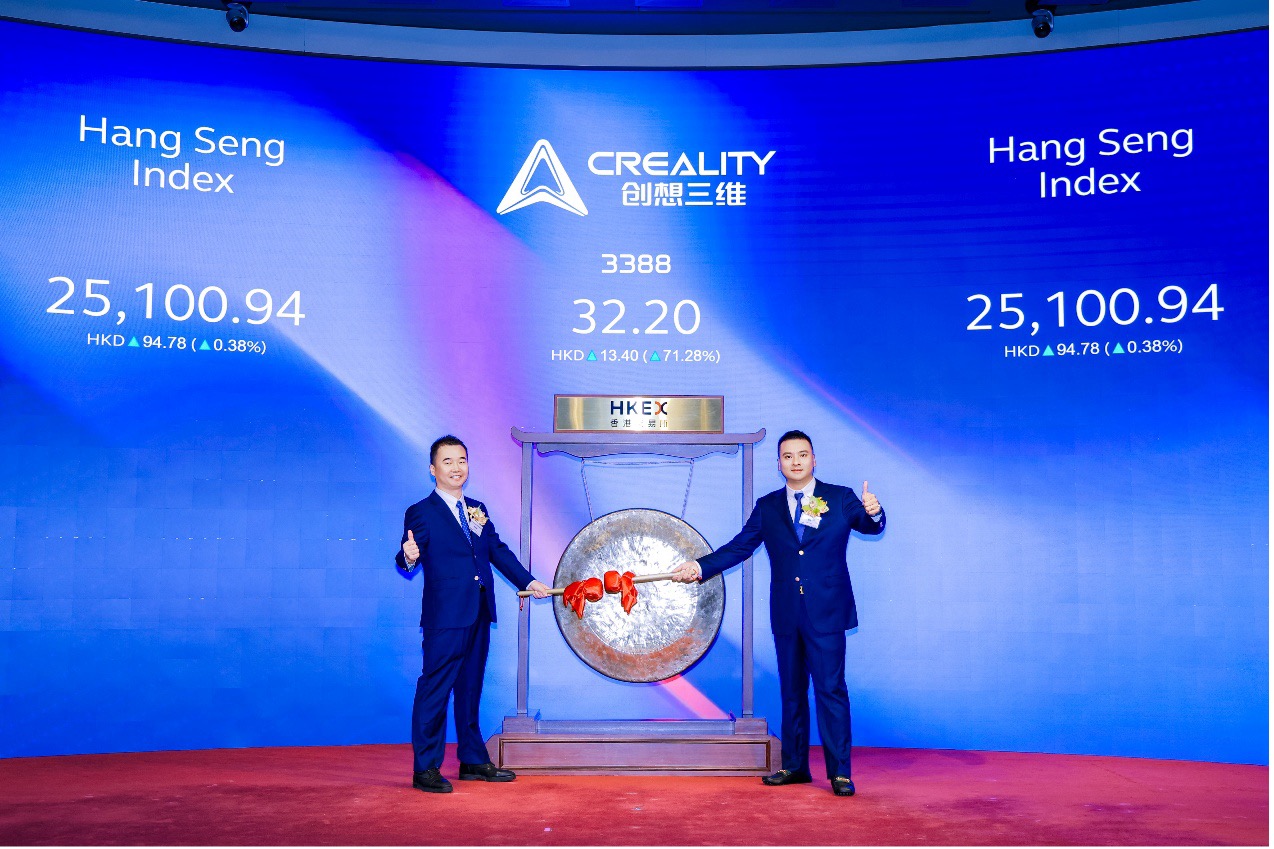
Creality goes public. Image courtesy of Creality.
Creality only began trading on the Hong Kong Stock Exchange on May 29, making these its first half-year results as a public company. The IPO raised about HK$1.27 billion ($163 million) in net proceeds. Much of that money was saved for growth, including R&D, overseas operations, marketing and sales. Those priorities are already visible in Creality’s higher spending in the first half.
Sales network is also part of the expansion, with plans to have more than 2,000 overseas display locations and about 30 stores in China by year-end, while investing more in AI and generative 3D content.
Creality Plans New RMB 550 Million AM Headquarters
Beyond that expansion, Creality plans to invest up to RMB 550 million ($81.8 million) in a new AM headquarters and innovation center in Shenzhen. The investment would include the cost of the land, which Creality still needs to secure through a public tender.
The site has not been acquired yet and the project still depends on the public tender process and government approvals; no formal agreement had been signed as of the announcement. But if it goes ahead, the site would support its business expansion, technology development and long-term growth. The plan is to finance the investment through a combination of internal resources and external financing. Plus, the company has much more cash available following its IPO. Creality reported RMB 1.45 billion ($215.7 million) in cash and cash equivalents at the end of June.

Image courtesy of Creality
Looking ahead, Creality expects its new printers to boost sales in the second half of 2026. That includes the K3, its new multi-color system, along with an upgraded i8 and a new line of printers for children. The company indicated that it hopes these products will drive a “significant increase” in printer sales during the second half. It also expects a larger user base to support sales of other products, including materials, scanners and laser engravers.
Subscribe to Our Email Newsletter
Stay up-to-date on all the latest news from the 3D printing industry and receive information and offers from third party vendors.
Print Services
Upload your 3D Models and get them printed quickly and efficiently.













You May Also Like
Why the AM Industry Should Pay Attention to Schneider Electric’s $22.6B PTC Acquisition
By late 2024, there was already enough signaling of the additive manufacturing (AM) industry opportunity in the data center infrastructure market for AM Research to write a report on the...
How Does Nike’s 3D Printing Approach Fit Into Its Restructuring Plan?
Shares of Nike stock hit all-time highs in late 2021 but have cratered in the years following, with the company losing nearly 80 percent of its market cap since peaking....
3D Printing News Briefs, October 1, 2026: Defense, Enclosures, & More
In today’s 3D Printing News Briefs, we’re starting with defense news, first from Massivit and then from AML3D. Then we’ll move on to U.S. manufacturing of a new large-format LPBF...
South Korea’s Lincsolution Lands Hanwha Defense Deal as Hanwha Invests Billions in US
I recently wrote about how the South Korean additive manufacturing (AM) firm Lincsolution is building an aerospace and defense hub, part of the company’s construction of “the largest AM facility in...
























































