Carbon Wins Patent Battle Over Dual-Cure 3D Printing Technology in Europe


Carbon has successfully defended a key European patent covering its dual-cure 3D printing technology after a multi-year challenge from a competitor.
The California-based additive manufacturing company announced on September 28 that the European Patent Office (EPO) Board of Appeal had upheld European Patent No. 3158400, which covers methods for producing 3D printed objects using materials with multiple hardening mechanisms. The technology is important to Carbon because it helps turn light-cured printed parts into stronger, more durable products for end-use applications.
According to Carbon, the EPO upheld the patent’s broadest claim and restored additional dependent claims that had previously been removed.
“This decision confirms the strength and validity of Carbon’s foundational dual-cure intellectual property in Europe,” said Phil DeSimone, Carbon’s co-founder and CEO.
The patent itself dates back to Carbon’s early years, with the underlying application claiming priority to 2014. The European patent was granted in 2022, but a challenge followed the next year. Oxon IP B.V. filed an opposition in 2023 on behalf of an unnamed competitor, according to TCT Magazine. In 2025, the EPO’s Opposition Division maintained the patent in amended form. The main claim survived, but the EPO removed some dependent claims. Both sides appealed parts of that decision. The EPO Board of Appeal considered the case on September 24, 2026 and Carbon announced the result four days later.
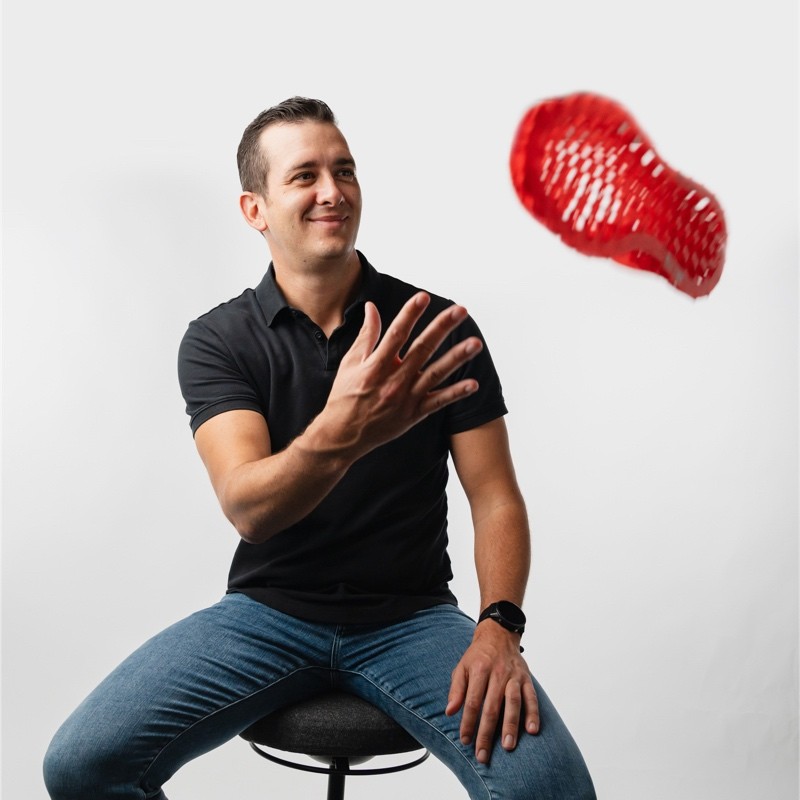
Phil DeSimone. Image courtesy of Phil DeSimone via LinkedIn.
The Tech Behind the Patent
The patent covers an important part of how Carbon makes its 3D printed parts. Carbon’s Digital Light Synthesis (DLS) process uses light to form a part from liquid resin. For some materials, however, the process doesn’t end there. The printed part is then cured with heat, which helps give it the strength and other properties needed for its final use.
Light creates the part’s shape, while the second cure gives the material the properties needed for its final use. This dual-cure approach has helped Carbon move its technology beyond prototypes and into production parts that need properties such as strength, durability, elasticity and heat resistance.
Carbon has used its technology across industries like automotive, consumer products, dental and medical manufacturing. Its best-known applications include the lattice midsoles used in Adidas’ 4D footwear, as well as producing components for Ford vehicles, customized bicycle saddles with Specialized, dental models and appliances, and medical products such as patient-specific devices.
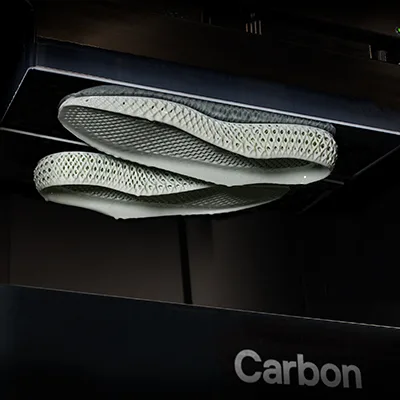
Adidas over 1MM 4D Midsoles Produced on Carbon’s L1 3D Printer. Image courtesy of Carbon.
This makes the patent important to Carbon’s larger production strategy. The company calls it a foundational patent and says the European decision strengthens its protection around dual-cure technology.
Carbon also holds related intellectual property outside Europe and says it has more than 750 granted patents and pending applications globally covering areas including hardware, software, materials and manufacturing processes.
A Patent Battle Behind Production AM
The Carbon decision comes as several major AM companies face legal battles. Earlier in September, a Texas jury awarded Stratasys $27.6 million after finding that Bambu Lab infringed four of its 3D printing patents. In August, Continuous Composites also sued Anisoprint and FibreSeek over 10 patents related to continuous-fiber 3D printing. Carbon itself is involved in another patent dispute with LuxCreo in the U.S. Together, the cases have put 3D printing patents back in the spotlight.

The technology covered by the patent has been part of Carbon’s approach for years. Carbon emerged from stealth in 2015 with its Continuous Liquid Interface Production (CLIP) technology, designed to make resin 3D printing much faster. The company later built on that technology with its Digital Light Synthesis (DLS) process.
The EPO decision does not give Carbon control over all dual-cure materials or methods. Instead, it protects the specific technology covered by Patent No. 3158400 in Europe. More than a decade after the first patent filing, and after several years of challenges and appeals, Carbon’s dual-cure patent remains protected in Europe.
Subscribe to Our Email Newsletter
Stay up-to-date on all the latest news from the 3D printing industry and receive information and offers from third party vendors.
Print Services
Upload your 3D Models and get them printed quickly and efficiently.













You May Also Like
3D Printing News Briefs, October 10, 2026: Drones, WAAM, Ceramics, & More
We have a packed 3D Printing News Briefs for you this weekend! First, America Makes celebrated the recent National Manufacturing Day with 3D printed drones, and then it’s on to...
3D Printing News Briefs, October 3, 2026: Hypersonics, Hotends, & More
We’re starting off with defense in this weekend’s 3D Printing News Briefs, as Titomic was awarded a $5 million U.S. defense contract, and VulcanForms announced a partnership with Specter Aerospace...
The Part Is Only Half the Story: Why 3D Printing Needs a Digital Thread
A 3D printed part can generate a lot of information. The challenge is keeping track of it. Manufacturers need to know which design was used, what material went into the...
Advanced Manufacturing at IMTS 2026: 3D Printing and AI and Drones, Oh My!
Last week’s International Manufacturing Technology Snow (IMTS) in Chicago welcomed over 90,000 attendees to the jungle that is McCormick Place. With over 1.17 million square feet of exhibit space, and...