Lithoz Revenue Up 40% as Customers Scale Ceramic 3D Printing


Lithoz says that its materials revenue has risen 40% year on year. This is a good sign pointing towards higher utilization and production volumes by its customers. Service bureaus and medical firms boosted Q2 revenue growth. The company also says that 20% of its customers run 50% of all the CeraFab systems worldwide. On the one hand, this is a supplier concentration, but on the other hand, it also points to efficient production partners who are growing into specialized 3D printing ceramics manufacturing firms. The three most significant growth areas for the firm are in aluminum nitride, silica-based ceramics, and calcium phosphates. With calcium phosphates used in medical applications, silica in casting, and nitride in electronics applications, this shows a clear split between three very different industries. This multi-industry growth will be a significant advantage to the firm going forward. It also contrasts with the usual dependence the market has on mainstays alumina and zirconia.
Traditionally, many LPBF-based firms were highly reliant on titanium, specifically orthopedic implants. It’s a great industry, a good application, and it has good economics. But a shift away from 3D printing would have a hugely detrimental impact on laser powder bed fusion (LPBF). Lithoz, meanwhile, can grow in things like bone replacement and patient-specific resorbable implants more generally while also gaining exposure to consumer electronics, semiconductors, and aerospace through heat management for electronics. That industry in and of itself is potentially huge, but the firm could also grow in casting cores. This is a nice position to be in, especially as the entire rest of the industry piles into defense. That focus and concentration could be very detrimental as well should defense departments somehow sour on 3D printing. The company also points to continued expansion of its installed base, with existing customers adding more LCM printers to production fleets.
Lithoz CEO Johannes Homa stated that,
“We are not only continuously improving and revalidating our materials. We’ve even developed a good number of customized materials for customers now persistently scaling their production to greater volumes. Reaching ISO 13485 certification for our quality management in material production was a big milestone and proved to be a powerful door opener to many demanding industries; even the most tightly regulated industries that can profit off our technology.”
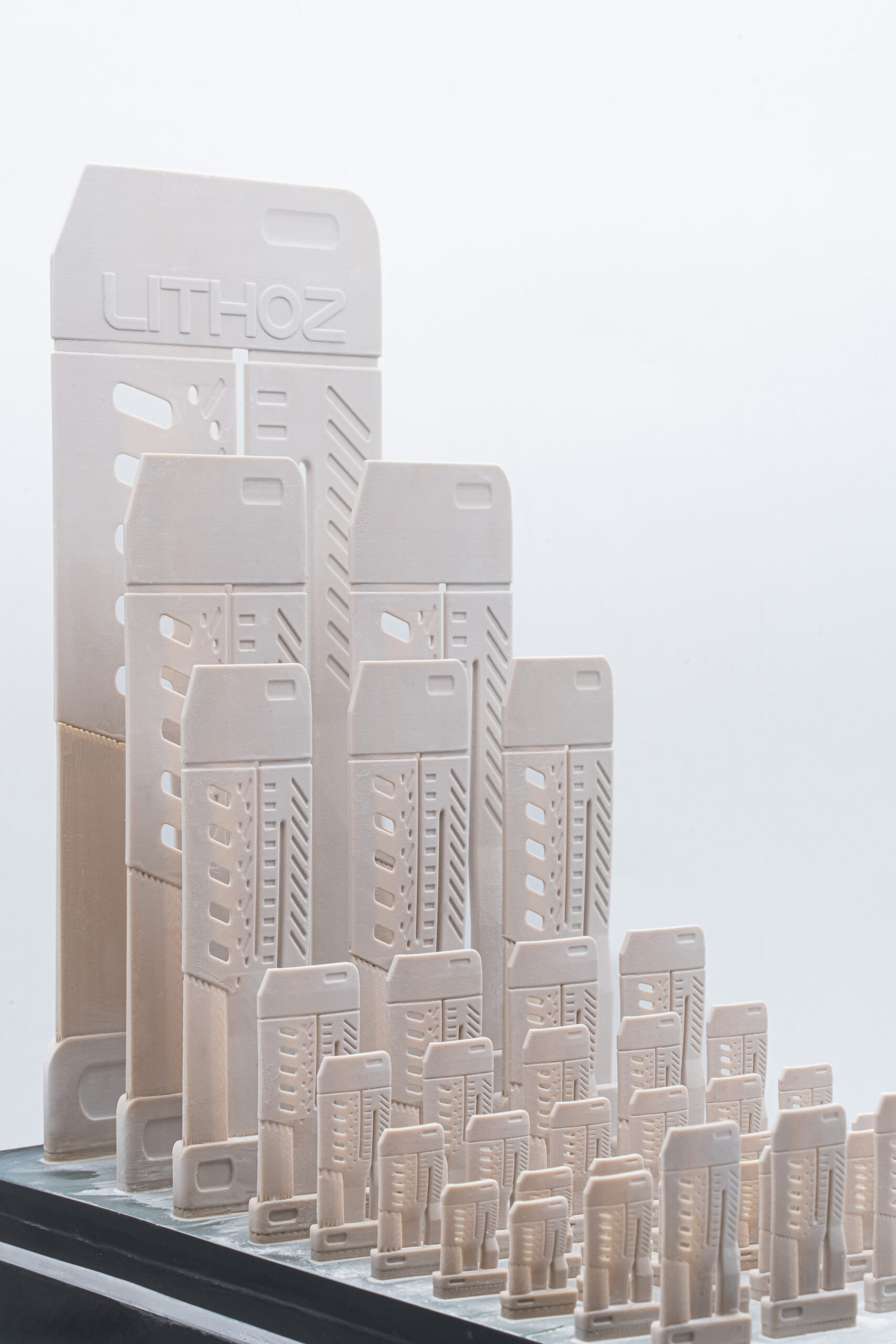
Lithoz Casting Core Range on build platform. Image courtesy of Lithoz.
The company hopes that future significant growth will come from resorbable implants. This area has huge potential, allowing for implants to not remain inside the body but essentially disappear when no longer needed. Some of these implants are also patient-specific, which could be a high-value growth area. The adoption of resorbable ceramic implants will take time. It took 3D printed titanium 30 years to become commonplace in spinal, knee, and hip implants. So the company may have a long road ahead there. But adoption in these kinds of high-value applications can bring in billions of revenue for implant companies in critical parts. Manufacturers will do well off them as well, as will Lithoz.
Semicon, on the other hand, is a different story. They’re spending like drunken sailors at the moment. If you’re having a bad quarter in Semicon, maybe you should go do something else. What’s more, many players in semicon are cognizant of the cyclical nature of their industry. This means that there are firms investing now in fundamentally more efficient and new ways of doing things. Similarly, the firm talks about data center cooling. Now, this at the moment is a bit of a money-no-object game. You can read more about this in our report on the matter. But the market for six-toed cat pictures and AI slop is an unbridled one at the moment. This gallop can not continue infinitely but is nonetheless a nice place to play.
The casting application may seem ho-hum by comparison, but builds on Safran Aircraft Engines‘ use of Lithoz for the cores for single crystal turbine blades. Continued adoption there could drive real growth for the firm in precision casting applications. So great news for Lithoz all around. Here is a firm with a series of ceramics 3D printing technologies that is really moving into production. Through enabling large manufacturers across several materials, applications, and industries, the firm is building a bright future for itself.
Subscribe to Our Email Newsletter
Stay up-to-date on all the latest news from the 3D printing industry and receive information and offers from third party vendors.
Print Services
Upload your 3D Models and get them printed quickly and efficiently.













You May Also Like
Mastrex 3D Printers: Made in the USA?
Mastrex has launched a line of six metal LPBF printers starting at $39,000. Recently, the firm partnered with Continuum Powders to validate its metal powders on Mastrex machines. But the...
The Formlabs Shuffle
For the latest development on 8/31/26, please see an update at the end of this article. Formlabs is doing a management shuffle, pointing the firm even more surely towards an...
3D Printing News Briefs, August 20, 2026: Metal Powders, Patent Infringement, Scanners, & More
We’re starting with metal 3D printing business news in today’s 3D Printing News Briefs, as SBO is expanding its capacity in the US and the UK, and Continuum Powders is...
Additive Economics 101, Part 1: Betwixt Rolex and Ryanair
Let’s look at what matters when we make things that matter. What considerations are there, what is important, what affects cost? Look at the levers in laser powder bed fusion,...