The State of the Desktop Filament Market 2026, Part 4: An OS for Reality

OK, so in this four-part series, we used a cutting-edge stealth mode AI business intelligence tool that outperforms all commercially available LLMs. We then gussied up the data using Google’s Notebook LM. What we found were some pretty groovy slides that sometimes hid the truth. We also found some blatant errors. Using 3D printing as a research tool can be powerful, but in my mind, it should only be done to catalog things and make connections. Going beyond this, or your own understanding, risks fatally obscuring the truth. Yes, AI will be an amazing tool for coding. But for research, we need to beware of drawing conclusions from it.
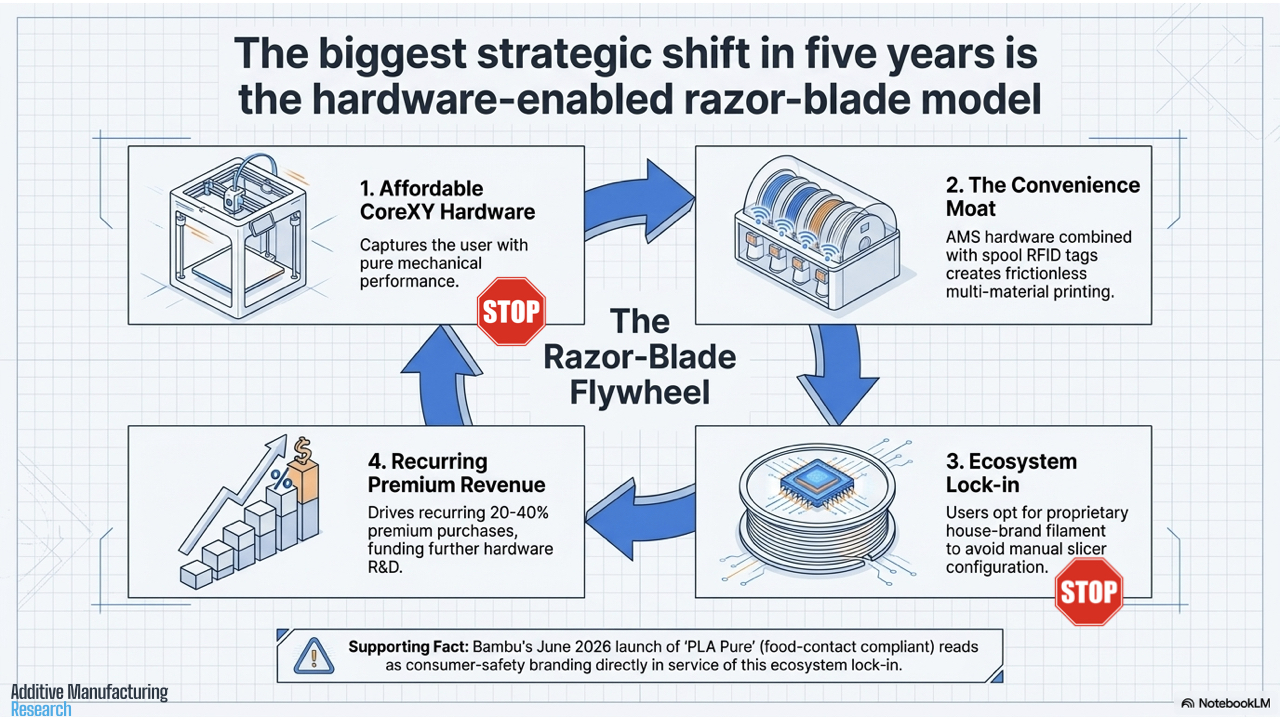
With regard to the filament market, the beautifully made slide above seems amazing. But I think that this would be an incorrect conclusion to draw. One major area of focus is the whole idea that this is a “razor and blades” model, a common trope in the business world. Now, I don’t think that is where the real power of Bambu and the others lies. I think that a software-experience-driven company that gathers more accurate usage data and, in effect, digitizes the Material Extrusion process while making it easier and more reliable to print at low cost by using sensors, images, and LIDAR, is more than a razor-and-blade play.
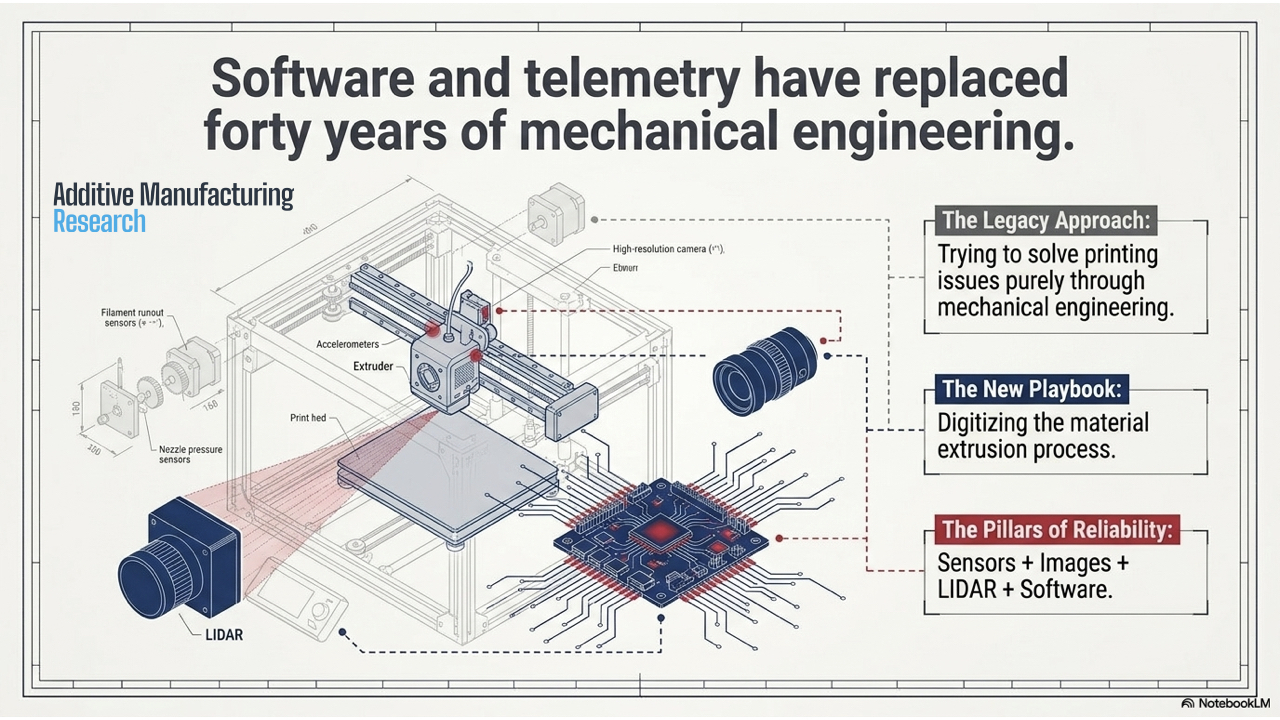
To me, ease of use, reliability, and low cost were the real reasons to adopt well-working Bambu units. The company then uses its access to the entire toolchain of data to get better printing results, not only for its filaments but for all filaments. It then becomes the first billion-dollar revenue company in 3D printing within five years. That’s around one-twentieth of the entire rest of the market, which took billions in VC and other investor capital and 40 years to grow to that point. It used sensors and software to solve a problem that everyone else was trying to solve via mechanical engineering. And whereas you had printers that worked for $5,000, they had one that works just as well for $1,000, then $500, and now $200. The firm then rolled out all of its innovations across its many printers, experimented with models, and pushed out hardware, sensor, and software updates to all models.
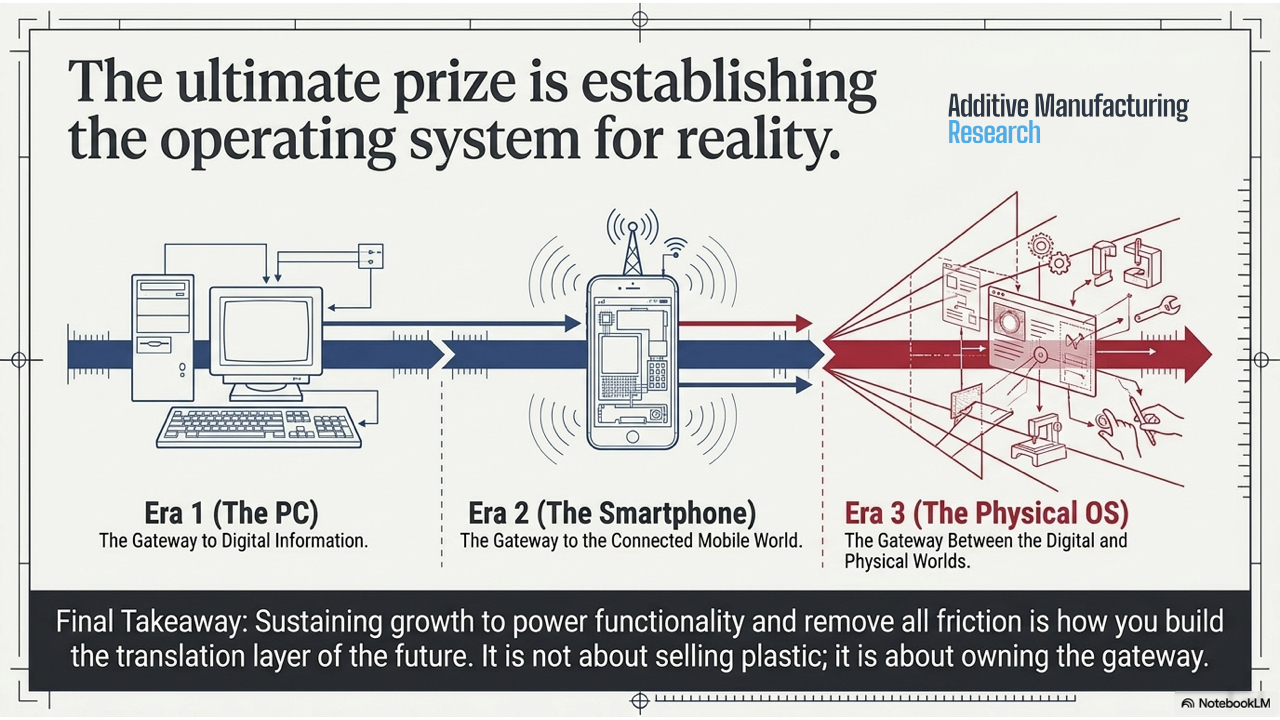
To me, this is obviously a commoditization play. Bambu wants to be the creation gateway between the digital and physical worlds. It wants to own the idea to the product pipeline for many or anyone. By building an app, desktop software, various machines, file sharing, AI creation, customization, filament, firmware, sensor, and data platform, it wants to, in effect, be a Microsoft Office for making stuff. Or, if Google is the operating system for the digital world, Bambu wants to be the OS for the physical world.
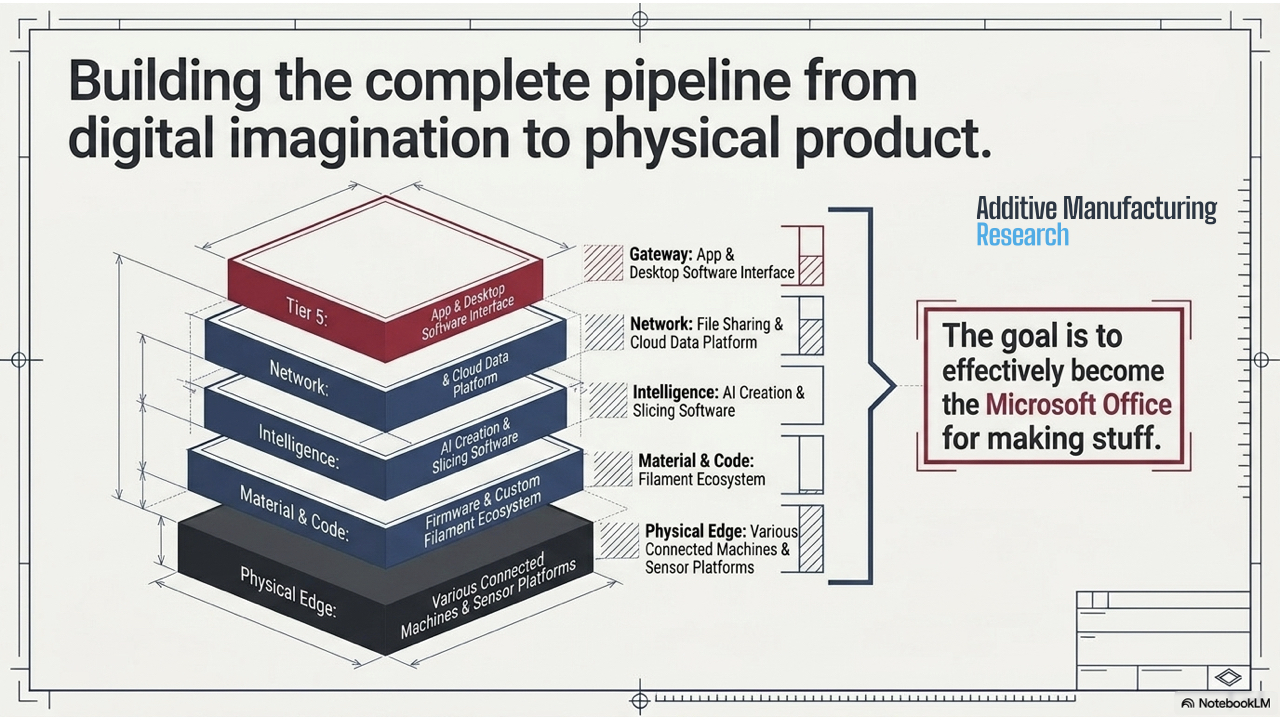
To me, the razor blade stuff is too simple, too stupid, too short-sighted. And it won’t really work when you’re targeting a community of engineers and inventors. Imagine if you wanted to be the richest person in the world. Is making a Nespresso for stuff going to cut it?
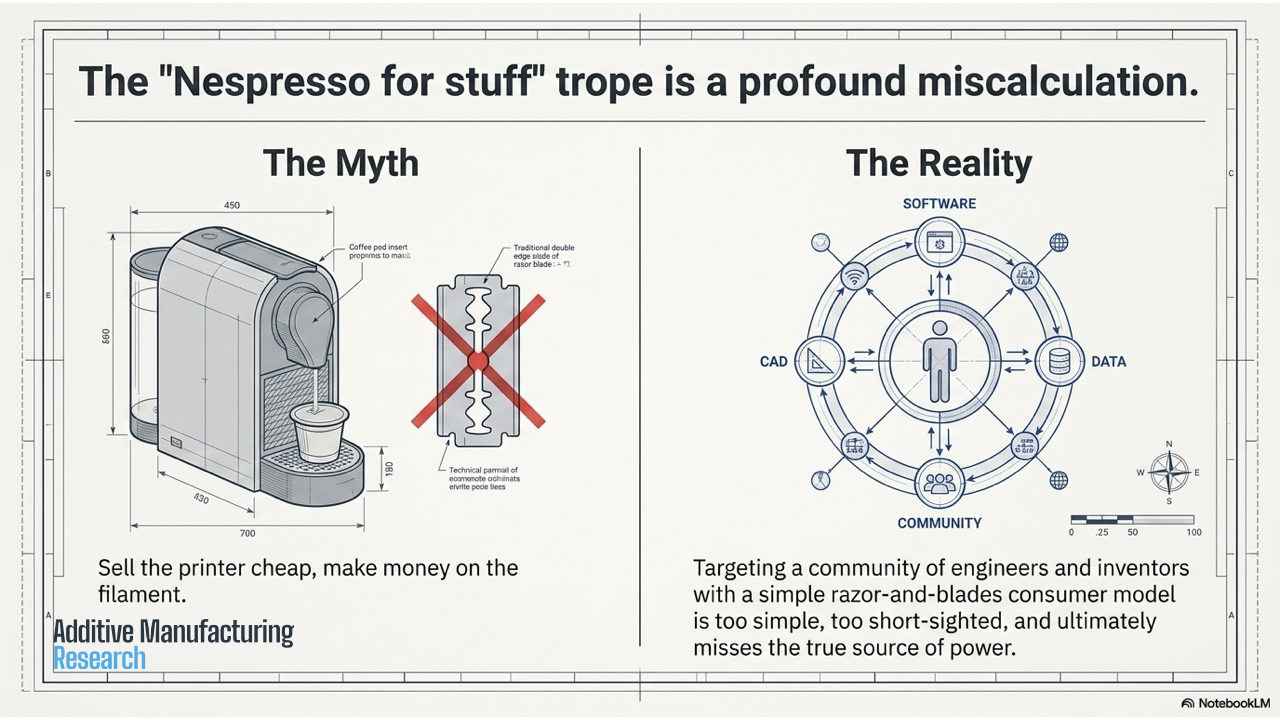
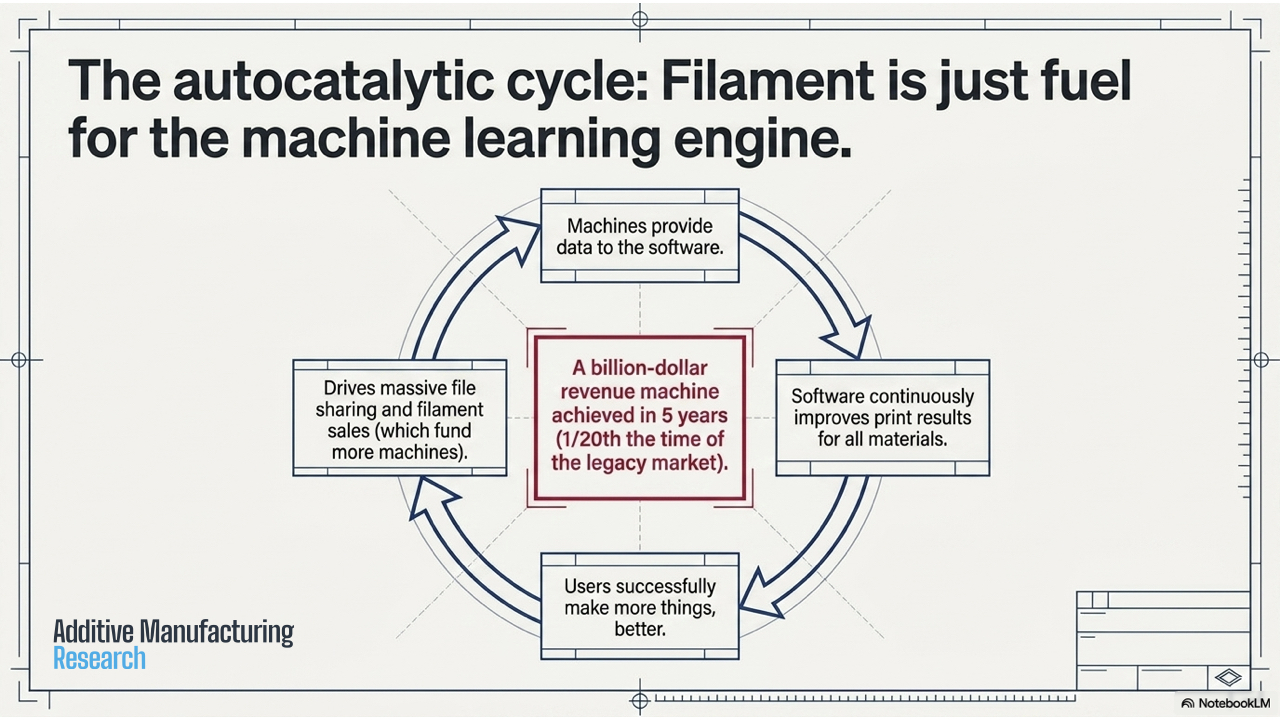
Imagine if you had to compete with Meituan, a multi-billion-dollar revenue delivery service that invested in Snapmaker, and cars to vacuum cleaner firm Xiaomi, which has its own 3D printer and also invested in Snapmaker, as well as DJI that invested in Elegoo, and on the side, you kind of have to compete with your frenemy at Tencent who invested in Creality. This is a completely insane situation to be in. Tencent has revenues of $107 billion, Xiaomi $64 billion, Meituan $51 billion, and DJI only has $11 billion. And do you really think that those guys care about a $20 billion revenue industry? Or that these firms are super excited about “it’s like Nespresso but for stuff”? The play is much more fundamental. Filament revenue is a way to fund the machines (as is revenue from the machines), and the machines provide data to the software, which gets better, which lets people make more things better, which drives filament sales and more files, and that’s how the autocatalytic cycle works. This could potentially be a gateway architecture like the phone or the PC was. So, to me, the pathway is to sustain growth in order to power functionality and make the entire platform more frictionless.
Manual Slicer Config
Now, putting in slicer configuration and dialing in filament did suck, don’t get me wrong. But I didn’t crawl under my bed to hide from it. It was annoying and made you less adventurous with choosing different filaments. Now I can pop pretty much any filament in a Bambu, and it works well. If there’s no RFID I can just select if from a menu. A few times I’ve not found it, but the Bambu does a great job of printing it anyway. The generic settings on Bambu systems are killer. That all doesn’t sound very razor and blades-like to me. If anything, it’s a convenience play for new users that keeps them loyal. Nespresso does not allow you to put other people’s coffee in their machines. Emphatically here, I think that razor and blades is completely not what is going on in 3D printing. This is a completely wrong conclusion by our AI tools. To me, the bigger, more correct, picture is in the gateway strategy.
And it’s a little more frictionless to put Bambu filament into the AMS, but not that much really. And I don’t even see it as a real pain now. So to me, that’s not the real driver here. I also don’t agree that pure mechanical performance is what’s happening here. Bambu is software-driven. And it’s the ease and reliability of the overall system that is driving sales into new markets. All the new folks aren’t buying this for 400mm/s or whatever; they don’t even know what that means. They buy it because this is a 3D printer that they can use, and they believe it because they’ve seen enough other people talk about it or use it.
Model T
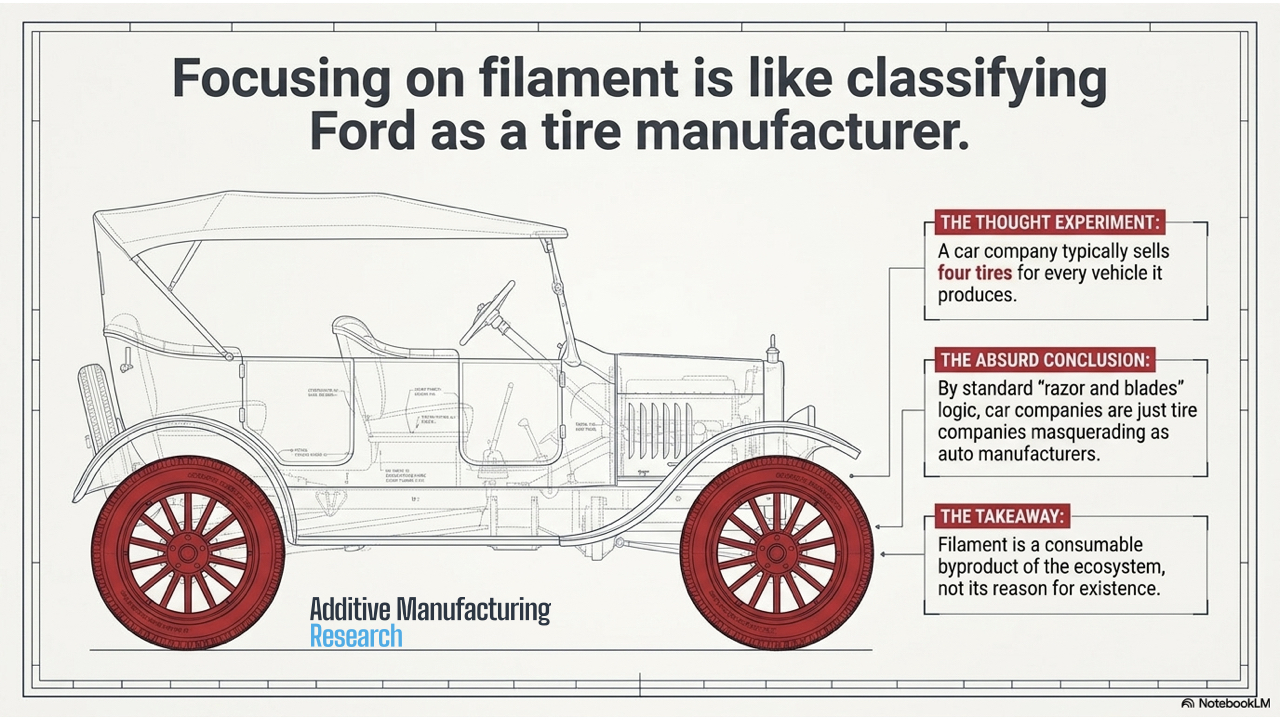
If you want to annoy people at car companies, ask them why, if they’re so focused on their product, don’t they outsource everything except making the tires? After all, that clearly it is their core business. A car company will typically sell four tires for every car it sells. They’re clearly tire companies masquerading as car companies. And I could totally imagine an AI analyzing Ford and concluding that the company was clearly entering into a razor-and-blade play. It would make these super-inexpensive automobiles to sell tires. And indeed, initially, Ford did make its own tires. So it may have been a very obvious thing to think about. Now, surrounded as we are by disposable products and examples of razors and blades, we have a selective perception bias.
But, if you want to transform the world, I think you’re going to have to build bigger moats and do better in this day and age. And if you looked under the hood at Ford, you might come to another conclusion and think that the mechanization, rote work, and assembly line were the real technology. Or you may think that the car’s serviceability and simplicity drove its adoption. It may be due to the fact that it was affordable and very tough. This point is overlooked; it was a car for places without roads or without good roads, not just another car for Manhattan or London. The Model T also quickly became a core for delivery trucks, ice trucks, and vans. So perhaps it’s the vehicle’s versatility that led to its success. Lighter steel and better shifting may also have helped. You may think of the Model T as a volume play or a commoditization.
To me, Ford’s transformational success was the result of all of those things, expressed most clearly in its prices, which were $850 in 1908 and $260 by 1925. For the same car! Ford’s $5-a-day pay increased salaries so his workers could afford the car with three months’ wages. To me, the Model T is a value innovation play that transformed the world. There were many cars before Ford, and many car companies, too. Now there was a car that, through the sum total of its innovations, made motorized transport practical and affordable. And it did so everywhere. Affordable personal transport was just an idea before the Model T and became a market after it. To profoundly reimagine the world as it could be, and to then imagine the product that could make it so, is already a magical thing. But, to then build a business that actually delivers on this while making the product better and cheaper all the time, that’s a revolution. And I think that this is what is happening to the filament market.
Notes on AI Research
On these pages you can see some completely entertaining images. These illustrate my points, and the only thing I had to do was feed my article into Notebook. I didn’t tweak anything or mess about with it; it ran in the background. So this is pretty powerful stuff. On the whole however, for now it’s very much a scary tool to use AI for research. I’ve been testing this extensively for a number of months now. And even with capabilities increasing, a lot of danger still remains. I’m no AI naysayer at this point, but I’m also not a cheerleader. I’m trying to figure out where it makes sense to use it. I’m more of a “It sure is a nice circular saw, it cuts well, but should we be using it to cut hair and mow the lawn?” kind of guy.
Chainsaw Moments
These are some of the biggest AI errors I’ve found so far over the past half year:
- AI crawlers and analysis tools routinely miss big trends, large datasets, and major data sources.
- They don’t know they miss them, so they infer a lot from their not being there, and this leads to huge errors.
- These tools infer a lot from very little. Often, a lot of grounded opinion or a basis of knowledge is built on three opinions or one sentiment repeated.
- AI is super good at categorizing and classifying things, but it’s not too good at super large datasets.
- A lot of data is nonetheless classified or interpreted incorrectly due to incorrect technical understanding, which surprised me.
- It sometimes seems as if it “latches on” to a key idea and then won’t let go, even if it’s incorrect.
- AI tools are often sycophantic and reconfirm any and all biases that you may have.
- Initial queries, data, or classes can really screw up later information.
- Old data is often passed off as new.
- Often, LLMs conflate or mix together two completely foreign concepts into one.
- AI tools seem to jump to conclusions a lot.
- When an authoritative source is wrong, and their lie is retold, it’s hard for the AI to find it or root it out.
- AI tools often try to make things slick and spiffy, which causes an enormous number of errors.
- There appears to be bias in the information entered initially or towards the top of the datasets.
- AI´s images or presentation can be very good, fast, and entertaining, which often hides faults.
- Eg data is not meant for study or interpretation but to convince.
- Much of the imagery, tables, and graphs can appear convincing, but obscure the truth because it seems holistic or logical.
- Generally, it presents itself as more knowledgeable and presents its conclusions more forcefully than the data often allows.
So these are some of the issues that I encountered. I would totally recommend using AI tools for research in areas that you understand, for general office work, and for creating images, graphs, and other materials. For brainstorming, making new connections, and rechecking things, it’s great. But it’s not suited for learning new things, new subjects, or understanding them well. Yes, there will be very powerful business tools created with AI. But I really do think that some people are going to completely gut their companies and blow their careers by staring blithely into these things and steering blindly by them. Already, we can see research at competitors degrade as they use more AI without sufficient safeguards. There’s such a font of information there, and it appears so quickly that you build up trust with every query. Rechecking data, cleaning up your datasets, eliminating bad data, and checking key assumptions becomes more important the less familiar you are with a subject. The mistakes are sometimes subtle, and sometimes embarrassingly obvious. So, to re-collate, present, and see connections in that which you know, it can be a great tool. But, for now at least, I’d stay away from learning anything new with it, so as not to make you learn the wrong things.
Subscribe to Our Email Newsletter
Stay up-to-date on all the latest news from the 3D printing industry and receive information and offers from third party vendors.
Print Services
Upload your 3D Models and get them printed quickly and efficiently.













You May Also Like
AM & National Competitive Advantage, Part One: the Real Problem with US Manufacturing
The problem with US manufacturing is the productivity growth rate. Depending on the source, US manufacturing productivity has either been flat or slightly declined since 2010. Before going any further...
Advanced Manufacturing at IMTS 2026: 3D Printing and AI and Drones, Oh My!
Last week’s International Manufacturing Technology Snow (IMTS) in Chicago welcomed over 90,000 attendees to the jungle that is McCormick Place. With over 1.17 million square feet of exhibit space, and...
Let the Games Begin! Xi Throws Down the Advanced Manufacturing Gauntlet
Sangmin Lee went to TCT Asia back in March and reported on the event for 3DPrint.com. He wrote two articles arguing that China’s AM industry looks “ready to scale.” This...
What 3D2GO Says About 3D Printing’s Growth in Southeast Asia
The Philippines offers an interesting case study in how 3D printing can develop in Southeast Asia, and Manila-based 3D2GO helps illustrate it. 3D printing in Southeast Asia doesn’t have to...