The State of the Desktop Filament Market 2026, Part 3: Special Hamburger Meat

Essentially, I used a cutting-edge stealth-mode AI tool that goes far beyond the capabilities of commercially available LLMs to conduct deep research into the desktop 3D printing filament market. I then sliced and diced the data using Notebook LM. I wanted to update you on this market while simultaneously showcasing the pitfalls and opportunities in AI-aided research. My own conclusion on Part 1 and 2 in this series is that “AI crawlers, indexing tools, LLMs, and research tools are powerful but misleading. Imagine having a bright intern who drinks heavily during the day and occasionally does coke.” AI will be a meaningful aid and may be able to give deep insight, but it will be wrong in ways that only an expert can know. So use it for digging for info, but not judgment.
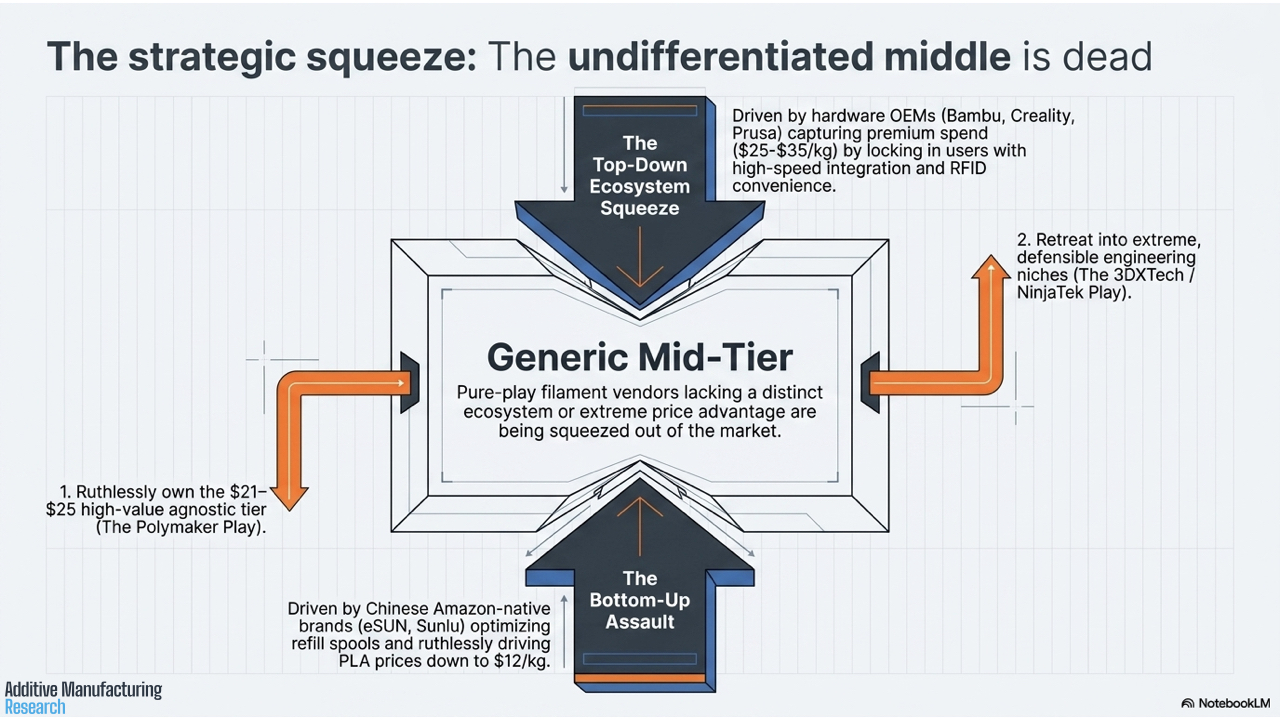
We start here with a very nice slide that sums up the market situation for many right now. You can either opt to be in a niche that is somehow protected or try to succeed at volume. Now the one proviso here is that for many players, these niches do not provide the revenue that some of the other, higher-volume markets do. We’ve seen companies go bust in this segment while trying to transition to premium or more defensible niches because they haven’t found enough revenue there to sustain them. Partially this is because moving from volume to quality can be difficult (especially if you’re in a rush), but this is also because the PAEK and PAEK-equivalent sector has very fragmented revenues for new players. Revenue there is also slower to come by.
Additionally, at first glance, a hospital is a great business, but it has many complexities that make it hard to succeed. Now these barriers make it a very good, sustainable business, but only for those who deeply understand the business and the intense human capital, administrative whirlwinds, and complexities involved. You can’t casually start a hospital, and the initial barriers and investment are significant. But a high-end filament business is easy to start. Similar to a hospital, it’s much more complex than it seems and much harder than it may look. At the same time, a lot of the levers that you can use in many businesses, such as sales, endorsements, social media, and the like, don’t really work for hospitals or high-end filaments. Maybe you’ll go for my cut-price MRIs, but you’ll likely not be looking for surgery with a mail-in rebate or the cheapest thoracic surgeon. So it’s a business where the vagaries are not immediately apparent. Similar to a hospital: habit, hard-won reputations, leading-edge research, having the right talented people stick around, and quality are paramount. Whereas a hospital is formidable from the inside and out, a high-end filament business is only so from the inside. Many have found this out to their detriment.
But the pricing pressure from below argument is real, and the outstanding competitor really is Polymaker, which is doing so well in this golden segment that it gives people just enough peace of mind without overcharging them. This is an incredibly hard balance to undertake! And all those people who had volume, factories, brands, and more but were squarely in the middle are under threat. And yes, the ecosystem squeeze is real as well, with the OEMs in the driving seat now. Through making their tools sticky, they’ve empowered new users who trust them. And these users will gladly stay loyal, especially if there is no real reason to seek out anything new. What this slide obscures is real growth in things like Varioshore for model aircraft and other niches. With unparalleled user behavior insight and connection, OEMs can stay in the driving seat. And it will take real innovation to get users to switch. And if you do the really new thing, as soon as there is an alternative, they will pounce by offering their own competing product or a white-labeled one. So Bambu Lab may see itself as a software company, but in the filament market, it’s a supermarket which is always on the lookout for a new house-branded product. This is why Bambu Lab has such steep periodic discounts to take the air out of the market and to reduce the chances of even their most penny-pinching users from switching. Bambu Lab filament sales keep the rest of the market at bay. It’s essentially a digital, user-insight-driven share-of-stomach play.
Strategic Options
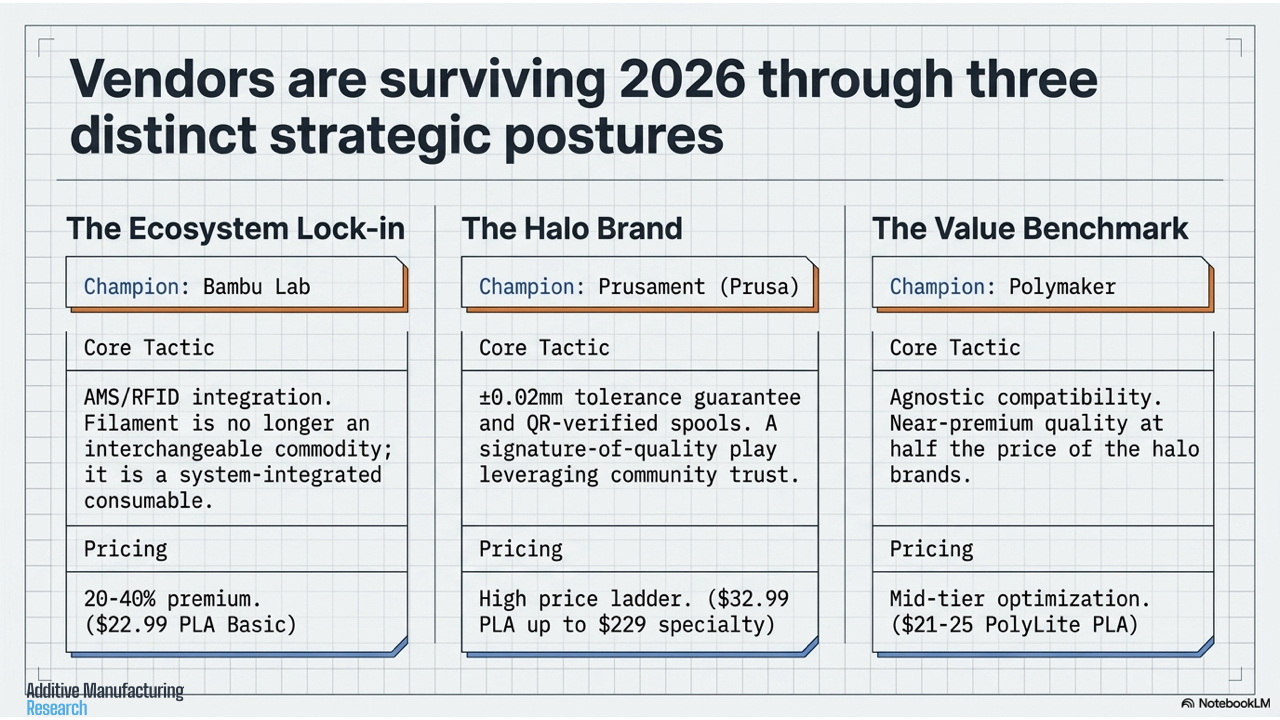
I really love this slide. It shows the potential of LLM-aided research to sum things up well. And indeed, here we can see the three major options that you have: the convenience lock-in, the super tolerance brand, and the value player. I think what is missing here is ColorFabb’s innovation play. To a certain extent, some strategies that have not worked could now work as well. What about more fit-for-purpose filament brands and lines? The market is ripe for an offering for tabletop gaming, cosplay, model aircraft, shoes, and more. Specific communities could benefit from a community-centric approach. The market is big enough now for people to do more niche plays and formulate more niche offerings. Someone could also develop an offering specifically for university print farms, for example, giving them the packaging, pricing, and offering that they need. So the slide is great, but seeing beyond it is where I think more margin and revenue will be found.
The Great High Speed PLA Scandal That Never Was
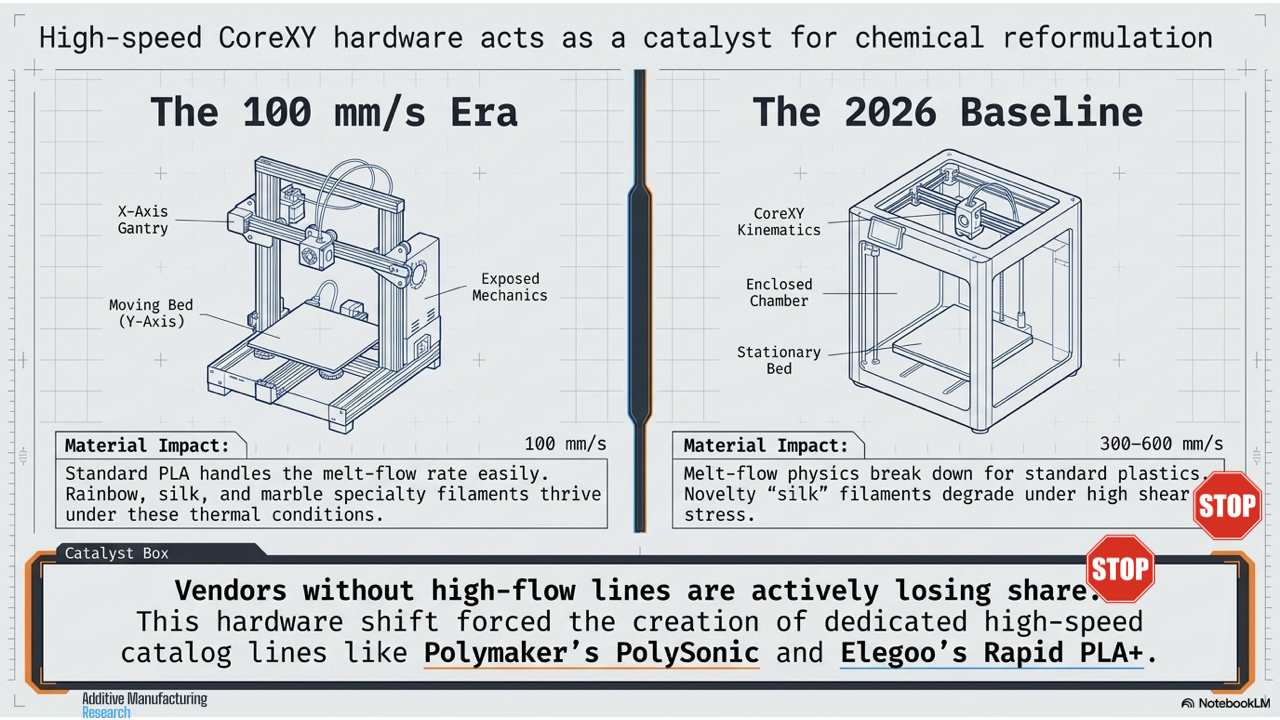
Now this is a gorgeous slide, made with a mouse click. And the general point is a really nice one. But the point is erroneous. Chemists, compounders, polymer experts, and 3D printing experts spent a lot of time adjusting plastics to work well in the previous 3D printers. Higher speeds made some of these materials work less well. But, more often than not, higher speeds exposed previously hidden quality issues with many filaments. If you always drive slowly, you may never find out that your airbag doesn’t work. Or significantly higher print speeds now made glaringly obvious the volumetric differences in filament in the extruder caused by filament that varied immensely in thickness. This led to extrusion problems that were obvious to users, especially since, on the new fast printers, one filament worked well while the other did not. New PLA’s were made with additives and, in some cases, actually with better quality, and these PLA’s became top sellers. Indeed, this move fundamentally changed the market, making a tonne of money for many players and pushing Elegoo and Creality to grow significantly in filament.
Marketing geniuses across the industry labeled these as high-speed PLA’s, and they sold in the tens of millions in revenue at higher margins. So it’s a lot like your protein-enhanced bread (did you know that we have beer with Probiotics in Spain now?). It’s mostly a marketing play, and a few years ago, I tested a bunch of the high-speed materials, and they actually did very little. Now, of course, with every major system, you can tweak materials to work better on them. And “kinematically,” a lot has changed, but I would argue that it was excellent marketing that led people to play more. I’ll give you an example. If I made a record player and then no longer offered it on the market, and you could no longer play your records on my new CD players, I could make a tool to make my units reverse compatible, which would be very nice of me. Or I could apologize. Or I could tell you about the amazing new CDs and how good the quality is and hope that you’ll not only buy a new CD player but all new CDs to replace your old records. Would the right conclusion then be that “new laser hardware acts as a catalyst for chemical reformation.” Or that people without high-flow offerings are losing market share? And I really take umbrage at the “melt flow physics breakdown for standard plastics.” This is not in any way true. The entire point of plastics is that we can reformulate them, compound them, and add additives to make them perform better. If everyone had just tweaked their PLA to work better at higher speeds without telling anyone, they would have just made less money. Now they get to charge you more.
Flow instability effects at laydown or immediately preceding deposition are more noticeable and disruptive at higher speeds. Meanwhile, wall slip effects, pressure buildup in the nozzle more generally, and backflow specifically are exacerbated due in part to the greater difficulty of properly heating the material in the nozzle. Changing your MFI is therefore one possible solution; specific additives could help, but so could longer heat/liquifier zones, smoother curves/transitions inside your nozzles, different nozzle materials, more accurate heating, and, indeed, increased force. A multichannel architecture such as Bondtech‘s CHT, high-flow Revo, solves this.
But, of course, rather than just selling everyone a new nozzle, you can just get them to pay $3 more for every roll of PLA, forever. Or another example: what if I sold you a new induction cooktop and then offered to sell you Special Hamburger Meat that costs $3 more per kilo than regular hamburger meat, but would work as well as regular hamburger meat did on your old cooktop, but now on your new one? Surely, you would never do that? You would feel cheated. Well, not if it was marketed to you correctly. So, in essence, the chart is correct, but it can be misleading.
So compared to the first installment of this series, we can really see more value and less having you walk out of the office with a box overflowing with multicolored dragons and pictures of your children. I really think that AI can do some killer analysis and make some killer connections. But I’d only be comfortable using it in something that I understood well. In the next installment, we’ll look deeper into the filament market and use AI as a research tool.
Images courtesy of Additive Manufacturing Research unless otherwise noted
Subscribe to Our Email Newsletter
Stay up-to-date on all the latest news from the 3D printing industry and receive information and offers from third party vendors.
Print Services
Upload your 3D Models and get them printed quickly and efficiently.













You May Also Like
The Manufacturing Race Behind the Drone Revolution
We are in the middle of a major manufacturing shift focused on the production speed and payload capacity of uncrewed aerial systems (UAS), or drones. A recent Manufacturing Dive article...
ADDMAN to Buy Up to $10.8M in Nickel 718 Powder from 6K Additive Over 30 Months
After years of buildup, we’re finally starting to see what the US metal additive manufacturing (AM) market could look like at scale. To be sure, it’s still not quite there,...
Metal AM in a Multipolar World, Part 2: How PBF and DED Could Change by 2035
The first decades of PBF development were heavily shaped by machine capability: more power, more lasers, larger build volumes, better recoating, and improved process monitoring. These developments will continue, but...
Advanced Manufacturing at IMTS 2026: 3D Printing and AI and Drones, Oh My!
Last week’s International Manufacturing Technology Snow (IMTS) in Chicago welcomed over 90,000 attendees to the jungle that is McCormick Place. With over 1.17 million square feet of exhibit space, and...