Amazon-Backed 14Trees and Tvasta Launch Construction 3D Printer for Remote Sites

14 Trees and Tvasta have launched a new construction 3D printer. The Cedar is a large-format gantry-style printer similar to the COBOD offering. Tvasta is an Indian automation firm founded in 2016 that produces 3D printers, software, and pumps in India. 14 Trees, meanwhile, is a joint venture between cement company Holcim, British International Investment, and Amazon’s Climate Pledge Fund. This is, of course, hilarious, akin to working with Philip Morris and the government to finance the manufacture of light cigarettes overseas.
But 14 Trees has experience in difficult places and has been engineered in India, and with the experience of working in those places, it should help the printer work in remote environments. It’s one thing to make something that works perfectly in a factory, but another to get it to work well in the field amid intermittent power, dust, and poor roads. In remote, austere environments, the need for 3D construction printing is greatest. What’s more, in these environments, construction 3D printing becomes more financially viable than alternative methods that rely on easy road transport of goods.
The printer has a total area of 240 square meters. The printer has a height of 10 meters, the mixer has a capacity of 250 liters, and can mix up to 5 m3/hr. The pump can deliver up to 5 m3/h at 60 bar, up to a distance of 100 meters.
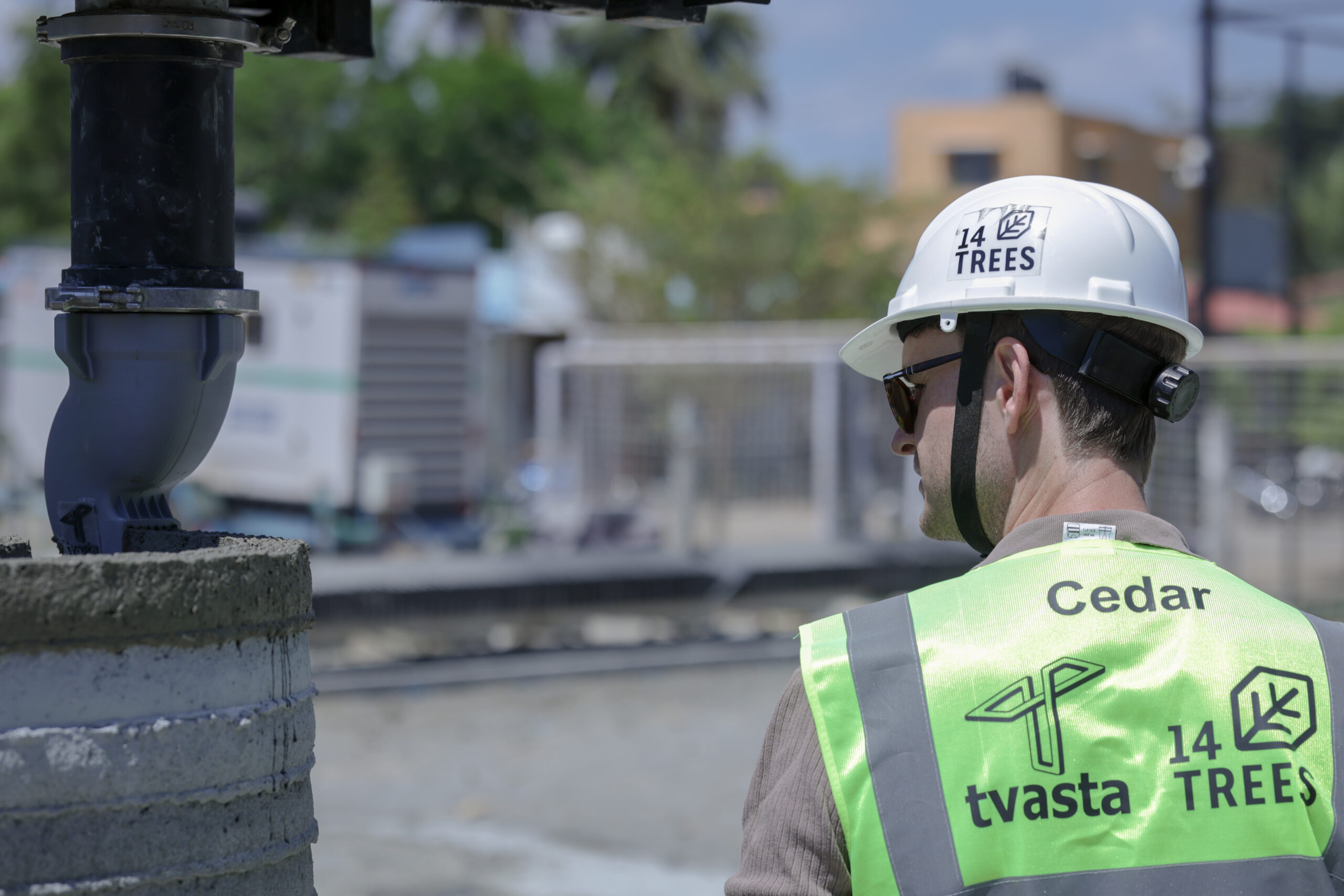
The Cedar 3D Concrete Printing in action. Image courtesy of Tvasta.
The printer is meant to be a reliable, scalable device. The system uses AI for material characterizations and has been optimized for regular concrete, which should make adoption easier. The AI system can take your local formulations and analyze the best possible ones for a particular application. Using regular concrete also means you can use it wherever you are printing, which is much cheaper than importing some or all of it.
14Trees, CEO Francois Perrot said,
“Automated construction technologies have already demonstrated strong technical viability. For these technologies to scale across the global construction industry, they must also make strong economic sense for developers and contractors. Cedar was designed to dramatically improve project economics, lower adoption barriers, and enable construction companies to deploy automation at scale.”
Meanwhile, Tvasta CEO Adithya V S stated that,
“By combining advanced manufacturing capabilities with cutting-edge robotics, software, and scalable engineering systems, Cedar delivers a robust and reliable platform built for deployment across highly diverse construction environments globally.”
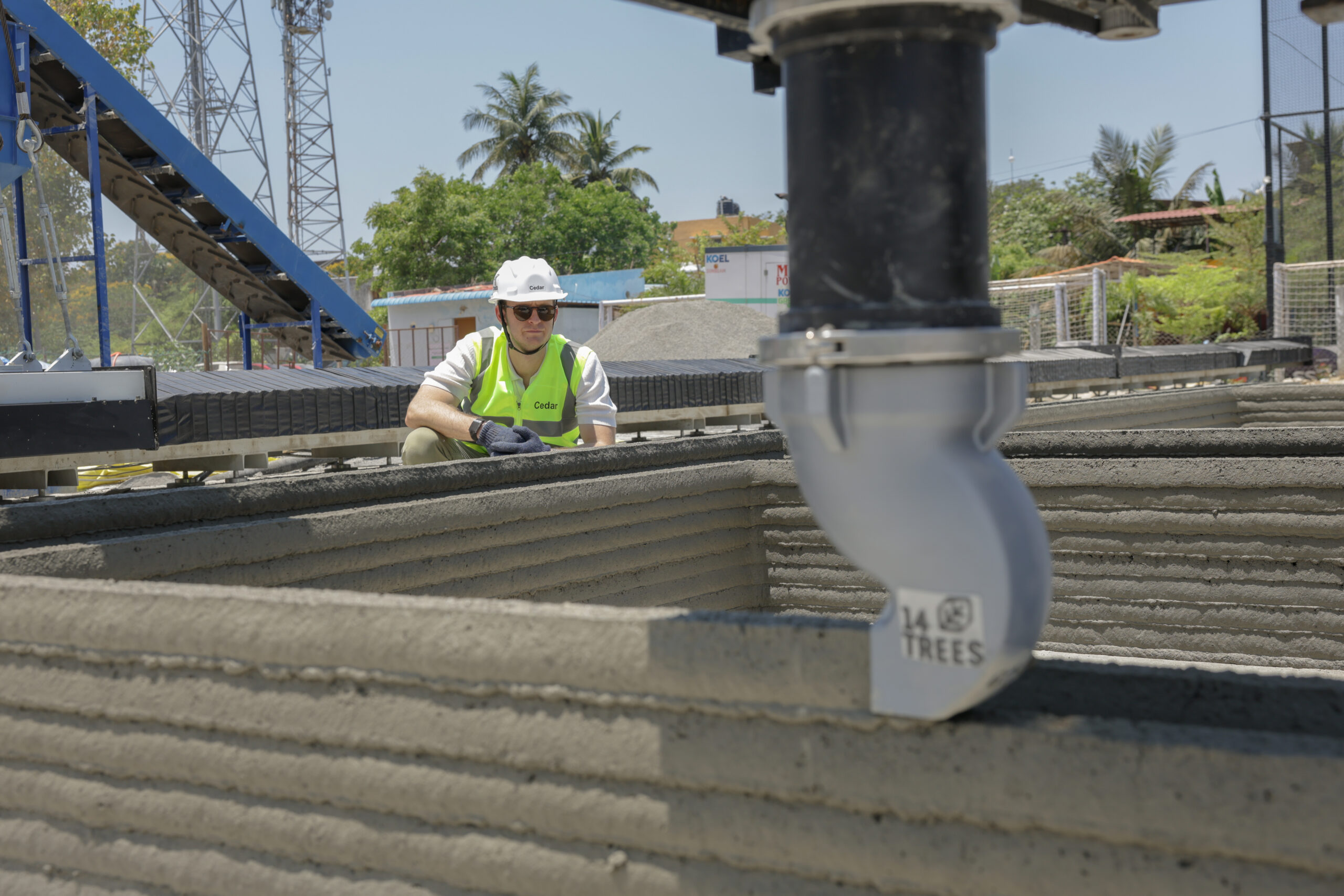
The Cedar 3D Concrete Printing in action. Image courtesy of Tvasta.
The hopeful thing about this collaboration is that the two have previously worked together on building projects around the world. This means that this device is steeped in experience. That would lead to a world-ready 3D printer made to work at the construction site. On the downside, these two decided to make their own printer rather than turn to their erstwhile supplier COBOD. Will more firms want to do the same? Will people develop their own solutions globally? Will we see the emergence of many more whole solution firms? Or will there be a stable group of vendors supplying the whole solution? Or will we see people just sell one part of the solution? It’s early days yet, so we don’t know how this industry segment will develop.
So far, in the gantry space, COBOD has led by a country mile. The Danish firm is trusted and a true global player. Maybe new firms will join it and together propel the market forward. Construction 3D printing is a burgeoning field with great potential. The most interesting area to me is austere construction. Construction of infrastructure and buildings in remote areas that are difficult to access by car. There, the technology makes the most sense to me. So this partnership is notable and may point to a future in developing nations and remote areas. At the same time, on-site printing for large construction projects in wealthier, more accessible parts of the world makes sense because it reduces labor costs. And making precast parts efficiently in a factory also makes a lot of cost-saving sense. In all of these modalities, gantry systems compete with robot-arm systems. For large projects and long-term steady printing, the gantry clearly wins. The robot arm is better at quick setups and faster prints of smaller areas. With a new entrant, we should see a sharpening of the differences between players. Companies will increasingly specialize and differentiate themselves for specific clients and applications. 3D construction printing is growing, and new competition should spur more innovation and growth in this vibrant segment of our market.
Subscribe to Our Email Newsletter
Stay up-to-date on all the latest news from the 3D printing industry and receive information and offers from third party vendors.
Print Services
Upload your 3D Models and get them printed quickly and efficiently.













You May Also Like
Stratasys Showcases 3D Printed Automotive Applications & New Printer at IMTS 2026
Just ahead of last week’s International Manufacturing Technology Show (IMTS) in Chicago, Stratasys launched the F870, a new large-format, production-grade FDM 3D printing platform designed to drive industrial manufacturing at...
3D Printing Financials: $28M in China, U.S. Deals and a Metal AM Comeback
Money continues to go into additive manufacturing (AM). From a $30 million raise for a Chinese metal 3D printing company to new funding for naval AM and a European company...
Stratasys Wins $27.6M in Patent Case Against Bambu Lab; Bambu Challenges Verdict
Update, September 21, 2026: This article has been updated with a statement from Bambu Lab responding to the verdict, along with additional information about the company’s ongoing patent challenges against...
AMAsia Pulse: AM Investment Picks Up Across Asia-Pacific
The first half of September brought fresh investment and expansion activity across Asia-Pacific’s additive manufacturing sector. China’s Xinjinghe secured funding for an aerospace AM hub, South Korea’s Lincsolution outlined plans...