How Haddy Landed Disney, and Why That Matters for 3D Printing


The Walt Disney Company relies on a wide network of partners to build its parks and attractions. But bringing a new way of making things into that system—and putting it to work in a live park—is something else entirely. That’s where Haddy comes in.
Through its work with Walt Disney Imagineering, the company is bringing large-format 3D printing into real-world use in an active theme park, something the industry has been pushing toward for years but rarely achieves at this level.
When I spoke with Haddy founder and CEO Jay Rogers in St. Petersburg, the Disney collaboration came up quickly, and for good reason. It is one of the clearest signs that Haddy is not just talking about large-format 3D printing in theory. It is already being used in one of the most demanding experience-driven environments in the world.
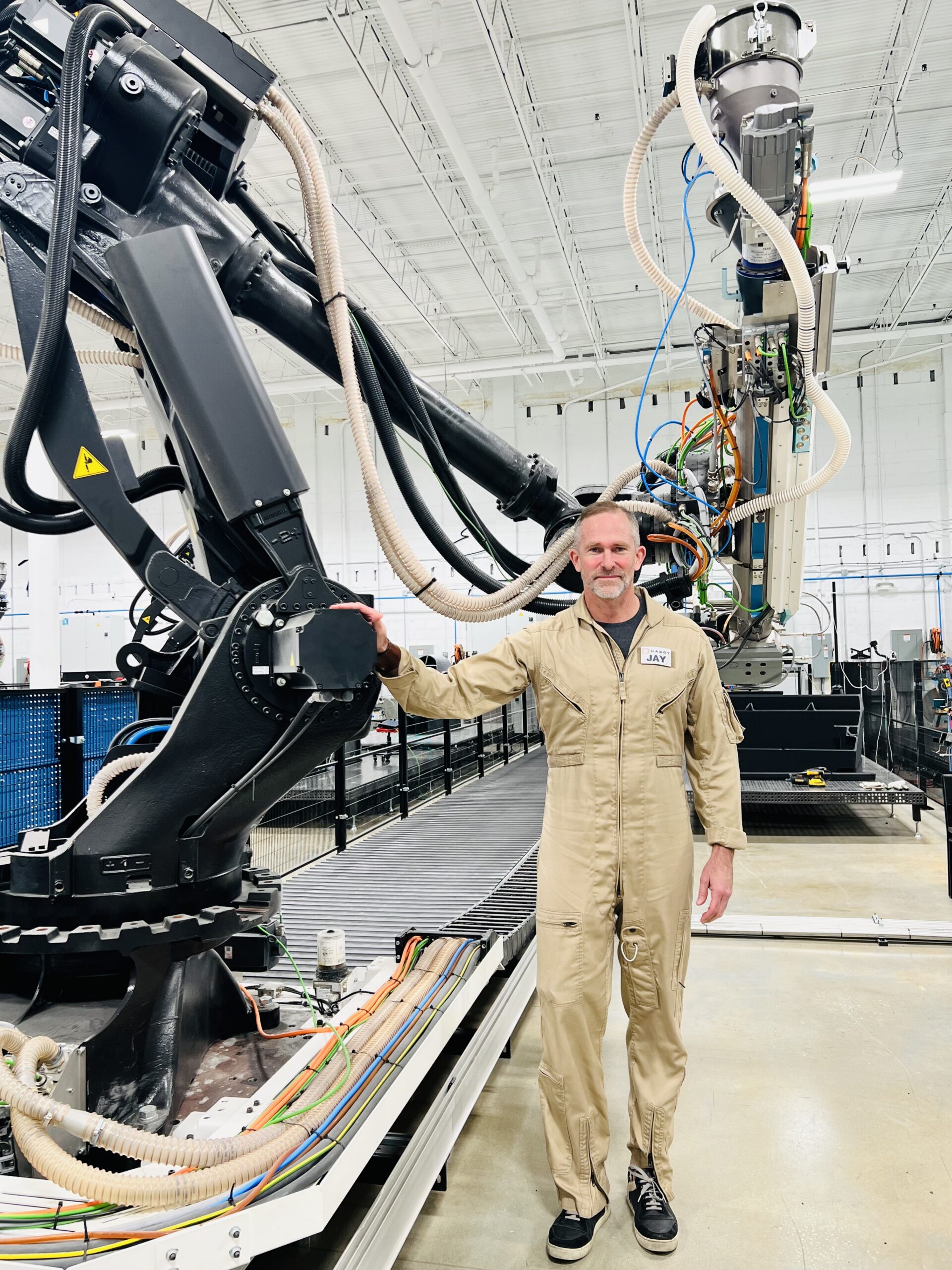
Jay Rogers next to one of the company’s robotic large-format 3D printing systems. Image courtesy of 3DPrint.com.
Disney spotlighted its relationship with Haddy earlier this year, in an article tied to CES, describing the company as an “AI-driven 3D printing pioneer” and a member of the Disney Accelerator class of 2025. Disney also said Walt Disney Imagineering worked with Haddy to 3D print a new outrigger canoe for the Jungle Cruise ride at Disneyland park, calling it the first permanently installed 3D printed prop in a Disney park attraction.
That alone was big.
In recent years, Walt Disney Imagineering, the team that designs and builds Disney parks, has begun showing more of how its attractions come together. That has included 3D printing, but mostly behind the scenes and as part of internal workflows. But this project goes even further. It brings in a dedicated 3D printing company to produce a finished part that ends up inside a live attraction. Also, in this case, Disney is talking about a permanent park attraction prop. It is a real object, in a real Disney environment, made for real use.
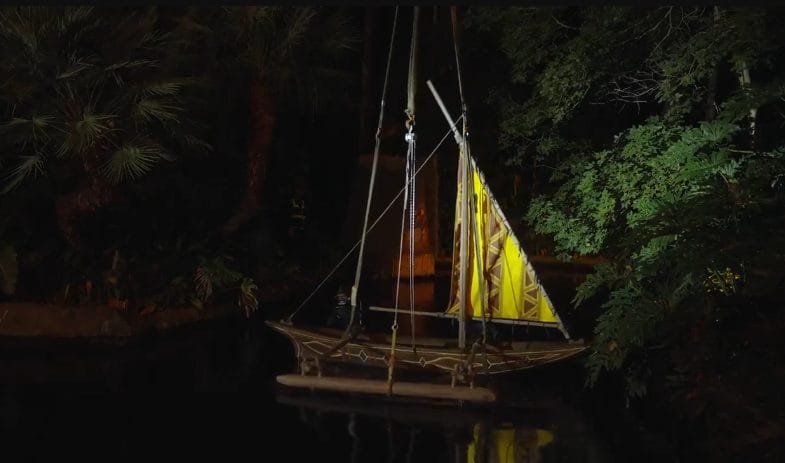
The Jungle Cruise 3D printed canoe; the first large-scale 3D-printed prop permanently installed in a Disney attraction. Image courtesy of Disney.
Rogers described the project as a canoe based on an original mid-century Disney boat.
“There was no CAD file. No digital paint file. No ready-made 3D model. Instead, our team worked from a photograph of the original piece and used that analog reference to help bring the object back into physical form,” he added. “That detail matters because it shows something important about what Disney needed from us. This was not just about printing a large object. It was about preserving the look and feel of something that already belonged to Disney’s world.”
Rogers had seen the canoe installed at Disneyland himself: “We printed it here, and then we sent it out to be themed with the painting. There was no CAD for it… It was totally not digital.”
In a way, the project captures the larger Disney-Haddy connection perfectly. Disney builds immersive worlds, and Haddy builds physical things that help bring those worlds into the real world.
Rogers said Haddy refers to the relationship as a collaboration, not just a partnership.
“Our collaboration between Disney and Haddy is enduring,” he said. “I think the reason is that Disney’s business is built around experiences — the parks, cruise ships, hotels, all of it. People want to be immersed in those environments, and that’s what makes us a good partner, because they need to keep growing.”
Disney is one of the most selective companies in the world when it comes to guest experiences. Its parks are guided by design control, operational standards, and brand consistency. Anything that goes into that environment has to work physically, visually, and logistically. So why is Haddy on Disney’s radar? Rogers believes it’s because Disney needs capacity.
“There are more people in the world who want to experience Disney’s magic, so we want to be there to help. But the physical parks only have so much room. At some point, Disney needs to build more. They’re also building parks in other parts of the world, and we want to be close to them wherever that happens. When Disney builds in a region, they want things made there. That creates local jobs and a supply chain. That kind of work is steady.”
That fits directly with the model Haddy has been building since day one. Instead of relying on a single centralized factory, the company focuses on distributed production through microfactories, positioned closer to customers and partners. For a company like The Walt Disney Company, that approach supports faster iteration, easier installation, and stronger ties to the teams that build and maintain each environment.
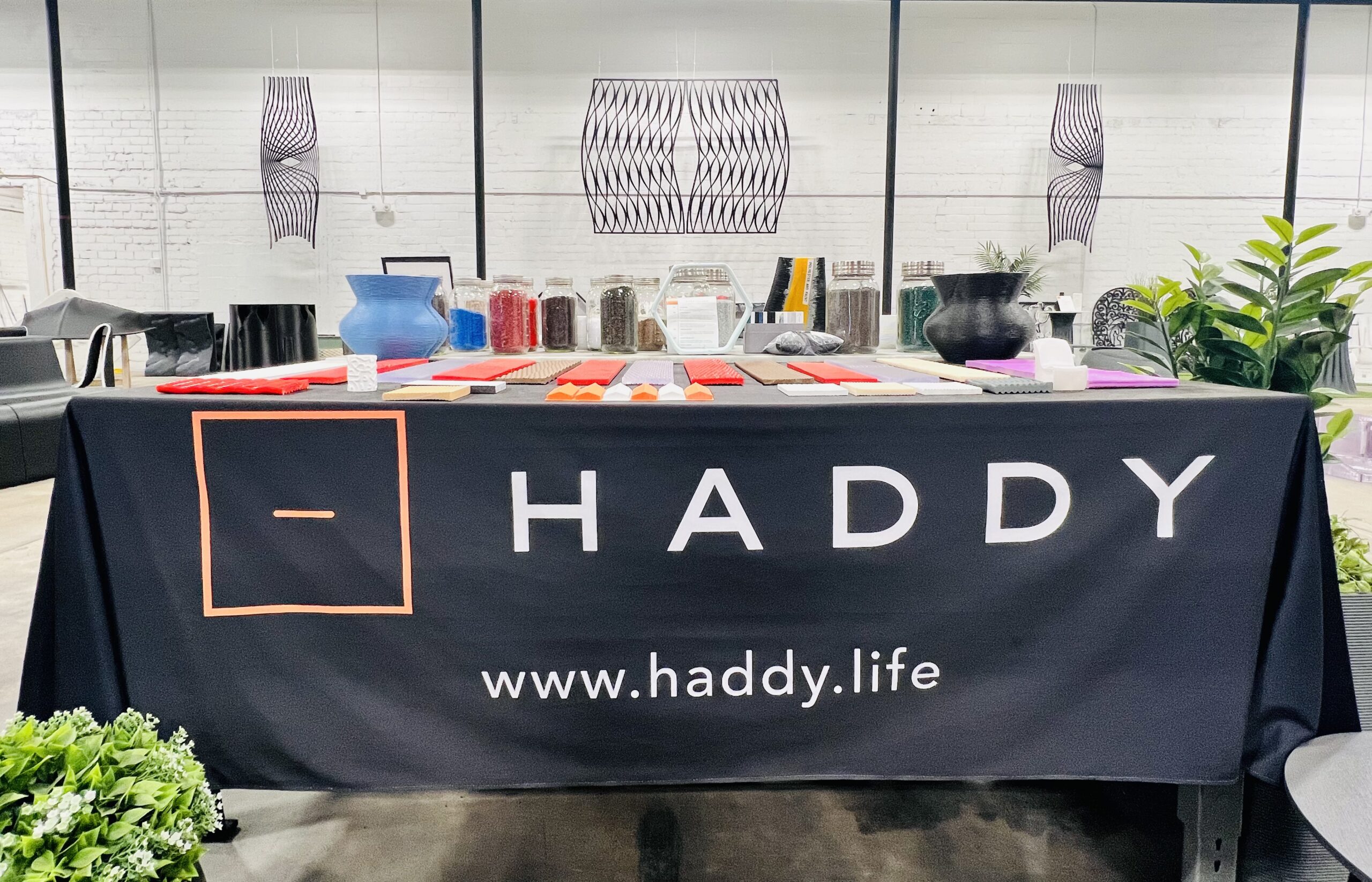
Material samples, printed textures, and recycled polymer feedstocks displayed at Haddy’s headquarters. Image courtesy of 3DPrint.com.
So Haddy is not interesting because it can print a cool prop. It is interesting because it can help support the physical expansion of experience-based environments. That means attractions, themed structures, fixtures, and other large components that need to be made with speed and flexibility.
Disney itself hinted at that broader role. In a statement released during CES 2026, The Walt Disney Company described Haddy’s MicroFactory as a way to support theme-park-scale fabrication, help Imagineers iterate faster, and offer a more flexible way to build “imaginative new worlds from the ground up.” The company also pointed to the Jungle Cruise canoe as an early example of how the technology could be used across its parks and experiences.
That is why this collaboration matters far beyond one canoe. It points to a larger shift in how additive manufacturing could be used in theme parks, resorts, cruise environments, and other experience-heavy settings where customization, speed, and replacement cycles matter.
What’s more, all of this also creates a stronger story for 3D printing itself. For years, additive manufacturing has been strongest at making specialized parts, prototypes, or low-volume products. Haddy’s Disney collaboration suggests that the technology may now be finding a more visible role in public experiences, where size and design flexibility matter just as much as precision.
That does not mean 3D printing is about to replace all traditional methods across Disney’s parks. It means the technology is finding places where it can do something especially well: move quickly, handle unusual shapes, support iteration, and reduce some of the friction of conventional fabrication.
There’s also something that just makes sense about this relationship. Rogers told me he is a Disney fan, but not only because of the movies or characters. What interests him most is Disney’s ability to turn imagination into something real.
“I love the idea of taking something that’s imagined and making it real,” he noted. “When Disney makes something, whether it’s a boat or a spaceship, it helps us dream. The question for me is: when does it become real?”
That is exactly what happened with the Jungle Cruise canoe. For Haddy, Disney is a major signal to the market. It shows that one of the world’s best-known experience companies sees value in large-format additive manufacturing. Meanwhile, for Disney, Haddy offers a more flexible way to build and update parts of its parks.
For the wider 3D printing industry, this collaboration is one of the clearest signs yet that the technology is moving into real, visible use; out in the open, where people can actually see it, adding a bit of its own kind of pixie dust.
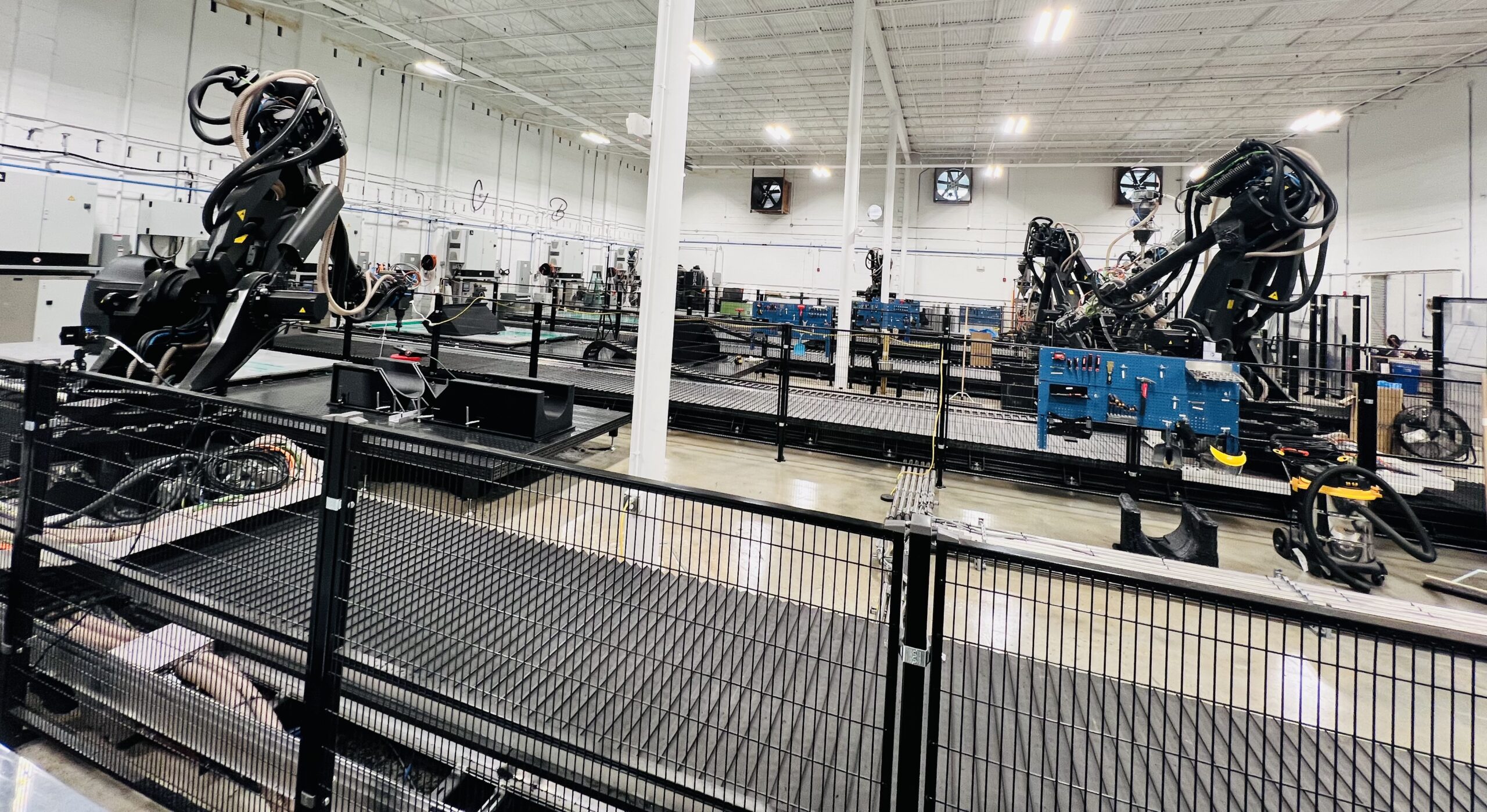
Multiple robotic printing cells operate inside Haddy’s production facility in St. Petersburg, Florida. Image courtesy of 3DPrint.com/Vanesa Listek.
Subscribe to Our Email Newsletter
Stay up-to-date on all the latest news from the 3D printing industry and receive information and offers from third party vendors.
Print Services
Upload your 3D Models and get them printed quickly and efficiently.











You May Also Like
3D Printing News Briefs, November 11, 2026: Financing, Distributor, Kickstarter, & More
We’re starting off with exciting AMUG news in today’s 3D Printing News Briefs, as Neil Hopkinson was selected for the 2027 Innovators Award. Then we’ll move on to business, with...
AM Investment Strategies 2026: Where 3D Printing Investment Is Going
Which parts of the 3D printing industry are growing, who’s buying, and where’s the money going? At the AM Investment Strategies webinar on November 5, executives discussed how customer orders...
Additive Manufacturing Simulation, Monitoring, Inspection, & More at Formnext 2026
Formnext 2026 is getting closer, and we’re already seeing lots of 3D printing industry news ahead of the trade show in Frankfurt. In this pre-event roundup, we’ll tell you about...
3D Printing News Briefs, November 5, 2026: Tungsten, Color Mixing, Prosthetic Socket, & More
We’re starting with business from Xact Metal, 3D Systems, and Freemelt, and moving on to materials from Snapmaker and hybrid manufacturing with Eplus3D. We’ll end with a custom prosthetic socket,...