
EOS Invests $3M In Its Texas Manufacturing & Logistics Facilities to Serve North American Customers

The trajectory of reshoring under President Trump has been largely a mixed bag so far. While tariffs still seem to be doing more harm than good to the U.S. domestic manufacturing landscape, it’s undeniable that American manufacturing stakeholders have been forced to rethink their long-term sourcing strategies.
In the additive manufacturing (AM) industry, one example of that came near the tail-end of 2025, when President Trump signed the 2026 National Defense Authorization Act (NDAA), which included provisions banning the DoD from using or purchasing AM hardware exported from, or digitally connected to, China, Russia, Iran, and North Korea. In this context, it’s worth mentioning that some of the leading metal AM OEMs selling to the DoD had already been in the process of diversifying their production capacity into the U.S.
One of those companies is EOS, which started expanding its U.S. manufacturing capabilities in 2024 and has now announced a $3 million investment in its Texas operations to ramp up that North American output capability even further. The investment includes an expansion at its Pflugerville site to enable increased assembly of three of its metal 3D printers, the addition of an in-house machine shop, and facilities designated specifically for powder handling. EOS is also combining its North American warehouse and logistics sites into a new, 40,000-square-foot facility in Belton, Texas, less than an hour’s drive from Pflugerville.
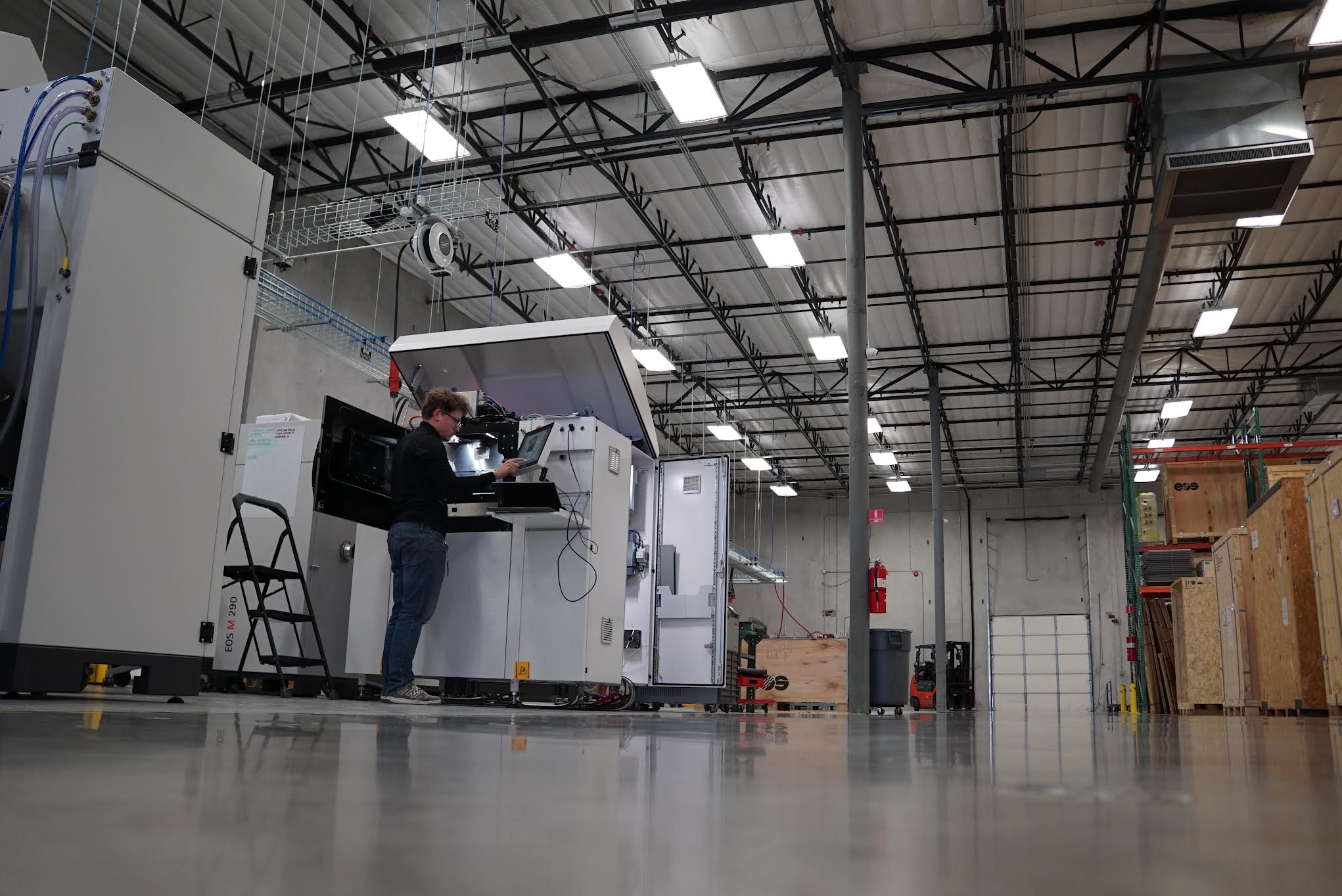
According to EOS, the new investment has also created ten additional jobs at Pflugerville. Along with putting the company in an even more optimal position to attract U.S. government contracts, the larger footprint also simply maximizes EOS’s ability to serve all its North American customers.
In a press release about EOS’s expansion of its U.S. manufacturing and logistics capacity, the president of EOS North America, Glynn Fletcher, said, “This expansion demonstrates our continued commitment to support the resurgence of American manufacturing. This expansion is not just an investment in our own infrastructure; it is also about standing shoulder-to-shoulder with the U.S. manufacturing community to provide products and services for a superior customer experience. It demonstrates our dedication to the growing U.S. markets where our technology is in greatest demand. We fully understand the criticality that AM plays in the future of domestic manufacturing, and this expansion ensures EOS will continue to play a leading role in years to come.”

As I noted above, EOS is one of a number of metal AM OEMs that have started to focus on accelerating U.S. production capacity of its hardware over the last several years: Velo3D, SPEE3D, and Nikon SLM Solutions are some of the others. One interesting angle here is that, aside from Velo3D, all of these companies either have a dual base in both the U.S. and abroad or are headquartered in a key U.S. ally.
That’s, of course, not a coincidence, but rather a symptom of how the U.S. government has gradually shifted towards prioritizing domestic and allied suppliers in DoD supply chains. While I’m sure there are plenty of individuals in the defense industrial base world who think this shift is happening far too slowly, I think that the fact that the shift is happening at all is the key takeaway for understanding the long arc of reshoring.
Until a few years ago, hardly anyone would’ve understood the rationale behind shifting your own supply chain — not just your sales pipeline — to the domestic U.S., as an indispensable component of a reshoring strategy. That some of the most important suppliers of metal AM hardware to the U.S. defense industrial base not only understand that rationale, but are fully in the process of executing on it, reinforces that we shouldn’t underestimate the long-term potential for reshoring.
I think it’s also worth paying attention to the specific location of EOS’s U.S. production operations: Texas gives the company ideal entry to the data center, energy, and space industry markets, three of the most critical target markets for the AM industry beyond defense. Going forward, the company’s geographical positioning gives EOS the best opportunity possible to truly test the sales appeal of point-of-need manufacturing.
Images courtesy of EOS
Subscribe to Our Email Newsletter
Stay up-to-date on all the latest news from the 3D printing industry and receive information and offers from third party vendors.
Print Services
Upload your 3D Models and get them printed quickly and efficiently.













You May Also Like
The Manufacturing Race Behind the Drone Revolution
We are in the middle of a major manufacturing shift focused on the production speed and payload capacity of uncrewed aerial systems (UAS), or drones. A recent Manufacturing Dive article...
ADDMAN to Buy Up to $10.8M in Nickel 718 Powder from 6K Additive Over 30 Months
After years of buildup, we’re finally starting to see what the US metal additive manufacturing (AM) market could look like at scale. To be sure, it’s still not quite there,...
Metal AM in a Multipolar World, Part 2: How PBF and DED Could Change by 2035
The first decades of PBF development were heavily shaped by machine capability: more power, more lasers, larger build volumes, better recoating, and improved process monitoring. These developments will continue, but...
Advanced Manufacturing at IMTS 2026: 3D Printing and AI and Drones, Oh My!
Last week’s International Manufacturing Technology Snow (IMTS) in Chicago welcomed over 90,000 attendees to the jungle that is McCormick Place. With over 1.17 million square feet of exhibit space, and...

























































