Camp Lejeune’s II Marine Expeditionary Force Innovation Campus: An Existing Model for the U.S.’s Future in Additive Manufacturing

A recent article in Military.com highlights the II Marine Expeditionary Force (MEF) Innovation Campus, located at Marine Corps Base Camp Lejeune in North Carolina. It provides a good touchstone for the sort of work that could be central to a government-led, accelerated manufacturing buildup effort, like the kind I suggested in a story I wrote last year, “An Operation Warp Speed for Manufacturing: a Recommendation for the 3D Printing Industry in 2026.”
Even if those in the additive manufacturing (AM) industry don’t know the exact numbers, virtually everyone seems to know that the 2026 U.S. defense budget significantly increases the funding allocated for AM activities (estimated to be $3.3 billion, an increase of over 80% compared to 2025). Despite the major increases over the last couple of years, however, one could easily argue that the number still has room to run much higher. As John Borrego, senior VP of aerospace and defense at Machina Labs, points out in his recent article for War on the Rocks, the number “is still only a small fraction of a research, development, test, and evaluation budget north of $100 billion.”
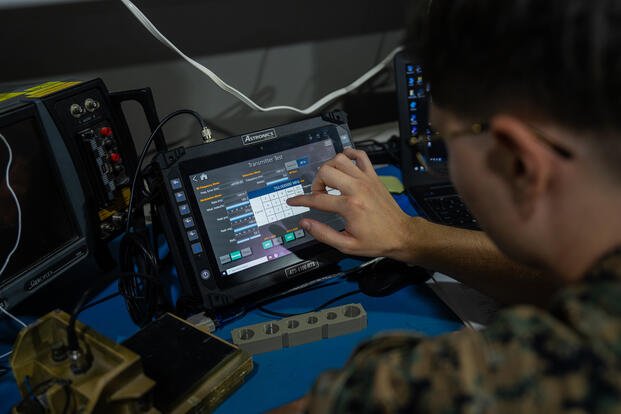
U.S. Marine Corps Cpl. Grant Morris, a digital wideband systems maintainer with 2nd Intelligence Battalion, II Marine Expeditionary Force Information Group, II MEF, works on the hand-held radio test set at Marine Corps Base Camp Lejeune, North Carolina, Sept. 4, 2025. U.S. Marine Corps photo by Lance Corporal Brady Hathaway, via Military.com.
As Borrego also rightly points out, “…while additive is a powerful tool, it is not the only answer.” For an endeavor along the lines of an Operation Warp Speed (OWS) for manufacturing, stakeholders across the American advanced manufacturing world should come together to build a consensus regarding the proper mix of processes and desired outcomes for an industrial base centered around the latest generation of advanced manufacturing processes.
If such a consensus can be reached, the article in Military.com, “Marines Revolutionize Readiness at Innovation Campus,” highlights the perfect sort of environment for implementing the path forward:
As the author, Robert Billard, describes, “2nd MLG opened the II MEF Innovation Campus in April 2022. It serves all Marines and Sailors at Camp Lejeune with advanced tools, including 3D printers, laser cutters, and electronics workstations.
“The campus supports quick fixes and new designs. Marines print custom tools, brackets, and prototypes that would otherwise take weeks or months through traditional supply chains. The campus nests perfectly with Marine Corps efforts to adopt innovative approaches such as [AM], which can allow deployed units to fix gear faster.”
In my interview last year with II MEF Innovation Officer Matt Pine, he highlighted how the work he’s done at Camp Lejeune has familiarized him with the same sorts of problems, albeit in a different environment, that the AM industry at-large is regularly faced with: slow certification timelines, workforce shortages, lags between advances in physical workflow, and reflections of those advances on virtual platforms. If you’re interested in hearing more from Pine, which is always worthwhile, you can also listen to this 3DPOD episode.
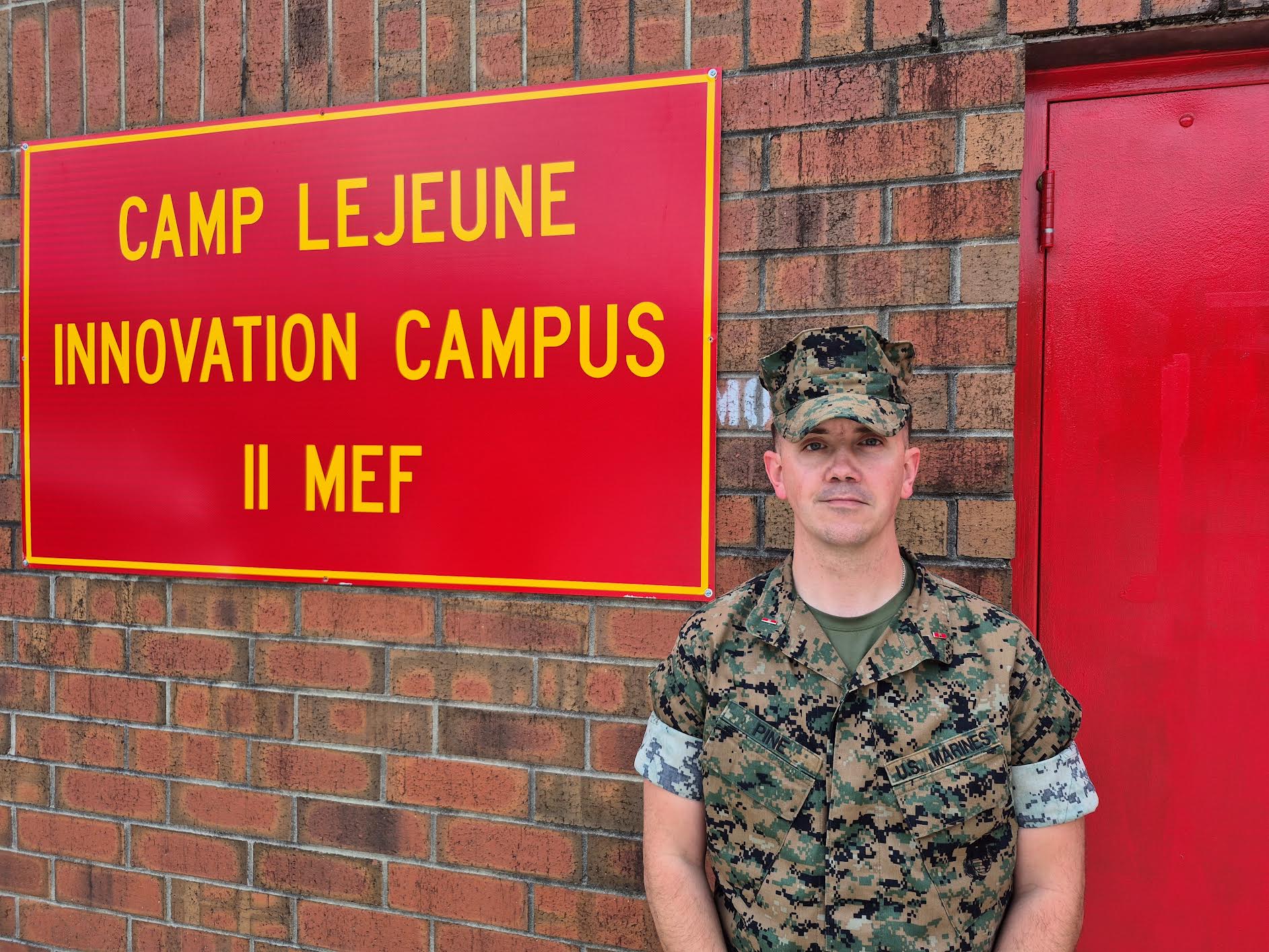
Image courtesy of Matt Pine
The reality that personnel at the II MEF Innovation Campus have such similar experiences to those working in the private sector is in fact an example of strength in how the U.S. military’s AM implementation has functioned up until now. For one thing, it illustrates that the military has not just been throwing resources at the problem, but has largely been judicious and conservative in its adoption of new, relatively unproven production technologies. This suggests that, even as U.S. military AM spending increases, the Pentagon is likely not at risk of the sort of overspend that Borrego rightly cautions against in his article.
Further, and perhaps even more importantly, the overlap between defense and civilian applications confirms that the AM industry shouldn’t be thinking of “dual-use” in terms of two sides that have no business being on the same coin, but rather as fundamentally synergistic spheres of industrial activity. Among other implications, this means that the world of defense and the world of commerce have much that they can learn from one another, provided that the right forums for cross-pollination exist.
One of the most promising angles of the OWS effort which helped accelerate the path to the COVID-19 vaccine was that it was a whole-of-government initiative. It relied heavily on a posture led by the Pentagon, but it couldn’t have succeeded without involvement from a host of other federal agencies, as well as private industry, academia, and state and local authorities. As U.S. Army General Gustave F. Perna, OWS’s chief operating officer, commented in a December 2020 press briefing, “…[I]t has been a whole-of-America approach.”
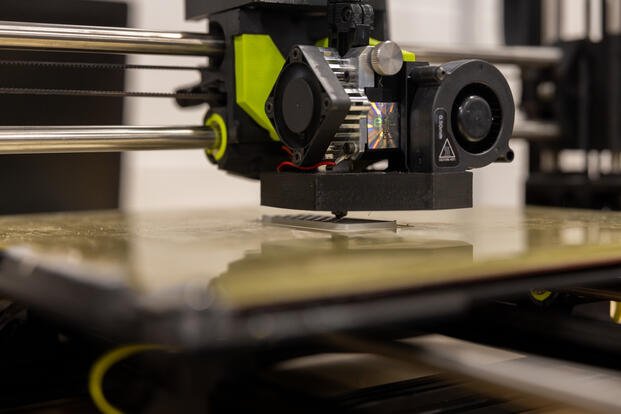
A 3D printer is utilized by the II Marine Expeditionary Force Innovation Campus, producing an additive fabrication at Marine Corps Base Camp Lejeune, June 13, 2025. U.S. Marine Corps photo by Corporal Apollo Wilson, via Military.com
I’m not arguing that civilians should be sent to Camp Lejeune for training, or that Marines should be sent to commandeer workforce training facilities. What I do think makes sense, though, would be a meeting-of-the-minds between leadership at key stakeholder institutions—like Pentagon decision-makers familiar with the work at Camp Lejeune, and those heading up MIT’s Initiative for New Manufacturing, for instance—which incorporates feedback from trainees on the ground who have undergone the respective workforce development programs. To reiterate, this shouldn’t be limited to AM, but should include voices from across the full range of advanced manufacturing processes.
As I noted in my original post on an OWS for manufacturing, the U.S. industrial base needs a standard model for creating the right number of the right mix of workers who can support a sustained advanced manufacturing buildup. Before the Pentagon commits to its next ramp-up of AM defense spending, U.S. manufacturing stakeholders need to start envisioning how that ramp-up fits into a broader strategy that incorporates the total suite of digital and conventional manufacturing processes comprising the U.S.’s forecasted future production capacity. And everyone involved needs to start from the premise that the key limiting factor isn’t the amount of machinery the U.S. can afford: it’s the number of new workers per year that can realistically be trained.
Featured image: ‘Photo By Staff Sgt. Gavin Umboh | U.S. Marines from around II Marine Expeditionary Force receive training on the Multi-Mission communications terminal during a Commercial Satellite Communication Operator Course at Marine Corps Base Camp Lejeune, Dec. 17, 2025. The purpose of CSOC is to provide knowledge and hands on training with commercial off-the-shelf communication equipment to modernize communication efforts in accordance with Force Design.’ U.S. Marine Corps photo by Staff Sgt. Gavin Umboh, via DVIDS
Subscribe to Our Email Newsletter
Stay up-to-date on all the latest news from the 3D printing industry and receive information and offers from third party vendors.
Print Services
Upload your 3D Models and get them printed quickly and efficiently.











You May Also Like
Formlabs Fuse 1+ 30W: Small SLS Printer, Massive Impact
Disclosure: With Formlabs permission I was able to sell my 4L and use that to help with the purchase of the Fuse 1+ and Fuse Sift. Aside from allowing me...
ASTM International Works with UK MoD on America Makes Project
The UK Ministry of Defense (MoD) will work with ASTM International on a $1.1 million project to let it work in closer concert with the US Department of War (DoW)....
3D Printing News Briefs, January 15, 2026: Project Call, Sports Medicine, Aluminum Alloy, & More
In today’s 3D Printing News Briefs, America Makes announced the winners of a $1.1 million Project Call, Austal USA named a new Vice President for Business Development and External Affairs,...
UK Government Partnership to Develop 3D Printed Metal Alloys for Nuclear Fusion
The UK Atomic Energy Authority (UKAEA), a government-funded research organization, has demonstrated a persistent interest in developing metal additive manufacturing (AM) materials for nuclear fusion applications, including multiple phases of...