Additive Construction Firm Black Buffalo 3D Files for Chapter 11 Bankruptcy

Black Buffalo 3D Corporation has filed for Chapter 11 bankruptcy protection. The U.S. company, known for manufacturing large-scale 3D construction printers and proprietary building materials, has not yet issued a public statement explaining the reasons for the filing.
Details from the court filing show that on December 24, 2025, the company filed a voluntary Chapter 11 petition in the U.S. Bankruptcy Court for the District of Delaware. According to the filing, Black Buffalo 3D reported estimated assets and liabilities each in the range of $1 million to $10 million.
In Chapter 11 cases, companies typically file a series of “first-day” motions seeking court approval to continue operations, pay employees, and access financing. Court records will show what actions Black Buffalo 3D seeks as the case moves forward.
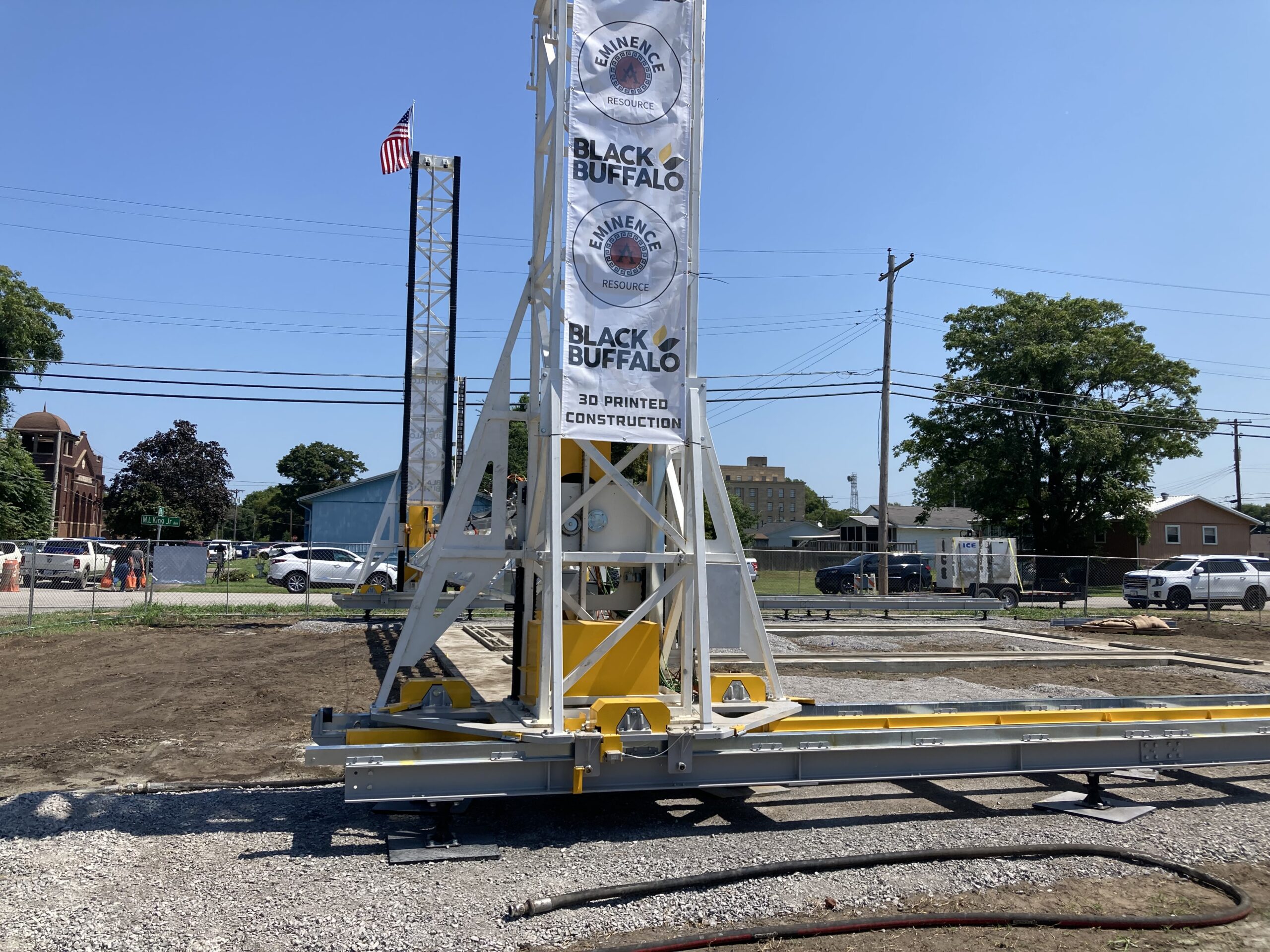
Black Buffalo Construction 3D printing. Image courtesy of Black Buffalo.
Who Is Black Buffalo 3D?
Black Buffalo 3D developed large-scale 3D construction printers and concrete-based materials to print load-bearing walls and structural components for residential and commercial buildings. The company, founded in 2020 and based in New Jersey, focused its technology on the NEXCON line of 3D construction printers — machines that deposit specialized concrete-based materials layer by layer to construct walls and related structures without traditional formwork.
In the past, the company said its materials and printed components met ICC-ES (International Code Council Evaluation Service) building code standards, an important step for construction approvals, and that it had formed partnerships to promote its technology internationally. Black Buffalo 3D also showcased its printing systems and printed wall structures at industry and government events focused on housing innovation.
Capital-Intensive Technology Meets Market Reality
Industry experts have noted that 3D construction printing is a capital-intensive segment of the broader additive manufacturing space. For example, Stephan Mansour, a consultant who has written extensively on additive construction for 3DPrint.com, has explained in past analysis that construction-scale systems are expensive, highly customized, and sold in far smaller volumes than desktop or industrial 3D printers. This means revenue depends on individual construction projects, making sales slower and harder to predict.
Experts say competition and investment in 3D construction printing have grown as companies try to move the technology beyond pilot projects. Without a steady flow of large construction jobs, even well-developed systems can struggle to build sustainable businesses.

By filing for Chapter 11, Black Buffalo 3D is operating under court supervision while it addresses its financial situation. Chapter 11 also allows companies to pursue asset sales under Section 363 of the U.S. Bankruptcy Code, a process that can be used to sell some or all of a business during bankruptcy, subject to court approval. Black Buffalo 3D’s Chapter 11 filing adds to the ongoing discussion about how large-scale 3D construction printing technologies are brought to market and used in the construction industry.
Subscribe to Our Email Newsletter
Stay up-to-date on all the latest news from the 3D printing industry and receive information and offers from third party vendors.
Print Services
Upload your 3D Models and get them printed quickly and efficiently.











You May Also Like
Additive Manufacturing’s Next Chapter: From Prototype Tool to Operating Model
Additive manufacturing is shedding its legacy reputation. While it remains the go-to for prototyping, its potential now extends beyond. Today, it’s increasingly used to support real production requirements, helping teams...
AMS 2026: The Gift of a Good Strategy
First things first, folks: if you’re planning on attending AMS 2026, February 24-26 in NYC, and you haven’t registered yet, you can do so here. We’ll consult some ghosts of...
The Barnes Global Advisors is at AMS
The Barnes Global Advisors (TBGA), the additive manufacturing (AM) consultancy based in Pittsburgh, is a pillar of the AM industry. TBGA’s expertise is sought by AM OEMs across the globe,...
Scaling AM Suppressor Production: Oerlikon AM & ATLIX Rise to the Challenge
End-of-barrel suppressors, oftentimes referred to as silencers, function by capturing and redirecting high-pressure propellant gases through carefully engineered internal structures and channels. By disrupting the gas flow before it exits...