Advanced Manufacturing Shows New Signs of Life at U.S. Research Universities


Additive manufacturing (AM) companies continue to demonstrate success at moving beyond R&D-centered, prototyping applications and one-offs, towards higher production volumes for end-use parts. Yet to keep that momentum going in the long run, it may make sense for the AM industry to remain just as committed as ever to R&D initiatives: not as an alternative to high-volume applications, but as an enabler for them.
In the U.S., research universities are opening up the potential for AM companies to explore such a strategy by making major investments in advanced manufacturing facilities that are designed to synergize high-level R&D with more immediately practical considerations like training new workers. For instance, Virginia Tech University just opened Virginia Tech Made: The Center for Advanced Manufacturing, where faculty will engage with engineering professionals in continued education programs and do outreach with K-12 students, in addition to teaching Virginia Tech students.
Metal AM processes like additive friction stir deposition (AFSD) will be a priority for Virginia Tech Made. Virginia Tech has proficiency in AFSD thanks in part to its working relationship with MELD Manufacturing, headquartered nearby. In August, the U.S. Army granted Virginia Tech a five-year, collaborative research contract worth up to $4.2 million to study AFSD processes.
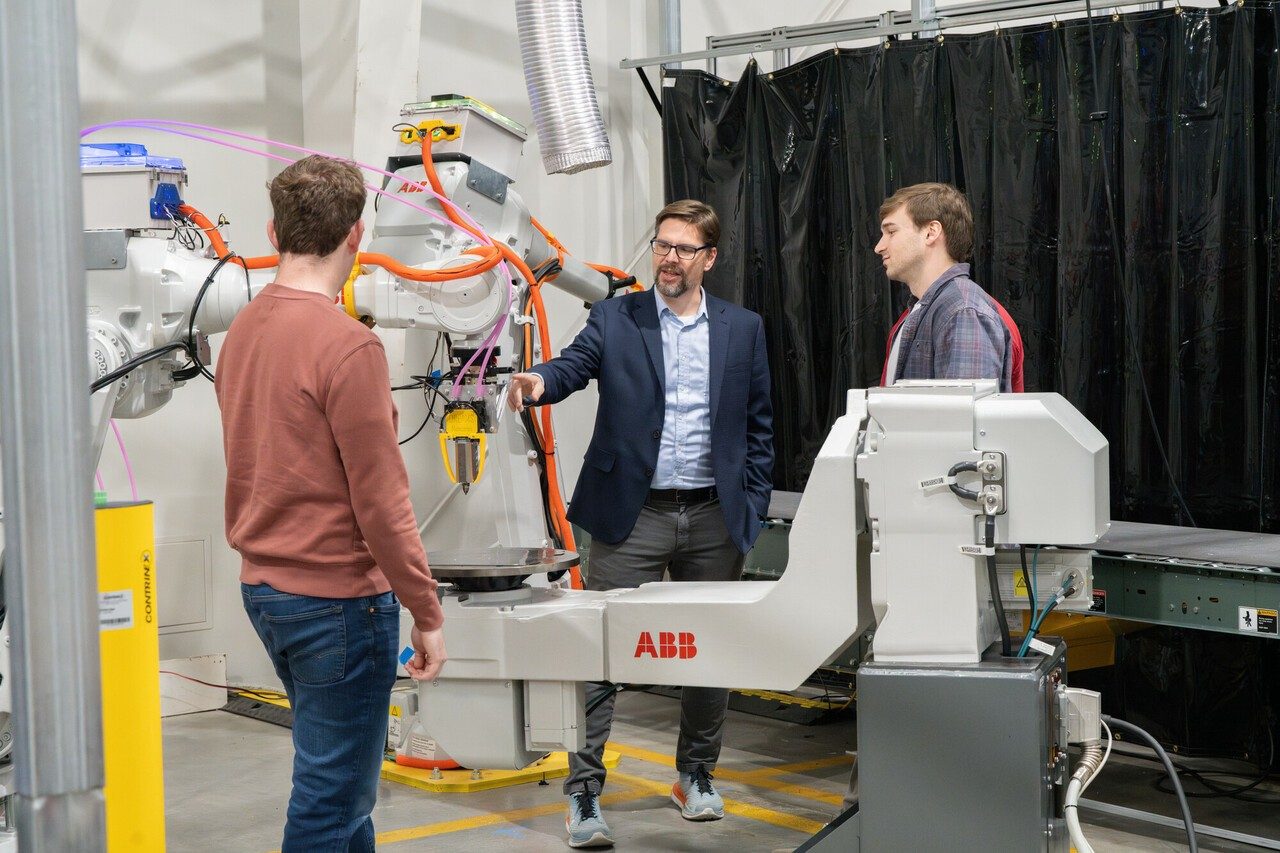
Professor Christopher Williams (center), the founding director of Virginia Tech Made.
Similarly, earlier this year, MIT launched the Initiative for New Manufacturing (INM), a program backed by a consortium that includes companies like GE Vernova and Siemens as founding members. John Hart, co-founder of VulcanForms, which leverages a proprietary metal AM process, is part of the INM leadership team. Like Virginia Tech Made, INM also has a workforce development component as a central feature.
Meanwhile, at the Advanced Manufacturing Collaborative (AMC), a 50,000 square-foot, $60 million facility that Savannah River National Laboratory (SRNL) just opened on the University of South Carolina (USC) Aiken campus, researchers will explore AM’s applicability to topics like the intersection between AI data centers and nuclear energy. And, back in May, before any of the already mentioned programs were announced, the University of Illinois revealed that the DoD awarded the institution about $8 million to establish a metal AM research center in partnership with the Army. As with Virginia Tech Made, AFSD is one of the processes that the University of Illinois site will study.
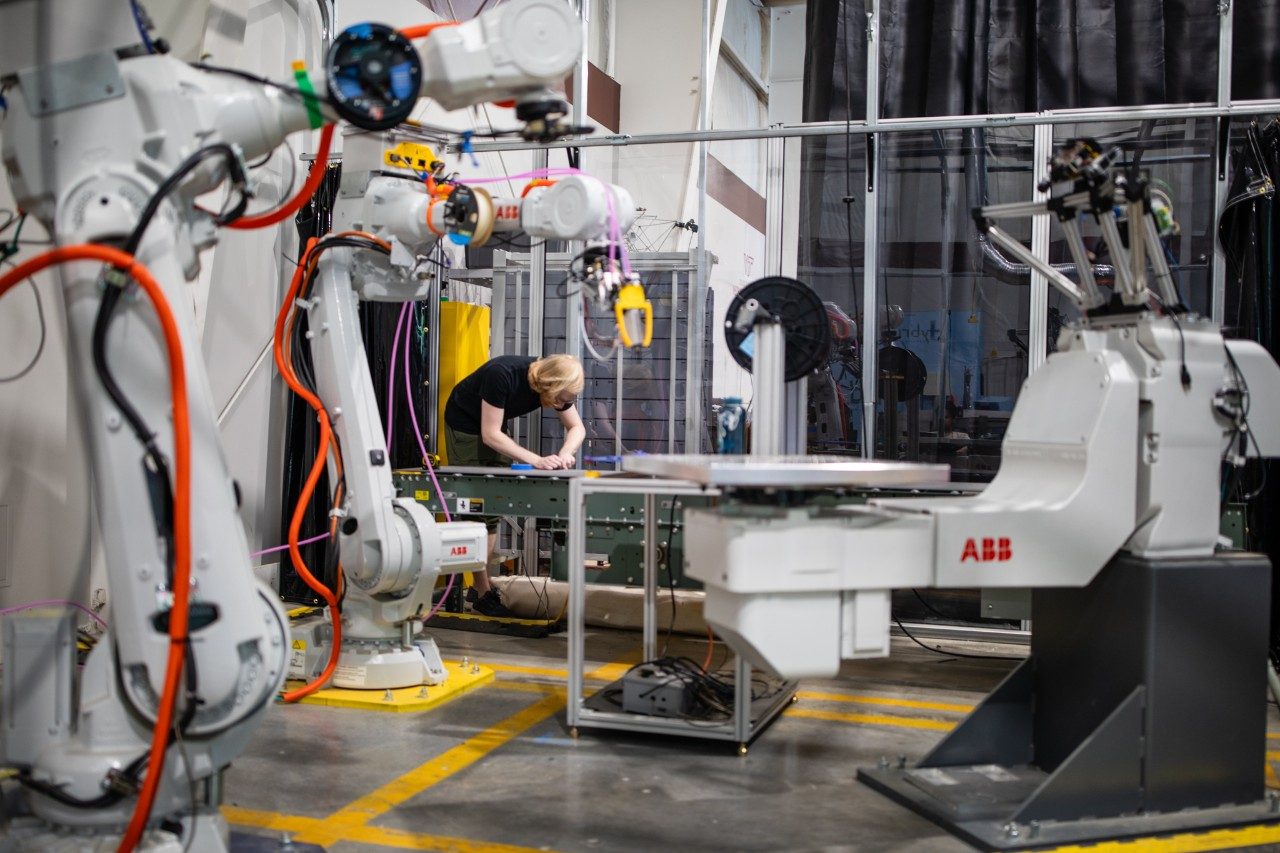
Inside Virginia Tech Made.
One reason these new facilities are such a major opportunity is that, until the last few years, U.S. manufacturing R&D had started to stagnate. According to a study by the Information Technology & Innovation Foundation (ITIF) released in January, “The growth of business R&D spending from 2018 to 2022 was quite uneven, with nonmanufacturing industries’ growth rate far exceeding that of manufacturing industries. …Manufacturing R&D only grew 8 percent from 2018 to 2022 when controlling for nominal GDP growth. In contrast, nonmanufacturing R&D grew nine times faster (70 percent).”
Declining investments into university research programs may have been a key factor behind that trend. According to an article the ITIF published in 2021, between 2013 and 2020, U.S. government funding of university research as a share of GDP fell faster than all but four of 35 other nations analyzed by the Organization for Economic Cooperation and Development (OECD). That matters because research done in a university setting has a special place in the social order:
As the authors of that same 2021 article note, “Even with robust corporate R&D investment, the private sector alone does not invest at the levels society needs, in large part because firms do not capture all the benefits of innovation. Numerous studies suggest the rate of return society receives from corporate R&D innovation activities is at least twice the estimated returns companies themselves receive. …Without public investment, the rates of economic growth, job creation, and living-standard improvement are all lower than their potential. The university system plays a key role in filling the gap between the current levels of private R&D and that which is optimal for economic growth.”
Finally, the authors also point out the disproportionate benefits to society-wide innovation that companies spun out of research universities yield: “A study by the Science Coalition found that ‘companies spun out of research universities have a far greater success rate than other companies.’ And a study by the Ratio Institute of Stockholm found that public university research spin-off companies have more patent applications and radical product innovations than similar non-spin-off firms…results [that] can be explained by both research cooperation between the companies and universities, and colocation factors.”
The points made about spinout companies may be the most intriguing details, above all in light of the establishment of the INM at MIT, since the latter has functioned as a veritable factory for producing AM companies over the last decade. But all the universities I’ve discussed here — not to mention all the other universities that have been undertaking similar endeavors in the 2020s — seem like fertile ground for sparking new enterprises.
The main difference between the present moment and the prior decade is that, at MIT in the 2010s, for instance, spinout companies like Formlabs and Inkbit were founded to develop and commercialize the infrastructure required to move manufacturing forward. Now, however, precisely because of the earlier phase’s accomplishments, so much of that necessary infrastructure already exists. Putting that infrastructure into the evolving university manufacturing landscape means that the R&D that occurs will be many steps closer to impacting the everyday business environment.
The next generation of manufacturing is no longer just a theory, but a practical reality. By aligning with the revamped manufacturing capabilities at U.S. research universities, AM companies have an opportunity to take that reality more fully into their own hands.
All images courtesy of Virginia Tech
Subscribe to Our Email Newsletter
Stay up-to-date on all the latest news from the 3D printing industry and receive information and offers from third party vendors.
Print Services
Upload your 3D Models and get them printed quickly and efficiently.













You May Also Like
Russia’s 3D Printed Missiles & Can NATO Get Its Act Together?
For most of US history, however much the two major parties differed on domestic policy (in some cases a lot, overall less than you’d think), there was always essentially a...
3D Printing News Briefs, October 21, 2026: Digital Twins, AI CAD Service, AR Smart Glasses, & More
In today’s 3D Printing News Briefs, America Makes announced the winners of its MIAMI Project Call, and AM Europe released a new report. Artec 3D launched its new Artec Twins...
3D Printing News Briefs, October 10, 2026: Drones, WAAM, Ceramics, & More
We have a packed 3D Printing News Briefs for you this weekend! First, America Makes celebrated the recent National Manufacturing Day with 3D printed drones, and then it’s on to...
The Manufacturing Race Behind the Drone Revolution
We are in the middle of a major manufacturing shift focused on the production speed and payload capacity of uncrewed aerial systems (UAS), or drones. A recent Manufacturing Dive article...