Pushing Hypersonic Limits: LEAP 71 & Farsoon Reveal AI-Designed Precooler at Formnext


There has still never been a single-stage-to-orbit (SSTO) craft launched from Earth, but plenty of companies are working tirelessly to realize that dream, and additive manufacturing (AM) is integral to the process. Earlier this year, for instance, Ursa Major announced a sale of ten of its Hadley engines to the U.S. subsidiary of Japan’s Innovative Space Carriers (ISC), a company aiming to make SSTO transport a reality.
SSTO more or less simply refers to a rocket that doesn’t have to shed any major hardware to reach space: essentially, a spacecraft that can take off from a runway like conventional planes. SSTOs don’t necessarily have to be hypersonic, but SSTO concepts deemed viable are generally designed with hypersonic engines.
Thus, even if it never comes to fruition on a widely accessible scale, SSTO serves as a catalyst for some important hypersonic research, as LEAP 71 and Farsoon have recently demonstrated. The Dubai-based computational engineering firm (LEAP 71) and the Chinese original equipment manufacturer (OEM) of AM platforms just revealed what Farsoon is referring to as one of the tallest parts ever built with powder bed fusion (PBF), a precooler concept for a hypersonic SSTO vehicle. Attendees of Formnext 2025 (November 18-21) can see the part at Farsoon’s booth, E11 in Hall 11.0.
The precooler, which stands at 1.5 meters, was printed on the Farsoon FS811M, which features ten 500W lasers. LEAP 71 designed the part with its Noyron Computational Model, which has leveraged AI to create engines that have achieved multiple successful hot-fire tests in the last couple of years.
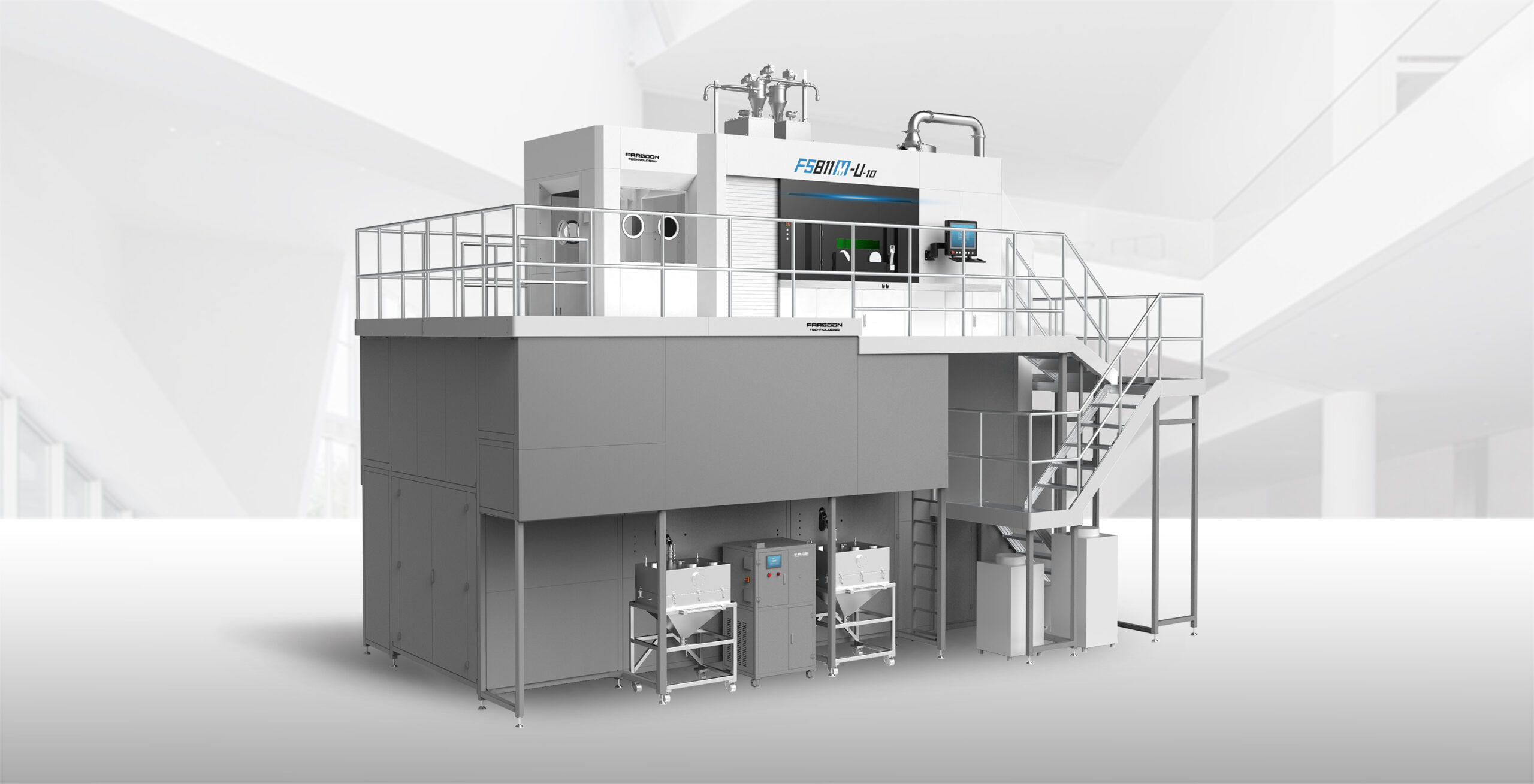
Farsoon FS811M. Image courtesy of Farsoon.
In a press release about the 3D printed hypersonic engine precooler produced by LEAP 71 and Farsoon, Oliver Li, the General Manager of Farsoon Europe, said, “This collaboration demonstrates how the converge of large-format [AM] and AI-driven design can redefine the limits of aerospace engineering. Farsoon’s open, industrial-scale LPBF systems empower partners like LEAP 71 to transform digital intelligence into tangible high-performance components — proving that innovation and collaboration are the true engines driving the next generation of space technology.”
Josefine Lissner, Managing Director of LEAP 71 and Principal Architect of Noyron, added, “At hypersonic speeds, incoming air can reach several thousand kelvins due to stagnation effects. To manage those extreme temperatures, we implemented a fractal folding algorithm in Noyron to maximize the available surface area without compromising aerodynamic flow. The intertwined structure separates the superheated air from the liquid-hydrogen coolant, enabling rapid thermal exchange in a compact, manufacturable form.”
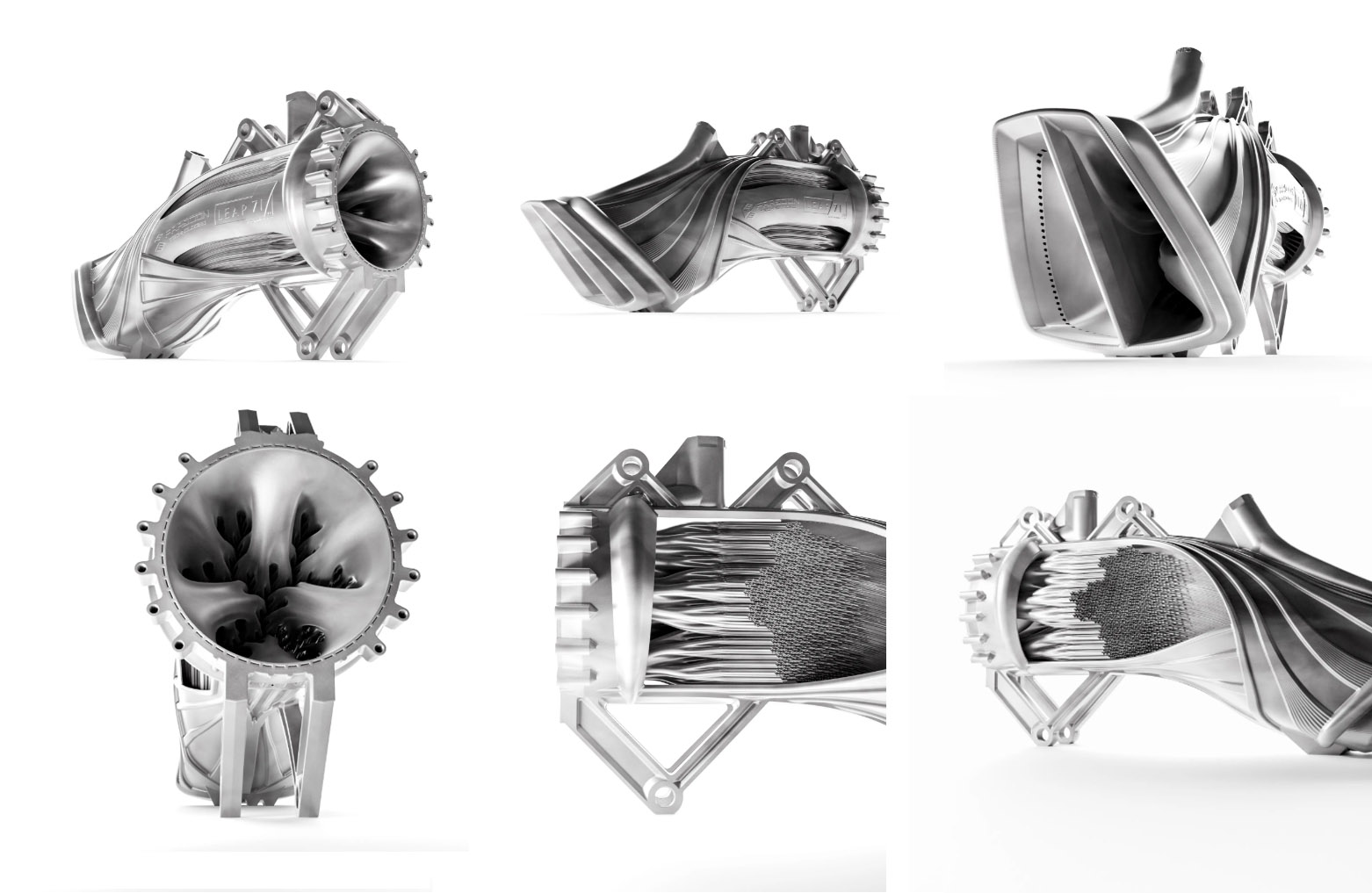
AI-designed hypersonic precooler printed on Farsoon’s FS811M. Image courtesy of Farsoon.
A precooler is a form of heat exchanger, so I think that the design principles here are relevant far beyond hypersonic applications. LEAP 71 and Farsoon could collaborate on 3D printed data center components, for instance, a vertical whose business case has just landed Fabric8Labs $50 million in its latest funding round.
I love the data center market opportunity, which is why I wrote the AM Research report on the topic that was published earlier this year. The most intriguing angle for the AM industry lies in just how early the demand cycle is for liquid cooling components: there is by no means a consensus on exactly what combination of solutions data center operators will require for the increasingly difficult task of managing the heat generated by servers using the latest AI chips.
That is why AI-driven design could prove pivotal to shaping the market for data center infrastructure over the next decade, creating the perfect conditions for a company like LEAP 71. No industry likes to eat its own dog food quite like the world of AI, and this is a situation that warrants it.
None of this is to say that what LEAP 71 and Farsoon have done here won’t ultimately play a role in a successful SSTO vehicle. The point is that even if that never occurs, the R&D certainly won’t go to waste.
Subscribe to Our Email Newsletter
Stay up-to-date on all the latest news from the 3D printing industry and receive information and offers from third party vendors.
Print Services
Upload your 3D Models and get them printed quickly and efficiently.













You May Also Like
3D Printed Propulsion Specialist Ursa Major Plans to Go Public via SPAC in Q1 2027
The Special Purpose Acquisition Company (SPAC) boom was devastating for the additive manufacturing (AM) industry. Peaking in 2021 — and, of course, subsuming companies from industries far beyond AM —...
South Korea’s Lincsolution Announces AM Defense Hub as Nation is Caught in US-China Trade War
In my most recent post about RIMPAC, I noted that US military joint exercises appear to be the latest function of the US government to be leveraged by the Trump...
Phase3D Gets Air Force Contract for Real-Time CMC Inspection
Inspection software and tooling firm Phase3D has been given a Department of the Air Force contract. Its Fringe Inspection platform will be used in ceramic matrix composites (CMCs). CMCs are...
Haddy’s Continued Attention to 3D Printed Drone Boats Shows Why It’s Becoming a Legit Dual-Use Contender
At some point last year, I stumbled across what has been, for me, the most valuable explanation of what ‘dual-use’ means, in this War on the Rocks article from January 2025, whose...