$50M to Boost Fabric8Labs’ Electrochemical AM Capacity in the U.S.


Additive Manufacturing Research (AMR) and Cantor Fitzgerald recently wrapped up AM Investment Strategies, and thermal management applications, specifically for the AI infrastructure market, were at the center of the discussion. In particular, AMR’s Scott Dunham pointed out the massive opportunities that the market research firm and consultancy sees for data center cooling hardware over the next decade.
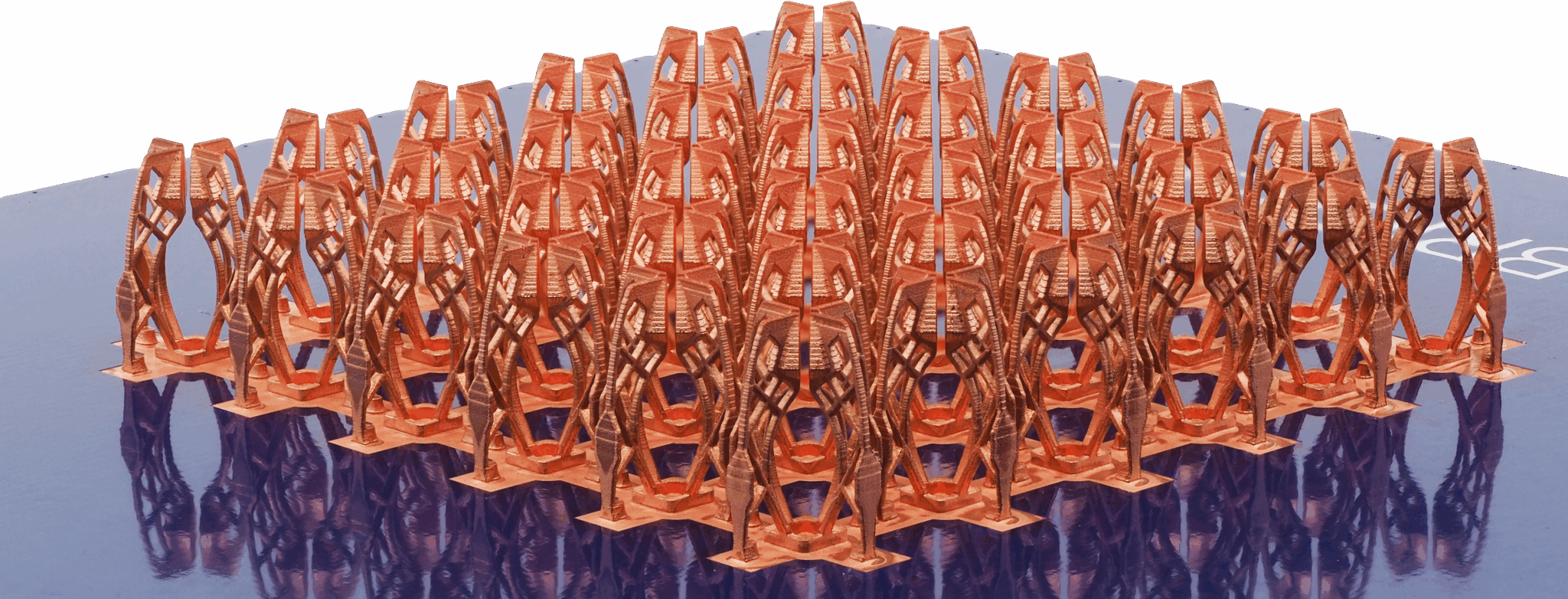
Fittingly, Fabric8Labs, which leverages its proprietary electrochemical AM (ECAM) technology to produce a variety of electronics-related components — including thermal management solutions for data centers — announced on the same day that the company had raised $50 million in its latest investment round. The funding for the San Diego-based company came from a host of existing investors, led by VC firm New Enterprise Associates (NEA) and the venture arm of chipmaker Intel.
Fabric8Labs will dedicate the new funds towards expanding its manufacturing capacity in the U.S., with a target of growing its output from 5 million to 22 million components across all its product lines. In addition to thermal management applications, the company also identifies wireless communications and power electronics for markets like electric vehicles (EVs) as key verticals in its expansion plans.
It looks like the plans for the money involve fairly fundamental ingredients for growing any organization: more facilities, more personnel, and higher machine utilization rates. Fabric8Labs also brought in $50 million in its previous funding round, a Series B in Q1 2023.

In a press release about Fabric8Labs’ $50 million raise in its latest investment cycle, Jeff Herman, the company’s co-founder and CEO, said, “This investment accelerates our mission to scale [ECAM] for our customers in high-growth, fast-moving industries where we are solving their most demanding challenges. With ECAM, we’re reshaping how critical components are designed and manufactured — delivering the performance, reliability, and supply chain resiliency that enables customers to rapidly innovate and deploy advanced systems.”
Greg Papadopoulos, PhD., Venture Partner at NEA, said, “We believe Fabric8Labs is redefining [AM] with its breakthrough ECAM technology. Early on, we recognized the potential of ECAM to deliver unmatched precision, scalability, and design freedom — unlocking new opportunities across thermal management, aerospace, and power electronics. We’re thrilled to continue supporting the team as they expand U.S. production and scale this transformative platform.”
With Carbon’s announcement of a $60 million haul the day prior, this is easily one of the best weeks that the AM industry has had in some time. Especially regarding the Fabric8Labs news, the two announcements are also a sign that the trade uncertainty which has plagued businesses all year might actually be pushing investors towards committing money to reshoring.
The Fabric8Labs round is also quite timely insofar as it happened against a backdrop of increasing uncertainty about where the AI boom goes from here. Much of that uncertainty has centered around The Big Short investor Michael Burry’s revelation that he has put options worth over a billion dollars on the market’s two biggest AI darlings, NVIDIA and Palantir. Meanwhile, SoftBank sold its entire NVIDIA stake of $5.8 billion.
On the other hand, we could just be moving to the next phase of a long-term investment cycle: this is even suggested by the SoftBank sale, as the Japanese firm announced it would be reallocating the funds to other areas of its portfolio like OpenAI. The chipmakers and early users have been the major — almost the sole — beneficiaries thus far, and the necessary infrastructure for a broader wave of adoption seems like a logical focus for the next step. I think the $50 million for Fabric8Labs fits nicely into that context.
It’s also worth mentioning that, while Carbon does sell its machines, the company has evolved into an applications-first brand, and Fabric8Labs is all about applications. This, plus the size of the rounds, reinforces what Vanesa Listek wrote in a recent 3DPrint.com PRO article about where the money is going in the world of AM investment in 2025. There are fewer investments to go around, but the investments that are being made are rather significant ones, and tend to go to companies that have zoomed in on very clearly-defined application categories.
Images courtesy of Fabric8Labs
Subscribe to Our Email Newsletter
Stay up-to-date on all the latest news from the 3D printing industry and receive information and offers from third party vendors.
Print Services
Upload your 3D Models and get them printed quickly and efficiently.












You May Also Like
Beyond the Prototype: How TPM3D Is Putting Industrial SLS to Work on the Factory Floor
A structural component for an autonomous police patrol vehicle in Dubai went from weighing 27 kilograms to just four. Delivery time dropped from seven days to two. The component was...
AMPulse Asia: The Push to Scale Up 3D Printing
China’s latest metal AM investments, Japan’s new hybrid manufacturing systems, and Australia’s defense-related projects lead this edition of AMPulse Asia. The 12 stories also cover advances in single-crystal 3D printing,...
Kratos Buys an AMCM M 8K to Increase Its AM Capacity in Indiana
As is true concerning the growth of any market, increasing AM adoption happens primarily through industrial clusters, hubs of economic activity which harness and accelerate innovation. While Indiana may not...
Aurora Labs Raises A$6M to Scale 3D Printed Turbojet Production
Australian metal 3D printing company Aurora Labs (ASX: A3D) is raising A$6 million ($4.2 million) to expand production of its small turbojet engines for defense and aerospace customers. The financing...