AM Takes on the Heat Challenge: Join EOS, Sintavia & nTop for a Free Webinar on Thermal Management


The webinar “Optimizing Thermal Management with Additive Manufacturing”, hosted by EOS and featuring AM contract manufacturer Sintavia and AM software provider nTop, is only two days away! You can register here to attend the webinar on Thursday, November 6, at 12 PM EST.
In my first notice for the webinar, I mentioned how thermal management is the problem that AM has been searching for. EOS, Sintavia, and nTop all have their own respective proficiencies in thermal management optimization, many of which also overlap with one another.
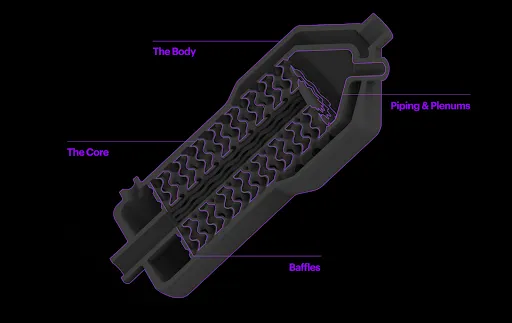
Image courtesy of nTop
EOS, for instance, works closely with Australia’s Conflux Technology, a company that leverages AM to make a variety of advanced heat exchangers for industries from motorsport to defense:
According to Michael Fuller, founder and CEO of Conflux, “Our customers’ have acceptance criteria that matches exacting quality and repeatable performance. EOS systems are the only AM platforms that can produce our challenging geometries whilst exceeding our customers’ requirements.”
In 2023, EOS and nTop announced a collaboration surrounding nTop Implicit Interop, which helped drastically speed up the file export time for the most complex AM designs. The proof-of-concept for the collaboration was a large industrial heat exchanger made for Siemens Energy:
Ole Geisen, who at the time was Siemens Energy’s Head of Engineering Services for AM, said, “This is a fascinating technical development. nTopology and EOS are years ahead of the game. The rest of the AM ecosystem now needs to catch up. File size hasn’t been much of a challenge in the past. However, with the industry’s advancements regarding topology optimization, generative design, and design for additive manufacturing (DfAM), part geometries are getting increasingly complex. As a result, exchanging such complex geometries with traditional data formats is becoming more challenging, severely hindering thermal management innovation.”
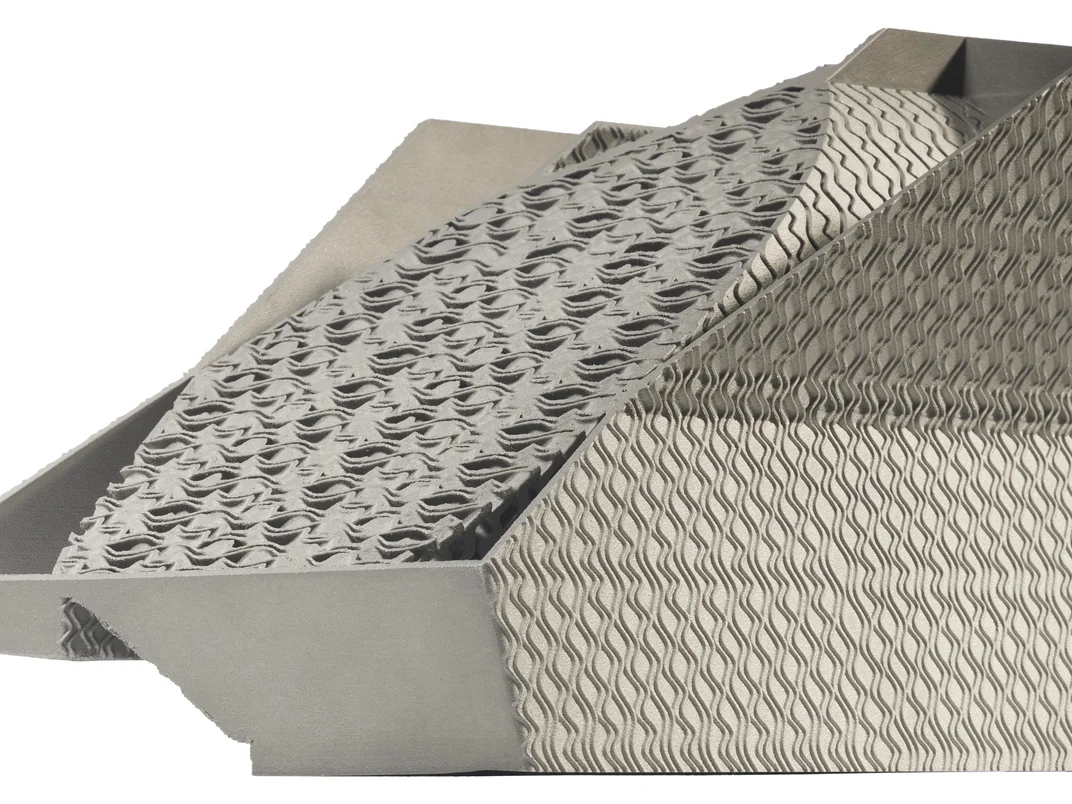
Close-up of a 3D printed metal heat exchanger core. Image courtesy of nTop
More broadly, heat exchanger design has long been at the core of nTop’s market-leading capabilities in DfAM.
Sintavia, meanwhile, operates a large fleet of large-format metal 3D printers made by EOS and EOS company AMCM. Heat exchangers for a variety of industries have been a central part of the company’s business for years.

Martin Bullemer, Managing Director of AMCM (left), and Brian Neff, CEO of Sintavia. Image courtesy of Metal AM Magazine
Thus, attendees will be getting an intro to what will likely continue to be one of the biggest drivers for interest in AM for the foreseeable future, and they’ll be getting that intro from three companies with rare levels of expertise on the topic. So join me, EOS, nTop, and Sintavia for this unique chance at a behind-the-scenes glimpse into how real-world experts are leveraging one of AM’s greatest advantages on a daily basis.
Subscribe to Our Email Newsletter
Stay up-to-date on all the latest news from the 3D printing industry and receive information and offers from third party vendors.
Print Services
Upload your 3D Models and get them printed quickly and efficiently.













You May Also Like
3D Printing News Briefs, October 24, 2026: Spinal Implant, Digital Dentistry, Recycled PLA, & More
We’re starting with a little business in this weekend’s 3D Printing News Briefs, and then moving on to FDA 510(k) clearance and digital dentistry. We’ll end with 3D printing waste...
3D Printing News Briefs: October 17, 2026: Affordable Housing, Bone Implants, Rubber Gloves, & More
In this weekend’s 3D Printing News Briefs, we’re starting off with quality assurance in metal additive manufacturing (AM), a new 3D printer, and 3D printed housing. We’ll finish up with...
AM Investment Strategies 2026 Sets the Stage for AMS 2027
AM Investment Strategies 2026 Nov. 5 · 12 p.m. ET · Free online event RESERVE YOUR SPOT ↗ A one-hour online discussion featuring some of the biggest names in 3D...
3D Printing News Briefs, October 10, 2026: Drones, WAAM, Ceramics, & More
We have a packed 3D Printing News Briefs for you this weekend! First, America Makes celebrated the recent National Manufacturing Day with 3D printed drones, and then it’s on to...