EPFL Is Growing Metal

Over the years, researchers in additive manufacturing have been working on different hydrogel systems for scaffolds, supports, and parts. Others have worked on different forms of growing 3D prints, while other groups have worked on metal salts. A new approach by the École Polytechnique Fédérale de Lausanne (EPFL) combines all three. Repeated soaking and heating of progressively more metal salt-loaded hydrogel scaffolds have led to a process that may be used for metal 3D printing. The hydrogel acts like a sacrificial support for the copper, iron, and silver particles that will make up the part. This process is akin to the Slurry SLA and DLP processes that we’ve seen, as well as some sintering step processes. These usually suffer from difficult-to-predict, variable shrinkage rates that can vary by geometry and part size. Or the resulting parts can be very weak, delicate, warped, or brittle. In this case, the results are promising enough that the team is looking at making this a technology with, they say, predictable shrinkage rates of 20%.
The paper, published in Advanced Materials and titled “Hydrogel-Based Vat Photopolymerization of Ceramics and Metals with Low Shrinkages via Repeated Infusion Precipitation,“ is very interesting. The team has progressively loaded hydrogels with up to 79% copper, iron, and silver. This is what reduces shrinkage, and the researchers think that it should also lead to better part densities. The uptake of metal ions in the hydrogels is limited, while precipitating reduces the ions, the team toyed with different cycles of precipitation and infusion. A hydrogel part is infused with ions, but they are not converted into a metal oxide; instead, a precipitation process is repeated. After completing ten cycles of precipitation with iron, they can reach a mass of around 79%, which is four times what they would in just one cycle, and significantly more than is usually used in Slurry SLA processes. For copper, seven cycles lead to 79%.
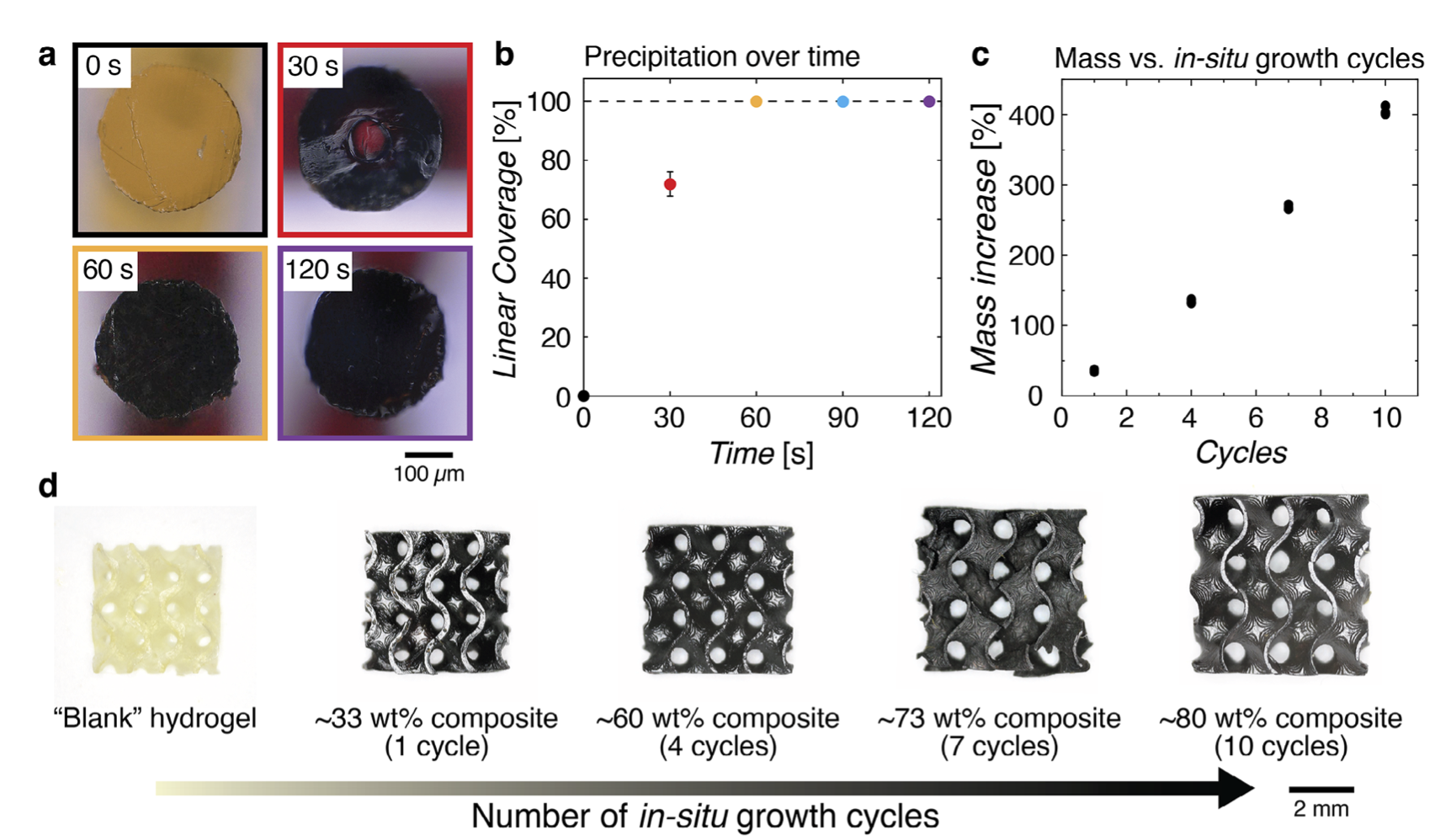
Images show iron-infused hydrogels becoming more filled and increasing in mass and size as ammonium hydroxide exposure time and growth cycles increase. Image courtesy of Daryl W. Yee et al., Advanced Materials, 2025. © Wiley.
When the desired weight is obtained, the metal structures are formed through a thermal process.  Currently, the team is working with iron, copper, and silver, which, in and of themselves, could provide for plenty of industrial applications, but more materials are possible. However, processed SrFe12O19 showed magnetic properties, indicating that it should be possible to make ceramics.
Different materials could need different cycles. Depending on the material, a maximum number was attained where the structure would collapse, or gas build-up would lead to cracks. Cycle time could also depend on the material and structure, but it would typically be around a minute. Optimal drying times also differ, but slower drying, especially in silica, leads to a reduction in defects. In parts, iron, copper, and silver had densities of 91%, 88%, and 76%, respectively.
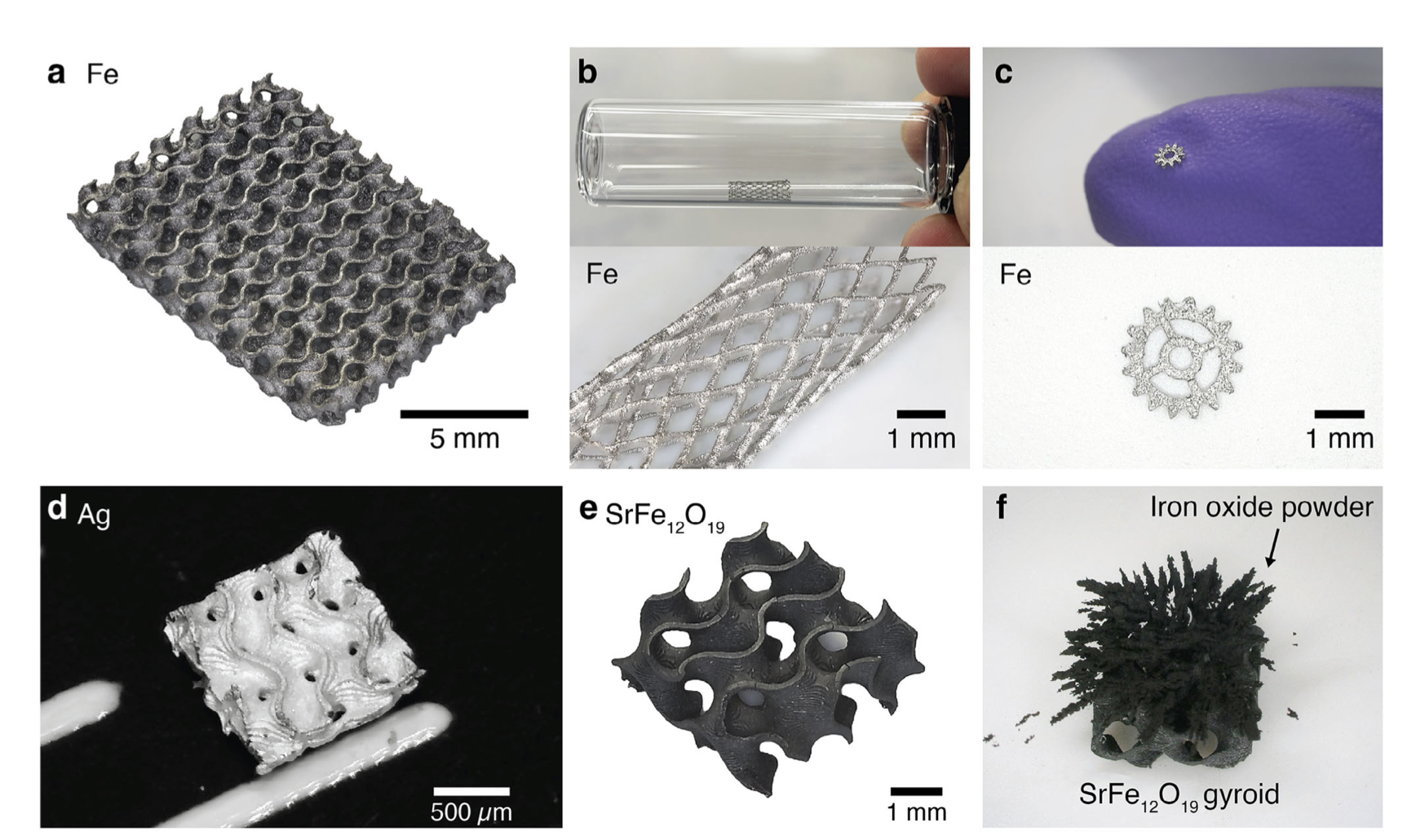
Fe and Ag gyroids and gears made by infusion-precipitation, including a magnetic SrFe12O19 gyroid visualized with iron oxide powder. Image courtesy of Daryl W. Yee et al., Advanced Materials, 2025. © Wiley.
The team then compared μCT images and files using CloudCompare, which showed bigger incongruities at the edges of the parts than at the center. Oxygen and carbon residue remained on parts as well. Throughout the experiments, the team believes that it can make use of slightly modified vat polymerization devices, which could point to ease of adoption and low-cost implementation of this technology. For these experiments, they used a MONO3-MZ4 by MonoPrinter. In the future, using existing and low-cost systems should also make parts very inexpensive.
Generally, the team is optimistic about implementing the technology, but they do point to issues in conveyancing and keeping hydrogel structures whole. This is analogous to the problems of collapsing green state parts in binder jet, which sounds like a relatively small problem, but significantly limits the geometric freedom attainable with binder jet.
They hope that carbon capture systems can be developed using this technology. I really think that this could be a promising path forward for metal and ceramic microfluidic devices. A lot of microfluidic research is done in polymers, and expanding this to easy-to-make microfluidics in metals and ceramics could yield really interesting results. Playing with magnetism could also lead to micro-sized devices, such as microfluidics, that could be highly functional. Beyond this, very complex, tiny heat exchangers could be possible. Assuming that this technology can be used to make complex components with tiny vasculature-like channels, it could lead to the development of high-performance conformal heat management solutions.
Of course, this is all speculation. We don’t yet know if this is a feasible technology in a lab machine, let alone at scale. But it’s nice to see some truly innovative progress being made in additive manufacturing. This could be a very low-cost way to make parts at scale that could significantly outperform existing technologies in one particular area. Let’s see which area that is!
Subscribe to Our Email Newsletter
Stay up-to-date on all the latest news from the 3D printing industry and receive information and offers from third party vendors.
Print Services
Upload your 3D Models and get them printed quickly and efficiently.













You May Also Like
3D Printing News Briefs, August 22, 2026: Polymers for CubeSats, Animal Mobility Devices, & More
We’re starting with defense news in this weekend’s 3D Printing News Briefs, before moving on to polymers for CubeSats and 3D printed prosthetics. We’ll end with a story about engineering...
Pusan National University & ORNL Develop Elastomeric Liquid Crystal Actuators
Researchers from Korea’s Pusan National University and Oak Ridge National Laboratory (ORNL) have developed 3D printed elastomeric actuators. In a paper published in Nature, the team used elastomeric liquid crystal...
Scientists Use BMF to 3D Print Seal Whiskers That Track Prey Long After It’s Gone
Seals use their whiskers to hunt. Not Navy Seals, although they may in some way also, but this article is about lowercase seals. Not Seal the musician either; as far...
Harvard’s Jennifer Lewis Lab Is 3D Printing Artificial Muscles That Twist and Bend on Demand
Researchers at Harvard John A. Paulson School of Engineering and Applied Sciences (SEAS) have developed a new way to 3D print materials that can move on their own, bending, twisting,...