Interview with Interspectral’s Isabelle Hachette on Predicting Defects Before They Happen

Interspectral is a Swedish company that enables data visualization and intelligence through AI. The firm has Quality Assurance and Process Monitoring software for additive, called AM Explorer, which helps companies get a grip on their additive manufacturing data. A spinoff of notable Swedish research institute RISE, Interspectral’s goal is to “accelerate and drive the adoption of Additive Manufacturing” and let people move from prototyping to manufacturing using a “sensor-agnostic…solution that is deeply integrated with 60–70% of the systems currently on the market.” That kind of interoperability is sure to drive adoption, but what does Interspectral do and who is it for? We interviewed CEO Isabelle Hachette to find out more.
She says that the company’s solution works with major LPBF and EBM systems and allows people to optimize “Additive Manufacturing across multiple layers: design, simulation, build, post-inspection, and service.” Through customized integrations for EOS, Nikon SLM Solutions, Colibrium Additive, AddUp, and others, the company has made integration as easy as possible. The key to what the firm does is in analyzing the reams of data that come from AM processes. Proprietary algorithms and making a full digital twin is how they can maintain accuracy while making data accessible. Every part is given a unique part fingerprint as well, with the software letting you have complete traceability.
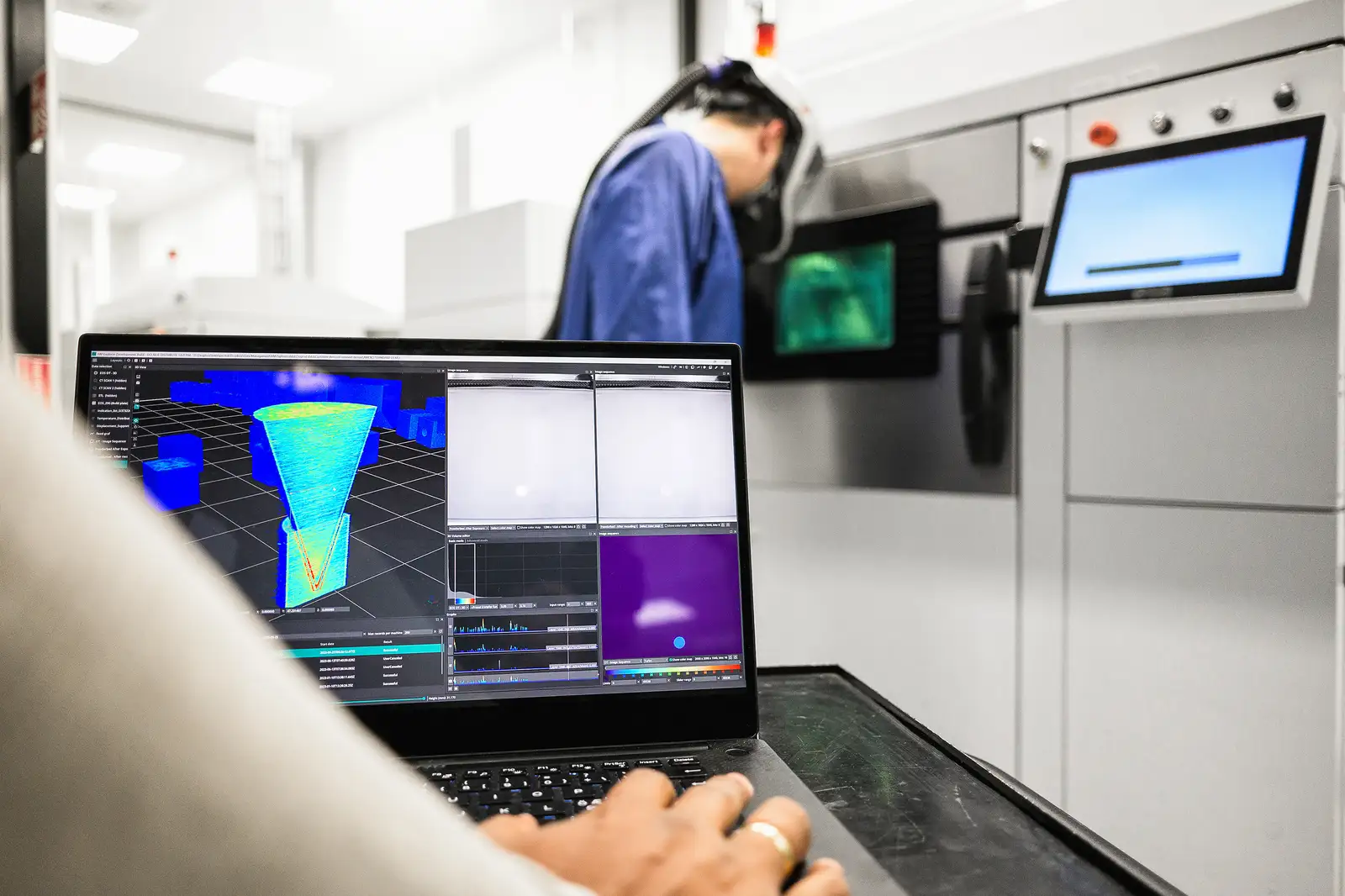
AM Explorer analyzing in-process monitoring data to enable defect detection from a 3D printing machine. Image courtesy of Interspectral.
The system works with “condition monitoring sensors like oxygen level and visible light cameras to more advanced sensors like fringe projections, laser/melt pool monitoring and optical tomography. End users can also add third party sensors. We are data and sensor agnostic. We do data fusion of point-clouds, volume data, signal data, sensor data etc. We can also provide a solution for individual system set-up.” Fault detection comes to the customer via a “unique anomaly indication list where the user can filter and customize results based on different characteristics, error type, severity score, or confidence interval.” Users can also have custom warnings implemented or see data through 2D and 3D plots. Detection is completely automated for each individual layer, with anomalies being identified, classified, and categorized automatically. You can then define your own warnings and prompts of “Go, Stop, Analyze, and Act,” depending on your own criteria, and on a case, process, run, or error.
AI is of course a many splendored thing nowadays, but Intespectral was ahead of the market and now has, according to Hachette,
“…developed a modular AI architecture that is unique in the market for its ability to support multiple AI algorithms. With this solution, there is no lock-in to specific AI models. We offer a flexible approach: our generic AI can be used off the shelf but can also be trained on specific datasets, and we can also integrate third-party AI modules into AM Explorer. A typical AI module from us is traditional powder bed analysis where we analyze post and after exposure images and look for the typical anomalies the market is interested in like lack of powder, streaking, protrusions and so on. But it could also be a module analyzing melt pool monitoring or OT data.”
The idea is to have a predictive model that can spot early indications of problems, predict defects before they happen, and look at past data to find future potential errors. The AI model can also look ahead a few layers to search for upcoming errors, or compare different build jobs.
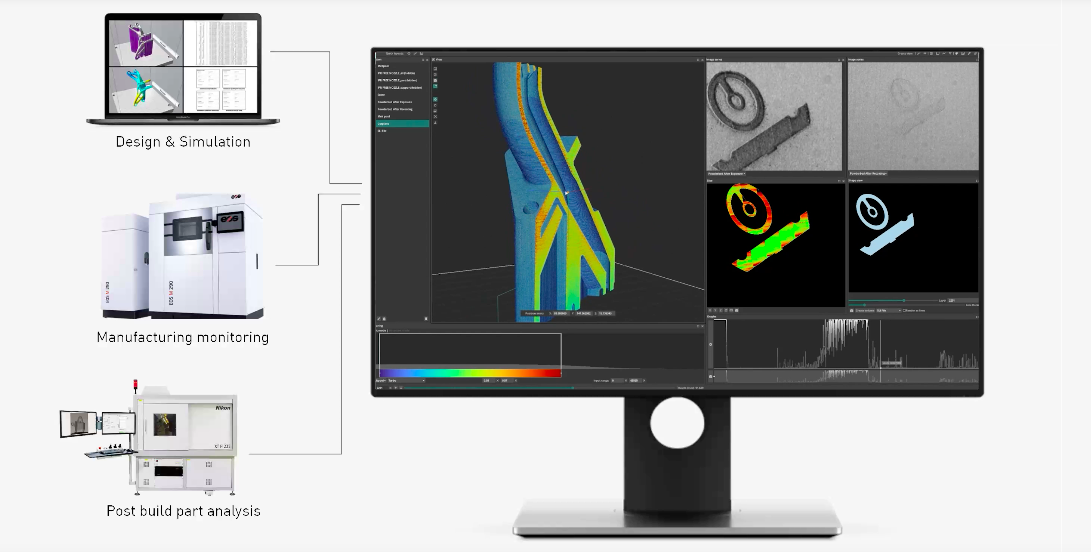
Interspectral’s AM Explorer software. Image courtesy of Interspectral.
So far, the company has found that customers can save around €50,000–100,000 per system per year with its solutions. Those are significant savings and can be compounded by operator time saved by doing a lot of analysis themselves. Interspectral reports that as of now, there has been on average an 80% efficiency improvement in terms of hours worked. The software is used in manufacturing, but also in parts qualification and prototyping set-ups by customers in aerospace, defense, energy, medical, and automotive. The solution can be used for fleets of printers of different models, set-ups, and brands as well.
Apart from the accessibility and insight into data, Hachette believes that customers choose Interspectral because they “always put the customer in focus and work to tackle their specific problem.”
“We offer efficient integration for quality assurance and process monitoring across virtually all systems and data sources in the market. We also have a tailored onboarding program to ensure optimal use of the software in each unique workflow while our efficient big data management helps organizations handle vast amounts of information without bottlenecks.”
True business intelligence for additive manufacturing seems to be Interspectral’s goal. This kind of insight, and the ability to act on that insight, would be very helpful to our industry. By allowing for error mitigation and optimization, a lot of money, and more importantly time, can be saved in industrializing additive and managing production thereafter. Additive, famously, is expensive, but through cost reduction, efficiency, and better insight, needless expenses can be removed, part cost can be reduced, and more can be makable.
Subscribe to Our Email Newsletter
Stay up-to-date on all the latest news from the 3D printing industry and receive information and offers from third party vendors.
Print Services
Upload your 3D Models and get them printed quickly and efficiently.













You May Also Like
AI Design and Point-of-Care Integration Headline ADDITIV Medical 2026
Medical additive manufacturing is expanding rapidly inside major healthcare institutions. In 2026 alone, hospital systems including Indiana University Health and Sheffield Teaching Hospitals launched dedicated point-of-care 3D printing facilities to...
GKN Aerospace’s UAV Demonstrator with 3D Printed Engine Avoids ITAR Regulations
The US CIA director recently made an unannounced visit to Moscow that has naturally raised much speculation, while the EU and NATO have now officially accused Russia of being behind...
The Business Case for 3D Printed Stents
A new 3D printed stent developed at New York University (NYU) does not look like the devices doctors typically use today. Instead of a simple tube, the prototype resembles a...
3D Printing Financials: 3D Systems, Prodways, and Align Build on Positive Momentum
The latest earnings from 3D Systems (NYSE: DDD), Prodways (EPA: ALPWG), and Align Technology (Nasdaq: ALGN) show that the 3D printing market continues to move forward. Some businesses are growing...