Bayern Innovativ’s Next Generation Manufacturing 2025 Conference

On the 23rd and 24th, Bayern Innovativ organized the Next Gen Manufacturing conference. Taking place at the Science Congress Center in Munich, this conference covers Additive Manufacturing, AI, software toolchains, and more. As well as a focus that is both a very logical one and new, the conference also includes politicians. Next Gen Manufacturing also has a decidedly German air. The conference is also centered on Germany, particularly Bayern. But, given Bayern’s strong manufacturing heritage, it manages to bring together local companies with real global heft.
On the political front, it also included Bavaria’s Minister of Economic Affairs, Hubert Aiwanger, and State Minister of Science, Markus Blume, so it’s kind of AI and AM meets CSU (Bavaria’s ruling conservative party) or maybe a Grias 3D if you will. We’re seeing sector-specific conferences gain in popularity. Events focused on the military or energy are doing well. At the same time, we’re also seeing regionally focused conferences start to emerge. It’s really looking like we have one big conference in Formnext and then sectoral ones or ones specific to an area, such as the technically-focused AMUG conference. Since we have our own Additive Manufacturing Strategies event in New York in February, we look around a lot at what is going on. At AMS, we’re focused on the big picture, strategies, investors, finance, and the market as a whole. We’d like to think we’re unique and hope that will give us the oxygen we need to keep this conference going. So it’s nice to see something in Bayern that is also quite unique. On the one hand, it can seem like a threat to Berlin’s excellent AM Forum event. But if it combined the more specific approaches we’ve seen with the regional conferences working on Next Gen Manufacturing, it could really be on to a winning formula.
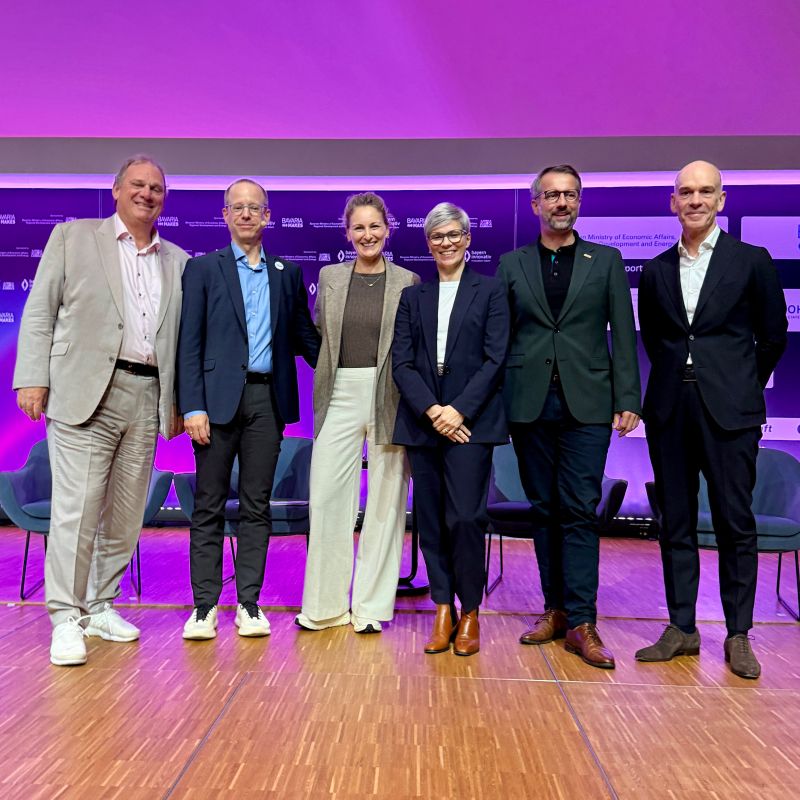
There is no one region where additive is predominant; we still don’t have a Silicon Valley. And a lot of the AM world is in Germany, while much of the installed base is in Long Beach, USA, and many new firms are in Shenzhen. Everything else is spread pretty much everywhere else. So, for any region, the big prize would be to be a global home for additive or be regionally strong in 3D printing. Bayern could potentially make this happen for itself. Even being a European home for 3D printing would be quite the prize for the region. Serious efforts by the Technical University of Munich (TUM) and companies in the region point to that being something that people are thinking about. Even if these goals are not reached, it really makes sense to do more as a region with regard to additive. Stimulating local cooperation in 3D printing has been done a lot in Denmark and Singapore to accelerate local adoption. A similar approach could be good for Bayern as well.
The lineup is impressive, with speakers from EOS’ Marie Niehaus-Langer, MTU Aero Engines COO Silke Maurer, BMW Group’s Stefanus Bosch, Frank Rethmann of Airbus Helikopters, Markus Bähr of Diehl Defence, and Hinrich Kötter, the Vice-President Technology and Innovation at Rheinmetall AG. There was also a strong contingent of leading Additive Manufacturing researchers presenting. One of these, University of Nottingham’s Richard Hague, told me that,
“This was a strong event with engaging panels and speakers. I’m really glad I came. A lot of the focus was on Germany while the topics and learning were centered around industrialization and manufacturing. Aeroengines, helicopters, automobiles were all represented, giving a look inside different sectors and needs. There was also an especially strong session on defense as well.”
Differentiating events can be very tricky. I think this event, which brought together around 400 people, is a good contender for an ongoing one. If it manages to parlay its regional focus into a real strength going forward and helps Bayern cooperate more on additive, it could find itself in a unique role to play.
Subscribe to Our Email Newsletter
Stay up-to-date on all the latest news from the 3D printing industry and receive information and offers from third party vendors.
Print Services
Upload your 3D Models and get them printed quickly and efficiently.













You May Also Like
UniFormation S10 Heads to Kickstarter with an Integrated Resin Printing and Post-Processing System
UniFormation will launch its S10 desktop resin 3D printer on Kickstarter on October 22, 2026, with pledges starting at $999. The S10 integrates printing, washing, and drying, allowing a print...
Creality Goes Pro with Sermoon P1S 3D Scanner
From making millions of value-engineered Prusa clones, Creality really has aggressively pivoted to more complex machines. The company has made strides forward in software, and the Ender’s of yore is...
Stratasys Showcases 3D Printed Automotive Applications & New Printer at IMTS 2026
Just ahead of last week’s International Manufacturing Technology Show (IMTS) in Chicago, Stratasys launched the F870, a new large-format, production-grade FDM 3D printing platform designed to drive industrial manufacturing at...
Creality Launches SPARKX i8 on Indiegogo, Bringing Fastest, No-Purge-Waste Printing
Creality announces the launch of the multi-color 3D printer SPARKX i8 on Indiegogo, at an early-bird price of $309 (MSRP $399) starting from Sept. 21. Designed for ultimate user experience,...