When Bioprinting Enters the Room: Wyss Institute’s Chris Chen Joins the National Academy of Medicine


Christopher Chen, one of the architects behind Harvard’s 3D Organ Engineering Initiative, has been elected to the National Academy of Medicine (NAM), a rare honor that points to just how far the field of bioprinting has come.
NAM is much more than a title; it gives the people driving the future of medicine a voice, from what gets funded to how new technologies find their way into clinics. That makes Chen’s election more than symbolic. It’s a sign that engineered tissues and 3D organ printing are no longer lab experiments. They’re moving away from niche research and becoming part of national health discussions and even entering the policy conversation.
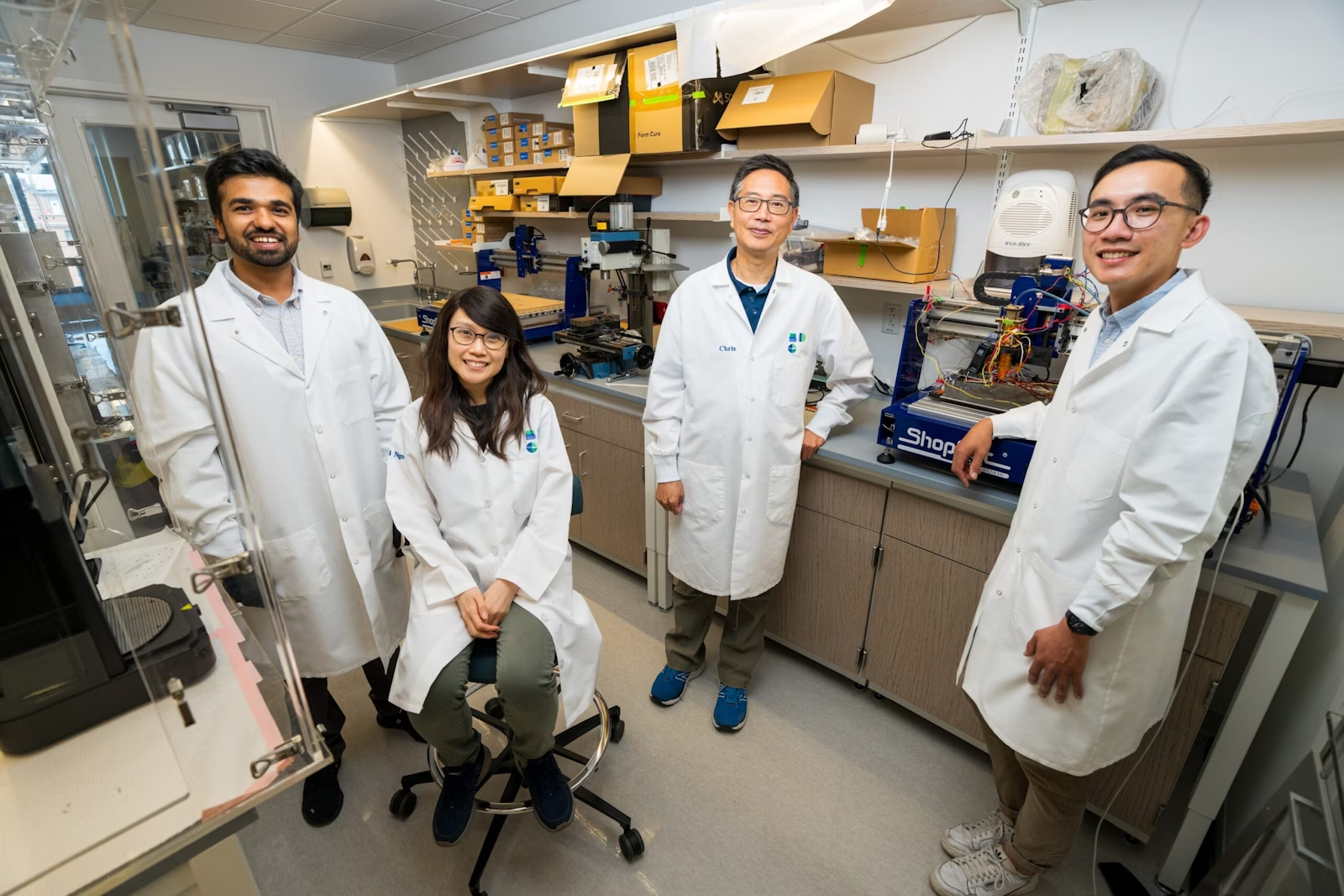
Chen’s lab has developed breakthrough microfabrication and bioengineering technologies. Image courtesy of Wyss Institute at Harvard University
NAM members advise the U.S. government on public health and biomedical priorities. Having Chen in that circle means a direct supporter of biofabrication, organ-on-chip models, and regenerative medicine, fields that often sit outside traditional medical funding systems.
It also shows the field’s evolution. A decade ago, 3D printing in medicine was dominated by prosthetics and surgical models. Now, scientists like Chen are using “additive logic” to re-create tissues with vasculature and function. With Chen joining NAM, bioprinting now has representation where national research agendas are set.
A List of Pioneers
Chen joins a growing list of bioprinting pioneers elected to the NAM.
Dr. Anthony Atala, director of the Wake Forest Institute for Regenerative Medicine, joined the then-Institute of Medicine (now NAM) in 2011. He’s best known for developing the world’s first lab-grown bladder successfully implanted in a patient, and for pioneering the Integrated Tissue and Organ Printing (ITOP) system. Atala’s work gave bioprinting some of its first real clinical proof points, showing that engineered tissues could do more than survive in the lab.
Dr. Gordana Vunjak-Novakovic followed in 2014, recognized for her groundbreaking research at Columbia University in tissue engineering using stem cells, scaffolds, and bioreactors. Her lab’s models of bone and heart tissue helped bridge experimental science and therapeutic application, pushing bioprinting closer to practical medicine.
Dr. Sangeeta N. Bhatia, elected in 2019, is known for her work at MIT developing micro-fabricated and synthetic tissues that mimic organ behavior. Uniquely trained as both a physician and an engineer, Bhatia bridges clinical needs with technical innovation. Though her focus extends beyond bioprinting, her advances in vascularized tissue systems and organ-on-chip technologies continue to influence how engineered tissues are built, tested, and scaled.
Together, these appointments mark a generational shift. The fact that each of these researchers has been elected to NAM means their work is not only scientifically impressive but also influential for national health policy, funding, and clinical translation.
Engineering Biology
At Harvard’s Wyss Institute for Biologically Inspired Engineering, Chen co-leads the 3D Organ Engineering Initiative with Jennifer Lewis, whose name is practically synonymous with bioprinting, and they’ve been bridging the gap between biology and manufacturing.
Chen’s lab builds cellular microenvironments that enable tissues to assemble themselves. So basically, his team designs microstructures that, in a controlled way, guide how cells move, connect, and build tissue, recreating how the body forms itself.
During a visit to Wyss in 2024, I saw how these collaborations play out in real time: engineers and biologists sharing the same benches, and ongoing bioprinting projects, revealing how quickly ideas move from design to biology. To me, what’s happening there would feel familiar to anyone in 3D printing: constant iteration, quick translation, and the sense that manufacturing and biology are finally speaking the same language.
The Wyss Institute often describes its approach as “a force of Nature solving the world’s toughest challenges.” And it’s truly people who make it work —a unique mix of mechanical engineers sitting next to stem cell biologists, startup founders chatting with surgeons, and so much more. Chen embodies that culture. And his election to NAM also has a lot to do with the recognition that engineering belongs inside medicine’s decision-making rooms.
If the last decade was about proving that we could print tissues, the next one (with people like Chen at the table) will be about making sure those tissues reach patients.
Subscribe to Our Email Newsletter
Stay up-to-date on all the latest news from the 3D printing industry and receive information and offers from third party vendors.
Print Services
Upload your 3D Models and get them printed quickly and efficiently.













You May Also Like
The Seminal Moment: Creality’s IPO Analysis & Possible Effects
Something super important happened just a few days ago, and too few people paid attention. Creality, a pioneer in low-cost desktop material extrusion printers, went public. Creality is now listed...
As Longevity Gains Momentum, Rem3dy Health Raises £14 Million for 3D Printed Nutrition
Longevity hack or healthcare trend? The answer may depend on who you ask, but investor interest in personalized nutrition is growing as consumers search for the next longevity hack. Now,...
3Dnatives to Present ADDITIV Metals 2026: Resolving Key Barriers to Scaling Metal Additive Manufacturing
As the metal additive manufacturing sector prepares for a massive leap—with market valuations expected to climb from $6.02 billion to $7.02 billion this year—the industry is shifting its focus from...
Stratasys Dental’s Negar Movahed Says They’re “Open for Partnerships”
According to “3D Printing for Dentistry 2025: Market Study and Forecast” by AM Research, the dental 3D printing market generated $5.2 billion in revenue in 2024—that’s nearly one third of...