ASTRO America Receives $1.6 Million for Inspection & Qualification Project

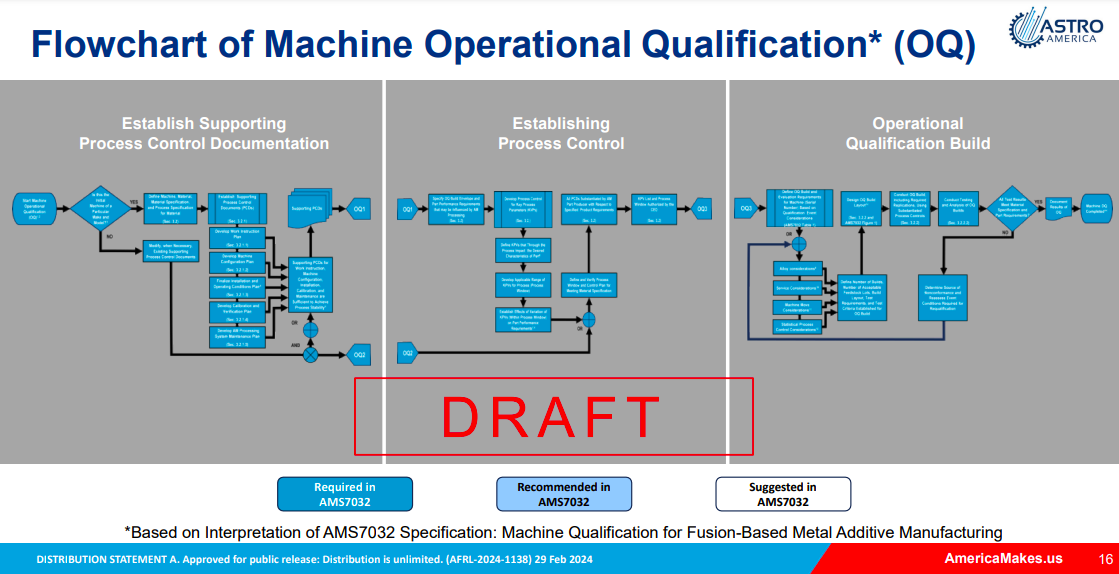
ASTRO America is set to receive $1.66 million from the Office of the Under Secretary of Defense, Manufacturing Technology Office (OSD ManTech), via America Makes and the National Center for Defense Manufacturing and Machining (NCDMM). For 12 months, the company will investigate how to make part inspection and qualification less expensive for Inconel 718 LPBF components on a Colibrium M2 Series 5. The award is part of the $5 million Quality Test and Inspection Methods Expediency (QTIME) project that was announced in May.
America Makes Technology Director Ben DiMarco said,
“Projects like QTIME highlight the invaluable contributions of our members, who steadily advance and mature additive manufacturing. We are honored to collaborate with them and confident that their work will enable future innovations in both in-situ and ex-situ monitoring and inspection, accelerating AM progress across the Department of Defense, the Federal Aviation Administration, and NASA.”

ASTRO America head Neal Orringer meets with officials at the Pentagon in August 2023, to discuss what would become the AM-Forward Fund. Image courtesy of ASTRO America
ASTRO America Vice President Dr. Abdalla Nassar stated,
“This award will allow us to focus on breaking one of the biggest bottlenecks in metal 3D printing: inspection. By integrating real-time, layer-wise monitoring with advanced modeling and analysis, our team will deliver a framework that reduces inspection time and cost while giving industry the confidence to scale.”
The award will let the team look closely at LPBF inspection: layer by layer, in situ, and flow detection, especially for lattices. The group wishes to predict deformation as well. The goal is to make builds more accurate and reduce CT scan time. ASTRO will work with the Colorado School of Mines, Honeywell Aerospace, Lockheed Martin, and Florida State University (FSU) on the QTIME project. Additionally, the Penn State Applied Research Lab will look at how to use AI to detect part errors in CT scans, while Applied Optimization will look at predictive modeling. Specific focus will go to both structural parts and heat exchange.
On the one hand, this is clearly a force multiplier for the industry. Qualification is hard. Moreover, a lot of additive work is a huge waste of time, with work being duplicated over and over again. We seem to be more into printing coupons than parts a lot of the time. Dialing in materials, printers, and parts is also repeated work, wasting tens of thousands of hours in print time and labor. If we had a more accurate understanding of our process and its flaws, especially with differences across the build volume and at various settings, we’d save a significant amount of time. Trust in 3D printing would also be increased if we could better predict and reduce errors as well. Overall we could make parts cheaper, quicker, and more accurately with this information.
At the same time, this research replicates a lot of work already done by commercial companies such as Interspectral, Euler3D, Phase3D. It would be great if this data were available to all commercial partners to accelerate everyone’s work. Now, since this is a US government spend, I’m not sure if this is something that will only be available to project partners, all America Makes members, or the industry in general. It’s up to America Makes to decide this, of course. If this data is not widely available, then it is a reminder that we should work together more broadly to help each other with qualification, monitoring, and data. With more analysis and data available, we can all accelerate everyone else’s work. Now, I know a lot of people see work and research that they do as being proprietary and a USP or advantage, but there is plenty that isn’t. By sharing more knowledge, insight, and data, we could collectively move more from the coupon 3D printing business to the component 3D printing business.
Subscribe to Our Email Newsletter
Stay up-to-date on all the latest news from the 3D printing industry and receive information and offers from third party vendors.
Print Services
Upload your 3D Models and get them printed quickly and efficiently.













You May Also Like
AI Design and Point-of-Care Integration Headline ADDITIV Medical 2026
Medical additive manufacturing is expanding rapidly inside major healthcare institutions. In 2026 alone, hospital systems including Indiana University Health and Sheffield Teaching Hospitals launched dedicated point-of-care 3D printing facilities to...
GKN Aerospace’s UAV Demonstrator with 3D Printed Engine Avoids ITAR Regulations
The US CIA director recently made an unannounced visit to Moscow that has naturally raised much speculation, while the EU and NATO have now officially accused Russia of being behind...
The Business Case for 3D Printed Stents
A new 3D printed stent developed at New York University (NYU) does not look like the devices doctors typically use today. Instead of a simple tube, the prototype resembles a...
3D Printing Financials: 3D Systems, Prodways, and Align Build on Positive Momentum
The latest earnings from 3D Systems (NYSE: DDD), Prodways (EPA: ALPWG), and Align Technology (Nasdaq: ALGN) show that the 3D printing market continues to move forward. Some businesses are growing...