After 17 Years at 3D Systems, Katie Weimer Is Betting on Regenerative Breast Tissue


After spending 17 years helping build healthcare applications at 3D Systems and its predecessor Medical Modeling, Katie Weimer wasn’t planning to launch a startup. But when a regenerative breast tissue project she had worked on for years was in danger of being shelved, she decided to take a chance.
“It was just kind of going to go away, and I said, ‘I’ll take it,'” Weimer told 3DPrint.com. “I had been working on this regenerative breast tissue project since roughly 2021. I believed in the mission and didn’t want to see it disappear. It needed focused money and attention, and I needed to move fast. Those things are really hard in a big company.”
That decision eventually became GenesisTissue, a Colorado-based startup developing a 3D printed scaffold designed to help patients regenerate their own breast tissue after cancer surgery.
The mission is also personal. Weimer lost her mother to breast cancer, an experience that helped shape her interest in breast reconstruction and regenerative medicine. When the project faced an uncertain future, walking away wasn’t something she was willing to do.
Of course, the company is still several years away from commercialization, but its technology represents a different approach to reconstruction, one that wants to replace permanent implants with tissue generated by the patient’s own body.
Looking Beyond Silicone
For decades, silicone implants have been the standard option for many breast reconstruction procedures and account for the majority of breast implants placed each year. In fact, they account for roughly 80-90% of breast implants used today. Genesis Tissue is not trying to replace them overnight. But Weimer believes there is room for something better, and that patients could benefit from a regenerative solution.
“There are hundreds of thousands of these implanted every year, and for breast reconstruction specifically, about one-third develop complications,” she said. “Tens of thousands are removed every year. They have a limited lifespan, they carry an FDA boxed warning, and they come with a warranty because they’re not meant to last forever. They’ve helped a lot of people, but we believe we can do better.”
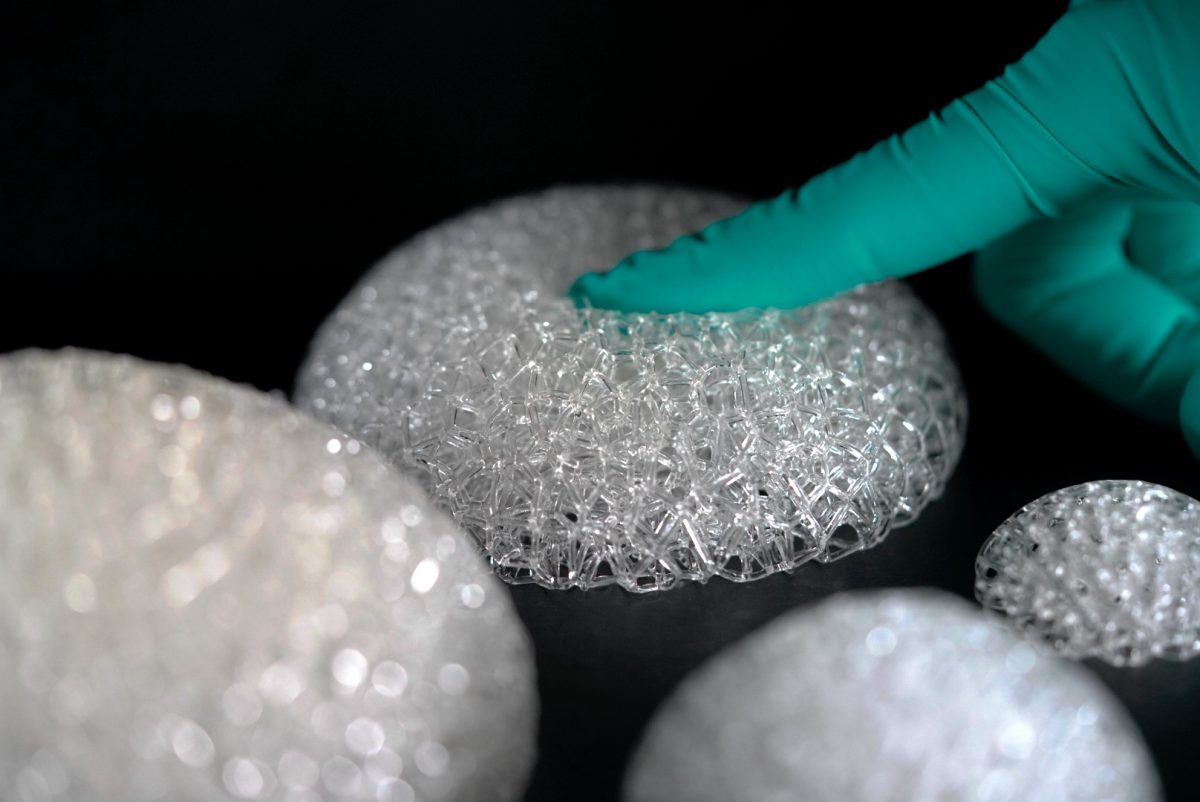
Genesis Tissue’s 3D printed regenerative breast tissue scaffolds are designed in different sizes and shapes to match each patient’s anatomy and support tissue regeneration. Image courtesy of Genesis Tissue.
GenesisTissue’s solution begins after a tumor is removed. A patient-specific scaffold is implanted into the breast and then filled with the patient’s own fat tissue, typically harvested through a small liposuction procedure. The fat contains cells and biological components that help support tissue growth. Over time, the scaffold slowly degrades while new tissue forms in its place.
“We use the body as the bioreactor,” Weimer explained. “We harvest the patient’s fat, which naturally contains stem cells, blood vessel fragments and other cellular components, and inject it into the scaffold. As the scaffold gradually degrades, the tissue grows and stabilizes. The goal is that you’re ultimately left with the patient’s own healthy tissue instead of a permanent foreign implant.”
At the center of the technology is a soft material that provides structure as new tissue forms and then gradually degrades as the body heals.
A Different Kind of Bioprinting Story
Weimer’s path into bioprinting began long before GenesisTissue. A mechanical engineer by training, she spent much of her career helping advance 3D printed medical applications. Along the way, she became interested in tissue engineering and regenerative medicine. That curiosity eventually led her to pursue a PhD in bioengineering at Colorado State University while still working in industry.
“I started working with all of these incredibly smart researchers, and they would start talking about cells and biology, and I realized how much I didn’t know. I thought I was going to take a class or two. But it turned into a PhD.”
Today, GenesisTissue operates out of an incubator at Colorado State University’s Spur campus in Denver, giving the startup access to academic resources and collaborators as it continues development. The transition from corporate executive to startup founder, however, was not always easy.
“There was a point where I was sitting at home trying to negotiate the technology transfer and build the company, and I had no dollars, no job, and no insurance,” Weimer recalled. “Every founder has some version of that story. It’s scary. But now we have this incredible team, and everyone is completely committed to the mission.”
Moving Toward the Clinic
GenesisTissue is currently in the preclinical phase of development and conducting large-animal studies. Like most implantable medical technologies, the product must still move through years of testing and regulatory review before reaching patients.
“It’s a long development pathway. You go through research and development, preclinical studies, clinical studies, and, hopefully, FDA approval. It’s difficult, expensive, and time-consuming. That’s one of the reasons people don’t pursue projects like this.”
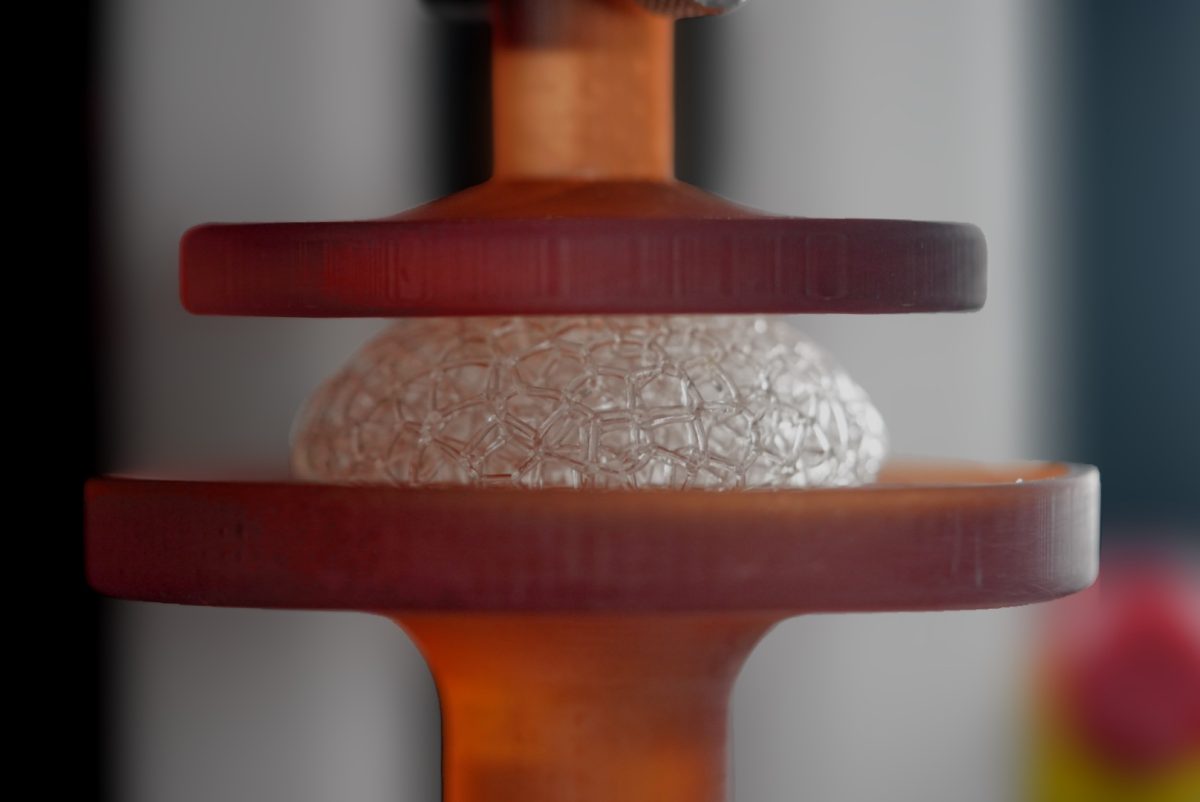
GenesisTissue’s regenerative breast tissue scaffold undergoes compression testing to evaluate its mechanical strength while maintaining the flexibility needed for soft tissue applications. Image courtesy of GenesisTissue.
What’s more, Weimer told me funding remains one of the company’s biggest challenges: “The technical challenge is creating the next generation of biodegradable, implantable soft materials. The business challenge is raising enough money to get through preclinical and clinical development. That’s true for almost every company working in this space.”
Still, Weimer believes regenerative medicine is approaching a turning point. For years, bioprinting has often been linked to printing entire organs for implantation. Of course, those efforts are still ongoing, but she argues that many practical applications are much closer than most people realize.
“What people sometimes miss is that bioprinting is already happening,” she noted. “There is an enormous amount of research, a tremendous amount of investment, and real applications moving toward the clinic. We finally have the tools to create materials that behave more like the human body. That’s what makes this moment different.”
For GenesisTissue, the immediate goal is breast reconstruction. But Weimer sees broader possibilities ahead, like pressure ulcers, traumatic injuries, cosmetic procedures, and other soft-tissue applications that could eventually benefit from the same platform technology.
At this stage, the company is fully focused on its first mission, which is helping women recover from breast cancer with a solution designed to regenerate what was lost rather than simply replace it.
“We’re not doing this to publish a paper; we’re trying to build something that helps people. That’s what keeps us focused every day,” concluded Weimer.
Subscribe to Our Email Newsletter
Stay up-to-date on all the latest news from the 3D printing industry and receive information and offers from third party vendors.
Print Services
Upload your 3D Models and get them printed quickly and efficiently.












You May Also Like
3D Printing News Briefs, August 1st, 2026: Project Calls, Contact Lenses, Chairs, & More
We’re starting with the winners of two America Makes project calls in this first 3D Printing News Briefs of August! Then we’ll move on to AM quality control for aerospace,...
Caracol to Build Large-Format 3D Printing Hub in Milan With Designtech & LAMÁQUINA
In the 1990 classic in economic strategy, The Competitive Advantage of Nations, business theorist Michael Porter wrote, “Most commentators on the Italian economy have persistently underestimated Italy, because they have...
Beyond Thermoplastics: Why JuggerBot Is Betting on Hybrid AM
For years, thermoplastics have been the workhorse of additive manufacturing (AM). They are pretty easy to process, available, and compatible with many of today’s industrial 3D printers. From prototypes to...
3D Printing News Briefs, July 22, 2026: Delisting, Wind Turbine Blades, & More
We’re covering business and energy news in today’s 3D Printing News Briefs. Würth Additive Group has closed its doors, and BigRep delisted from the Frankfurt Stock Exchange. RA Wind received...