Outlaw3D: FBI Director’s 3D Printed Gun Gifts Destroyed in New Zealand


During a visit to New Zealand this July, FBI Director Kash Patel cut the ribbon on the bureau’s first standalone office in Wellington. At the same time, he presented senior law enforcement and intelligence officials with display stands that included 3D printed pistols. While the office opening was publicized, news of the gifts only surfaced later. The gesture quickly turned into a legal issue. New Zealand authorities have since confirmed that, under local law, the gifts were considered restricted firearms and had to be destroyed.
The Gift
When Patel traveled to Wellington, he gave the replicas to three of the country’s top security leaders: Police Commissioner Richard Chambers, Andrew Hampton of the New Zealand Security Intelligence Service (NZSIS), and Andrew Clark of the Government Communications Security Bureau (GCSB).
According to an official report, the plastic pistols were built into “challenge coin” display stands, which are plaques or holders often given in military, law enforcement, and intelligence circles to display commemorative coins. In this case, the stand featured a 3D printed pistol as part of its design. Although described as inoperable by the FBI, New Zealand regulators later “judged the items could potentially be modified to fire.”
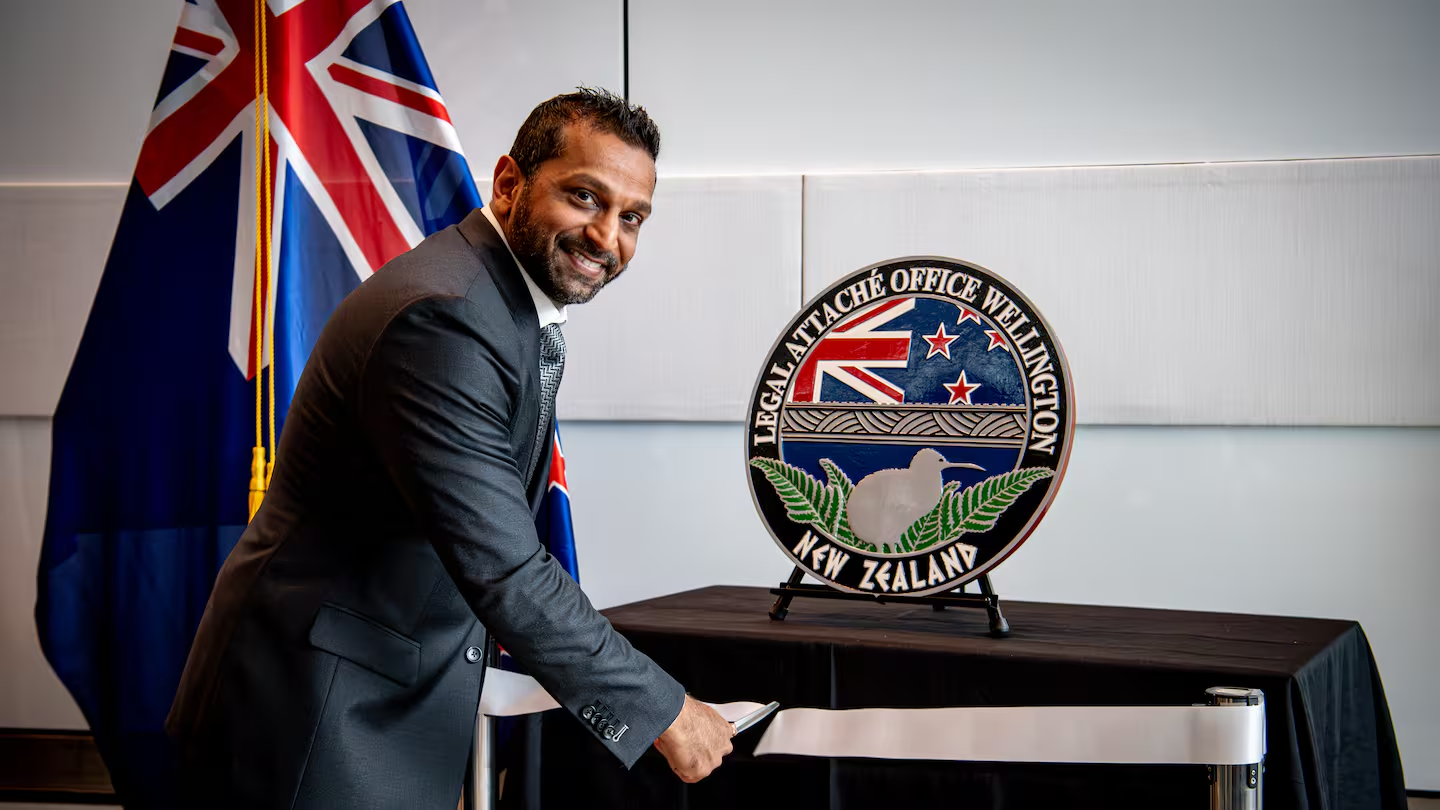
FBI director Kash Patel gifted New Zealand’s Police Commissioner a 3D printed gun in July.
In New Zealand, pistols are tightly controlled. They fall under a special category of firearms that covers handguns with shorter barrels. To legally own one, a person needs more than a standard firearms license. In fact, they must apply for a special permit, meet strict storage requirements, and usually belong to a pistol club.
The law also treats inoperable or replica firearms as though they are real if they could be modified to work. After consulting with the Firearms Safety Authority, Commissioner Chambers ordered the gifts to be retained and destroyed.
“To ensure compliance with firearms laws, I instructed the Police to retain and destroy them,” Chambers said in a statement.
New Zealand’s Gun Laws and 3D Printing
The incident highlights New Zealand’s strict stance on firearms. In fact, gun ownership in New Zealand is considered a privilege, not a right. The country tightened its laws after the 2019 Christchurch mosque shootings, banning many semiautomatic weapons and adding tougher checks and enforcement around gun ownership.
3D printed guns are treated no differently from traditional firearms. If a printed weapon could function or be modified to function, it is illegal to possess it without the appropriate license.
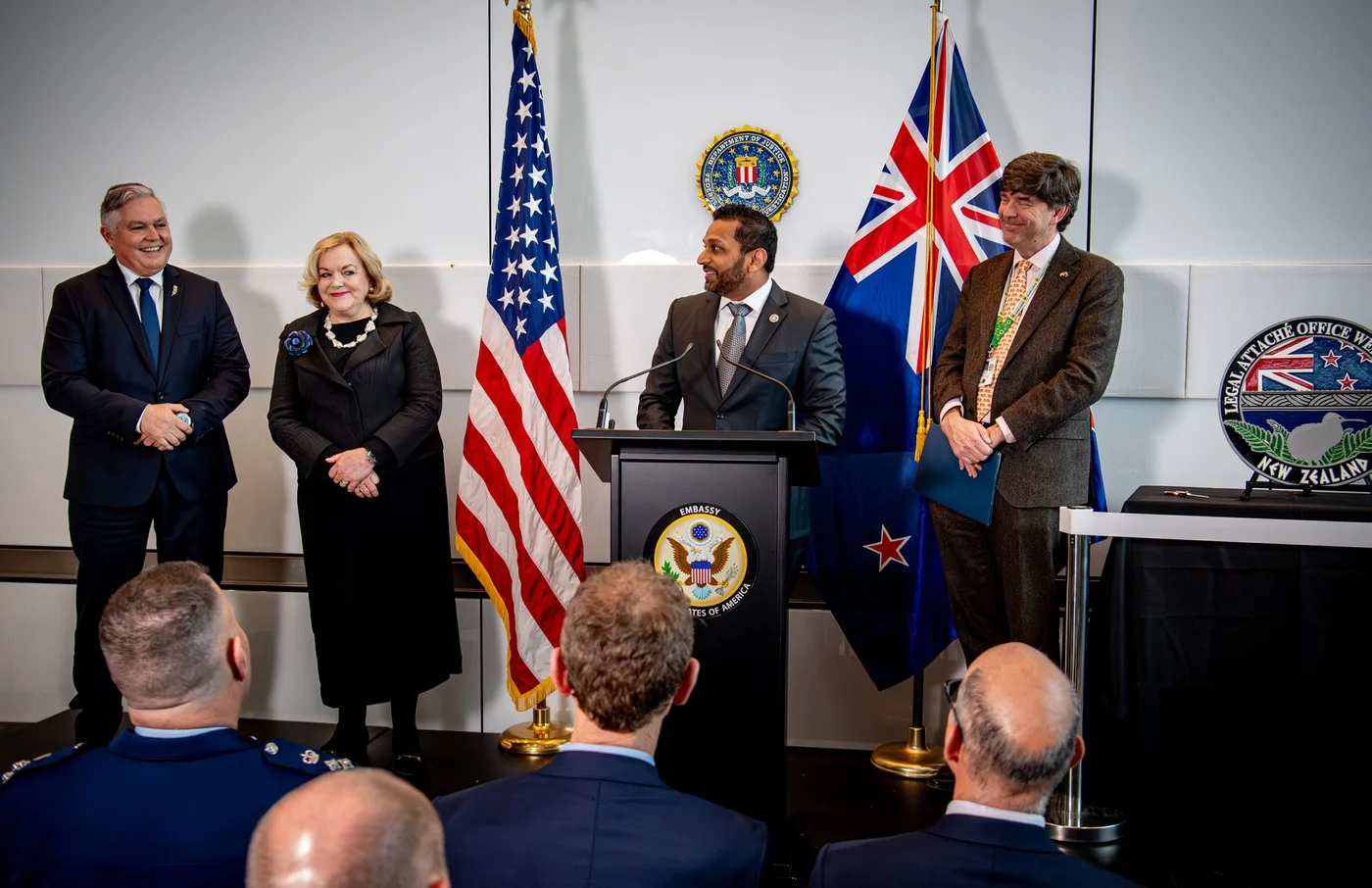
FBI director Kash Patel inaugurates New Zealand.
The gift issue happened during Patel’s visit to formally open the FBI’s new office in Wellington. The FBI described the move as bringing New Zealand in line with its presence in other “Five Eyes” countries, a long-standing intelligence alliance between the United States, the United Kingdom, Canada, Australia, and New Zealand that focuses on sharing signals and security information.
“The FBI has had a strong relationship and collaborated closely with our counterparts in New Zealand for years,” said Director Patel during the opening of the new office last July. “Expanding the Wellington office demonstrates the strength and evolution of our partnership as we continue to work together to address our shared security objectives in the region.”
In other remarks, Patel said the new office would help “counter” the influence of the Chinese Communist Party in the Pacific region. New Zealand officials, however, responded more cautiously by pointing out that the office’s role would be focused on joint work on transnational crimes, including child exploitation and drug smuggling, rather than framing it as a counter-China initiative.
As far as the pistols are concerned, although they were quickly destroyed, the case is a great example of how different national rules on 3D printed weapons can complicate even official exchanges.
Images courtesy of the US Embassy
Subscribe to Our Email Newsletter
Stay up-to-date on all the latest news from the 3D printing industry and receive information and offers from third party vendors.
Print Services
Upload your 3D Models and get them printed quickly and efficiently.













You May Also Like
HeyGears G1 Passes $14M on Kickstarter with Full-Color 3D Printing
HeyGears was started in 2015 and has been making value-driven Vat Polymerization systems for dental and home use. The company is marketing savvy and very driven. Now the firm has...
3D Printing News Briefs, August 26, 2026: Meshy 7, 4D Printed Implants, & More
We’re kicking things off today with software news, as the new Meshy 7 is now live. Then we’ll move on to business, with ExOne and voxeljet now operating as a...
Hi3D V3.0 Launches Industry’s First Commercial 2048³ Ultra-High-Precision AI 3D Model, Free for 48 Hours
Hi3D, the all-in-one AI 3D creation platform, has launched Hi3D V3.0, the industry’s first commercially available AI 3D model with 2048³ voxel resolution. The new version is designed to dramatically...
One Machine, Three Worlds of Creation: Inside the HeyGears G1 Series
Turning a digital idea into a finished full-color physical product often requires several machines, multiple software tools, manual coloring, repeated positioning, and outsourced production. For creators and small businesses, this...