
Chinese Trade Association Report Says China is Evolving from “World’s Factory” to “Global Supply Chain Hub”


The Chinese trade association China Federation of Logistics and Purchasing (CFLP) has released a report detailing the development of China’s supply chain management industry over the last year, according to Chinese news outlet Global Times. The report’s broad assessment is that China is moving away from its longtime status as “the world’s factory floor”, towards a new role as “the global supply chain hub”.
The report doesn’t seem to be available online, and it’s worth keeping in mind that, although the CFLP isn’t a formal government agency, it is a “social organization” representing the Chinese logistics industry — a designation that often implies close alignment with state priorities in China. So it’s in the association’s interests to paint China’s supply chain management activities in a positive light. (In the same way as it’s in the interests of U.S. manufacturing lobbying groups to highlight the challenges U.S. manufacturers are facing, thereby driving support for reshoring.)

Formnext Asia Shenzhen. Image courtesy of Sangmin Lee.
Even with that caveat, though, it’s noteworthy in itself that the CFLP views a trajectory of “factory floor to supply chain hub” as the goal that the nation is working towards, and as a development to be celebrated. Moreover, the overall finding tracks with what analysts of the additive manufacturing (AM) industry have observed over the last couple of years, regarding the Chinese market.
Most recently, for instance, Sangmin Lee, co-founder and CEO of WeeklyVentures, and frequent 3DPrint.com contributor, wrote in an article about Formnext Asia 2025, “China’s strategy extends beyond manufacturing to complete supply chain control. The localization push represents systematic independence building, not just cost reduction. …
“The revolution won’t be 3D printed in exotic materials using breakthrough physics. It’ll be manufactured overnight in standard polymers and metals, delivered on time, at prices that make sense. China’s betting the future of [AM] looks less like science fiction and more like regular business.”
Compare that to what the Global Times article on the CFLP report notes:
“…Chinese enterprises are currently moving from ‘product exports’ and ‘capacity exports’ toward a new stage of ‘industrial and supply chain exports’ with different manufacturing clusters cooperating […] to build overseas ecosystems.”
Additionally, and unsurprisingly, Global Times says the CFLP report focuses on “AI + Supply Chain” as a development of the “major industrial transformation trend”. The report found that the Chinese supply chain management industry has accelerated in its AI adoption progress over the last year, and is “becoming deeply integrated into many supply chain scenarios, including new products R&D, logistics, procurement management, and supplier management…”
Again, while it’s important not to lose sight of the fact that there is an angle of geostrategic competition coloring more or less everything that major U.S. and Chinese stakeholders say about manufacturing — and even more so about AI — Lee’s observations from Formnext Asia reinforce that aspect of the CFLP report, as well:
”Tripo AI demonstrates China’s integration of digital and physical manufacturing. With 3 million developers and 40,000 corporate clients generating 40 million models, they’ve reduced design barriers to minutes. Users upload photos or type descriptions; Tripo generates print-ready 3D models—no CAD skills required.
“The platform has already integrated with major players, including Creality, Anycubic, and gaming giants like Tencent Games, which embed Tripo’s API into their platforms. Customers generate assets that are uploaded to their own profiles, creating a B2B2C model that enables mass customization at an unprecedented scale.”
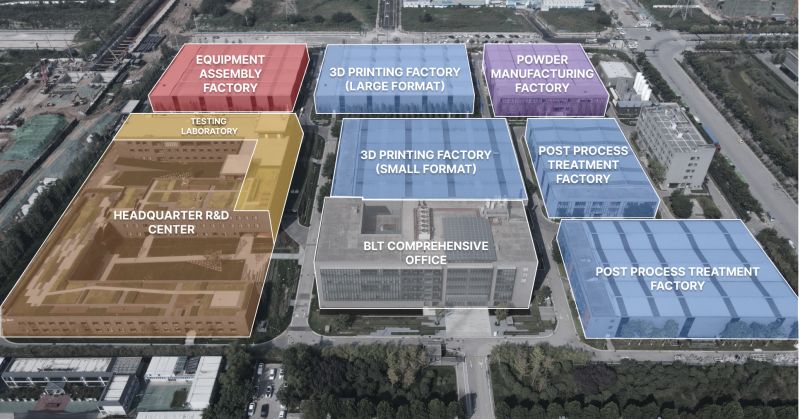
Xi’an BLT’s giant headquarters, posted on LinkedIn in 2024. Image courtesy of BLT
From a macro perspective, perhaps the most interesting tidbit from Global Times’ relay of the CFLP report involves the rapidly expanding geographic distribution of Chinese industry: “A total of 80 national-level advanced manufacturing clusters are now scattered across China, including high-end equipment making and new energy production chain, with high-end equipment clusters accounting for 36.25 percent…”
About two years ago, China’s State Council adopted a policy “accelerating the development of advanced manufacturing clusters”, with a major feature of that policy being a focus on producing “higher-end” products. At least according to the CFLP report, then, China’s industrial policy is succeeding at what is arguably its highest priority.
For those whose businesses depend primarily on Western markets, there’s no point in continuing to whine about Chinese state support of its domestic industries. Complaining alone won’t change anything, and even if those concerns were heard, they would only matter if backed by policies that mirror China’s approach. As I noted in my post from a few weeks ago about MMX, the U.S., for one, is in its current predicament because it dropped the ball by neglecting industrial policy for a generation.
In reality, that’s not entirely accurate: the U.S. did have an industrial policy between around 1990 and 2020. It was effectively the Defense Appropriations Act, which functioned as a de facto industrial policy, and its annual failures are largely responsible for the U.S.’s current scramble to play catch-up.
At this point, Americans are so far-removed from knowing what it looks and feels like to live in a manufacturing nation that we have little choice but to emulate the Chinese, anyhow. In that sense, however tough the information may be to swallow, U.S. manufacturers should be grateful for every bit of insight they can get into China’s industry progress.
Featured image courtesy of CCTV News via Global Times
Subscribe to Our Email Newsletter
Stay up-to-date on all the latest news from the 3D printing industry and receive information and offers from third party vendors.
Print Services
Upload your 3D Models and get them printed quickly and efficiently.












You May Also Like
50,000 Orders and Counting: EPlus3D & Chinese AM Services Provider Are Scaling Liquid Cooling Solutions for AI Servers
An under-appreciated story driving the additive manufacturing (AM) industry this year has been the divergence between what’s driving the market in China and what’s driving it everywhere else. Let’s start...
Additive Manufacturing Has a Major Growth Opportunity; Trust Will Decide Who Captures It
After years of overpromising, the next phase of AM growth will be won by companies that consistently deliver what they say. When I entered additive manufacturing in 2014, after 15...
Seven Trends Reveal What’s Next for 3D Printing at TCT Shenzhen 2026
TCT Shenzhen 2026 opened on October 14 in Hall 15 of the Shenzhen World Exhibition & Convention Center in Bao’an, and ran through October 16. The event brought together equipment...
AM Investment Strategies 2026 Sets the Stage for AMS 2027
AM Investment Strategies 2026 Nov. 5 · 12 p.m. ET · Free online event RESERVE YOUR SPOT ↗ A one-hour online discussion featuring some of the biggest names in 3D...


























































