To Dissolve or Not to Dissolve: The Power of Soluble Supports in FDM Printing


Disclosure: The PrusaXL used for this review was provided to me by Prusa free of charge, and I have not received any other compensation. All opinions expressed are my own, and Prusa has had no influence on the content of this review.
-
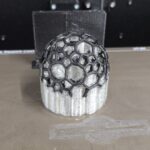
- PA12 Voronoi Sphere in PVA Supports
-
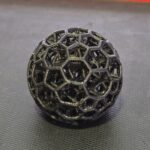
- PA12 Voronoi Sphere
To Dissolve or Not to Dissolve
Why do industry-leading FDM printers, like those from Stratasys, consistently feature dual print heads? The secret lies in one game-changing innovation: soluble support material. This technology is a cornerstone of industrial 3D printing, enabling unparalleled precision and complexity. But what makes soluble supports so special, and why do they outshine traditional breakaway supports? Let’s dive into the world of soluble supports and explore why they’re a must-have for cutting-edge 3D printing.
What Are Soluble Supports?
Soluble support materials are engineered to bond seamlessly with the primary material of your print while being removable through a simple chemical process — typically by soaking in water or a mild base solution. Unlike traditional breakaway supports, which require manual removal and can leave behind imperfections, soluble supports dissolve entirely, leaving your model pristine. This unique property makes them ideal for printing intricate designs with tight tolerances, where a 0.00mm clearance or gap between the model and support ensures flawless dimensional accuracy.
-

- Gyroid Cube Printed in PA12
-
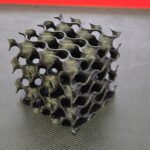
- Voronoi Cube Printed PA12
The Flexibility Advantage
Imagine printing a model with intricate overhangs, delicate internal structures, or complex geometries that would be impossible to support with traditional methods. Soluble supports make this a reality. Their defining feature is near-infinite flexibility — they can support virtually any model, no matter how complex, without requiring clearance between the support and the part. This 0.00mm clearance allows supports to hug every contour of your model, ensuring precise dimensional accuracy while maintaining structural integrity during printing.
Once the print is complete, simply immerse the part in a solution (often just water for materials like PVA). After a few hours, the supports dissolve completely, leaving behind a clean, flawless model. No prying, no cutting, no risk of damaging delicate features. For high-temperature materials, such as advanced polymers, stronger base solutions may be needed to dissolve tougher supports. Yet, the model material remains unaffected, retaining its strength and intricate details.
Unlocking Complexity with Soluble Supports
Soluble supports shine when complexity is non-negotiable. Whether you’re crafting aerospace components with intricate internal channels or artistic sculptures with delicate overhangs, soluble supports ensure every detail is preserved. As long as the model can maintain its structure during printing, soluble supports can handle the rest. With a 0.00mm clearance, they provide perfect support without compromising the model’s geometry, resulting in parts that meet exact specifications every time.
Take it from personal experience: since upgrading to a Prusa XL, I’ve relied on PVA (polyvinyl alcohol) as my go-to support material. Paired with a variety of model materials, PVA dissolves effortlessly in water within hours. This has enabled me to produce models of staggering complexity — designs that would be nearly impossible with traditional breakaway supports or single-material FDM printers. The ability to achieve perfect dimensional accuracy with zero clearance has been a game-changer for my projects.
-
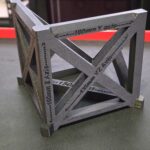
- Printer Skew Test
-
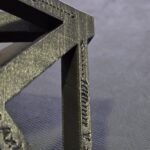
- Printer skew Test Clean Underside
Breakaway Supports: A Simpler Alternative?
For less complex models, multi-material printers offer an alternative: dissimilar breakaway supports. By printing with two materials that don’t chemically bond — like PLA and PETG — you can create supports that are relatively easy to remove. For example, PLA can serve as the model material with PETG as the support, or vice versa. These materials separate cleanly, making them a solid choice for simpler geometries.
However, breakaway supports come with a catch. You must manually remove them, which can range from tedious to outright impossible for intricate designs. Unlike soluble supports, which dissolve uniformly even in hard-to-reach areas, breakaway supports require physical access to every supported region. This can lead to damaged parts or incomplete support removal, especially in models with tight internal structures. Additionally, breakaway supports often require a small gap to facilitate removal, which can slightly compromise dimensional accuracy compared to the 0.00mm clearance offered by soluble supports.
Why Soluble Supports Reign Supreme
Soluble supports are the gold standard for industrial 3D printing because they combine precision, flexibility, and ease of use. Their ability to support complex geometries with zero clearance ensures unmatched dimensional accuracy, while their dissolvable nature eliminates the risks and labor associated with manually removing support. Whether you’re a hobbyist pushing the boundaries of design or an industrial user crafting high-performance parts, soluble supports unlock possibilities that breakaway supports simply can’t match.
So, the next time you’re planning a print, ask yourself: To dissolve or not to dissolve? For precision, complexity, and ease, the answer is clear—soluble supports are the way to go.
-
- PA12 Voronoi Sphere in PVA Supports
-
- Gyroid Cube Printed in PA12
-
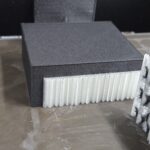
- Gross Exaggeration of Flat Overhang
All images courtesy of Orville Wright
Subscribe to Our Email Newsletter
Stay up-to-date on all the latest news from the 3D printing industry and receive information and offers from third party vendors.
Print Services
Upload your 3D Models and get them printed quickly and efficiently.













You May Also Like
3D Printing News Briefs, September 12, 2026: Rebranding, Cybersecurity, Project Call, & More
We’ve got a lot of business news from ATLIX to start off this weekend’s 3D Printing News Briefs, with a new identify for its additive manufacturing (AM) portfolio and some...
Apple’s 3D Printed Hinge Cover & the Inauguration of the Ternus Era
Marc Andreessen notwithstanding, it turns out that hardware is, in fact, eating the world. Perhaps after being starved for so long, the hardware side of tech innovation is now overcompensating,...
3D Printing News Briefs, September 10, 2026: Tax Credits, Polymer Research, Microneedles, & More
We’re starting off this week’s 3D Printing News Briefs with a little business from Axtra3D and Beehive Industries, before moving on to a scientific collaboration agreement between Roboze and a...
IperionX Gets $11.5M Army Boost to Make Titanium Fasteners in the U.S.
IperionX is going to get another $11.5 million, potentially up to $25.4 million, of an existing SBIR Phase III with the Army (Task Order W911QX26FA097). The award covers low-cost titanium...