Space 2025: Arkisys CEO David Barnhart Talks the Future of Space Industry Growth


The space industry is changing fast, driven by growing investment, big government plans, a surge of 3D printing innovations from private companies, and the critical role of sustainable space infrastructure. At the center of this dynamic landscape is David Barnhart, CEO and co-founder of Arkisys, who shared his thoughts on the opportunities and challenges shaping the sector in 2025 and beyond.
Barnhart, whose company specializes in modular spaceports and autonomous in-orbit servicing platforms, said he is optimistic about the industry.
“The amount of funding that has gone into the industry in general has continued to increase, which is good. This upward trend, coupled with the renewed focus on space by the incoming Trump administration, signals what I believe will be a prolific era for commercial space activity,” he told 3DPrint.com.

David Barnhart, CEO of Arkisys. Image courtesy of Arkisys.
New Government Push for Space
The Trump administration’s return to office promises to focus on space exploration and commercialization. Plans include ambitious goals such as sending astronauts to Mars and creating a “Space National Guard” to expand the U.S. Space Force. These policies, alongside ongoing partnerships with private companies like SpaceX, aim to open doors for new players in the commercial space sector.
Barnhart sees this as a chance to enable more government-invested space technologies into the domain of commercial space. Having an advocate close to the administration pushing space could mean more opportunities for the commercial sector and faster progress on key initiatives. “The hope is a big wave will lift all boats, and advocacy for space will translate to multiple companies,” Barnhart explained.
In addition, 3D printing plays a vital role in this evolving landscape. Early indicators suggest that the new administration recognizes the potential of additive manufacturing, particularly for producing cost-efficient components for rockets and satellites. This recognition enables innovations in microgravity manufacturing, which boosts the new markets in space servicing.
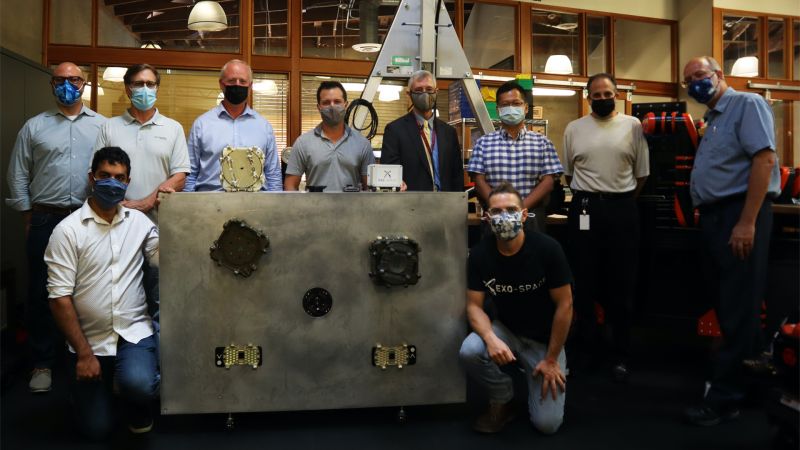
Arkisys unveils its first generation orbital outpost spacecraft element, the Port Module Wedge. Image courtesy of Arkisys.
During Trump’s first term, his administration showed an interest in advanced manufacturing technologies, including 3D printing, through initiatives like Space Policy Directive 1, which highlighted public-private partnerships to accelerate lunar and Martian exploration. Building on this foundation, the renewed focus on space opens new doors for developing advanced infrastructure and technologies to support ambitious space missions, including long-term plans for lunar and Martian exploration.
The U.S. government has actively invested in these technologies to enhance the space industry’s capabilities. In the realm of space exploration, 3D printing has shown plenty of potential. NASA’s experiments indicate that 3D printers can function effectively in microgravity, paving the way for new logistics systems for long-duration missions. Additionally, the agency is exploring the use of 3D printing for constructing habitats on the Moon and Mars and looking to use on-site materials to build structures.
The Next Frontier
For Arkisys, 3D printing is more than a tool for prototyping; it’s central to its vision for the future of space operations. Barnhart noted that the company is already integrating 3D printed components into its “Cutter,” a last-mile transport vehicle designed to dock with Arkisys’ modular spaceports.
“We’ve gone to two different 3D printing companies to support internal joints and external structures for the Cutter,” he explained.
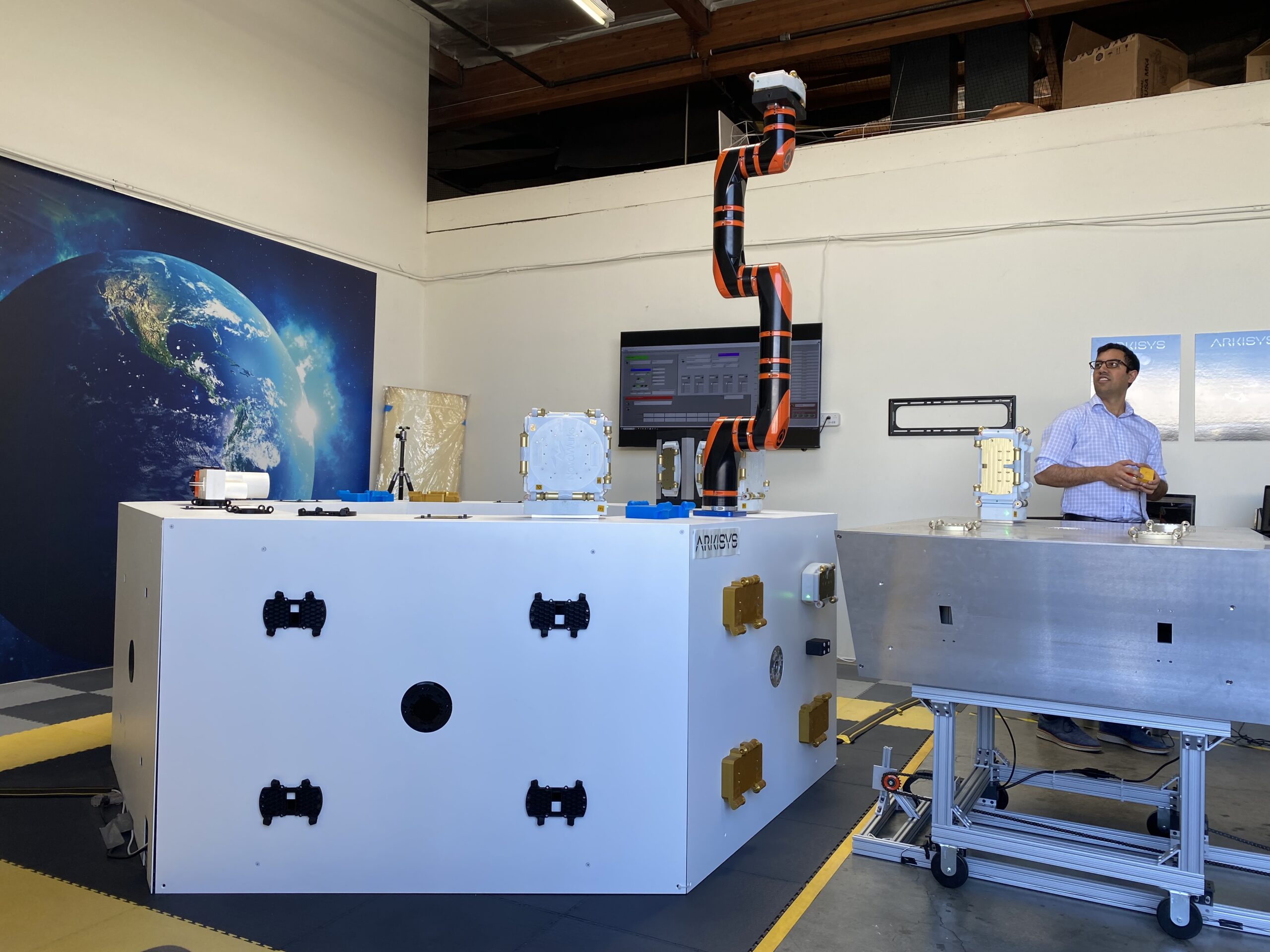
Arkisys hosted SpaceWERX and other Government and industry representatives at a ground demo to demonstrate the capability of their Port Module 1G testbed. Image courtesy of Arkisys via X.
But it’s not just about Earth-based 3D printing. Arkisys is laying the groundwork for additive manufacturing in space. “We have several companies interested in some level of 3D creation on orbit,” Barnhart said. “This includes structural components, hybrid manufacturing methods, and even biological applications. The idea of creating components in orbit, bypassing the complexities of launching fully assembled systems from Earth and leveraging microgravity, could revolutionize space logistics.”
One of Arkisys’ long-term goals is to bring a 3D printer to space, democratizing the process by allowing multiple companies to use it as an on-orbit “printing service.” Barnhart envisions this as a step toward opening up space innovation to more players, saying, “3D printing represents the democratization of creating new things.”
Solving Space’s Throwaway Culture
Barnhart was particularly passionate about the need for sustainability in space. He said there is currently a “throwaway culture” in satellite use, where today’s systems are designed for a single mission and life and then abandoned.
“Every satellite that goes up has one life, one mission, and then it’s gone because that’s how it’s designed. We’re not going to grow the trillion-dollar, off-world industry by doing that. Everything we’re doing, from the Cutter to the Port Module, is meant to be a reusable spacecraft that has no shelf life.”
Arkisys’ solution of a reusable infrastructure includes a spacecraft architecture (Port Modules and Cutters) designed for longevity, with the ability to be upgraded, serviced, maintained, and reused over multiple missions.

Arkisys David Barnhart and Argo Space signed a deal to host their refueling interface technology on the first Arkisys Port Module. Image courtesy of Arkisys via LinkedIn.
Barnhart compared this to harbors on Earth that hold nautical ports only in space; both thrive by supporting a variety of activities and players without the need for constant replacements.
What’s more, the need for sustainability ties into a broader issue: the growing problem of space debris. With plans to launch tens of thousands of satellites in the coming years, Barnhart stressed the importance of proactive measures.
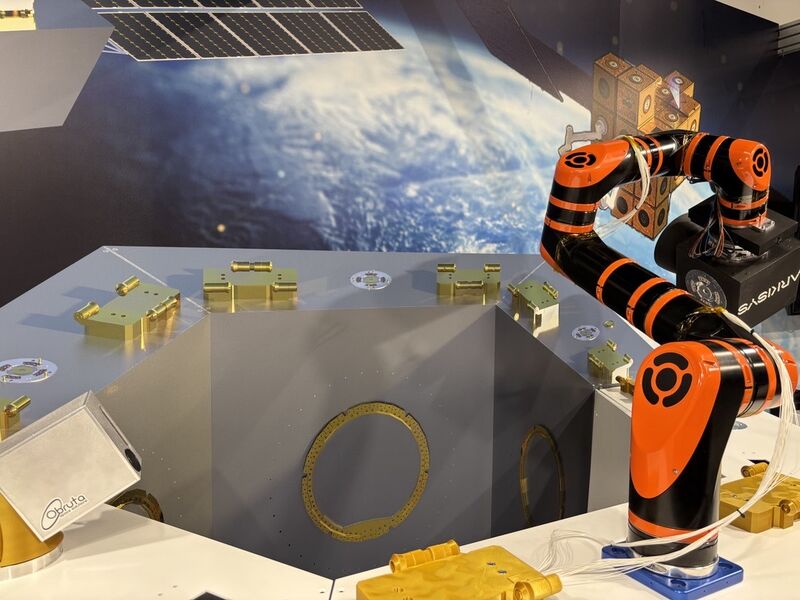
The RPOD kit in action on the Arkisys Port Module. Image courtesy of Arkisys via LinkedIn.
“We’re literally talking about 30,000 to 40,000 new space systems whizzing past each other,” Barnhart said. “The probability that something will happen just goes up. It’s critical to think about solutions, especially with multiple countries and companies planning to do the same thing. The throwaway culture of satellites won’t help; we need reusable platforms and smarter orbital management to address this growing issue.”
A Prolific Era for Space?
Founded in 2014, Arkisys’ focus on autonomous systems is one of its key differentiators. Barnhart described his company’s approach as bridging the gap between fully human-rated systems, like the International Space Station, and disposable satellites. Their platforms are designed to operate autonomously, reducing costs and risks associated with human presence in space.
The timeline for Arkisys’ vision is moving quickly. “This year, we’re pushing hard to get the first Cutter craft up,” Barnhart said, referring to the last-mile transport vehicle critical to their Port Module operations. “This mission will validate key technologies, software, and operational processes. The plan would be to get the first Port Module up in two years, the rendezvous the Cutter on orbit to validate the goal of deploying a fully functional spaceport in orbit.”
The company has built a full-scale, one-to-one Port Module and Cutter prototype for ground testing, complete with robotic arms and digital twins to simulate autonomous operations. Barnhart explained that this level of autonomy is critical for long-duration missions and future applications around the Moon and Mars, especially when human oversight isn’t practical.
“You need systems that can connect, adapt, and be trusted to make the right decisions,” he said. “Right now, the ISS relies on a full-time operations center to manage systems and ensure safety. But future platforms, like those being developed by Arkisys, Axiom, Above Space and others, will need to operate with minimal human intervention. The challenge lies in finding the balance between autonomy and reliability, ensuring these systems can handle complex tasks without constant ground support.”
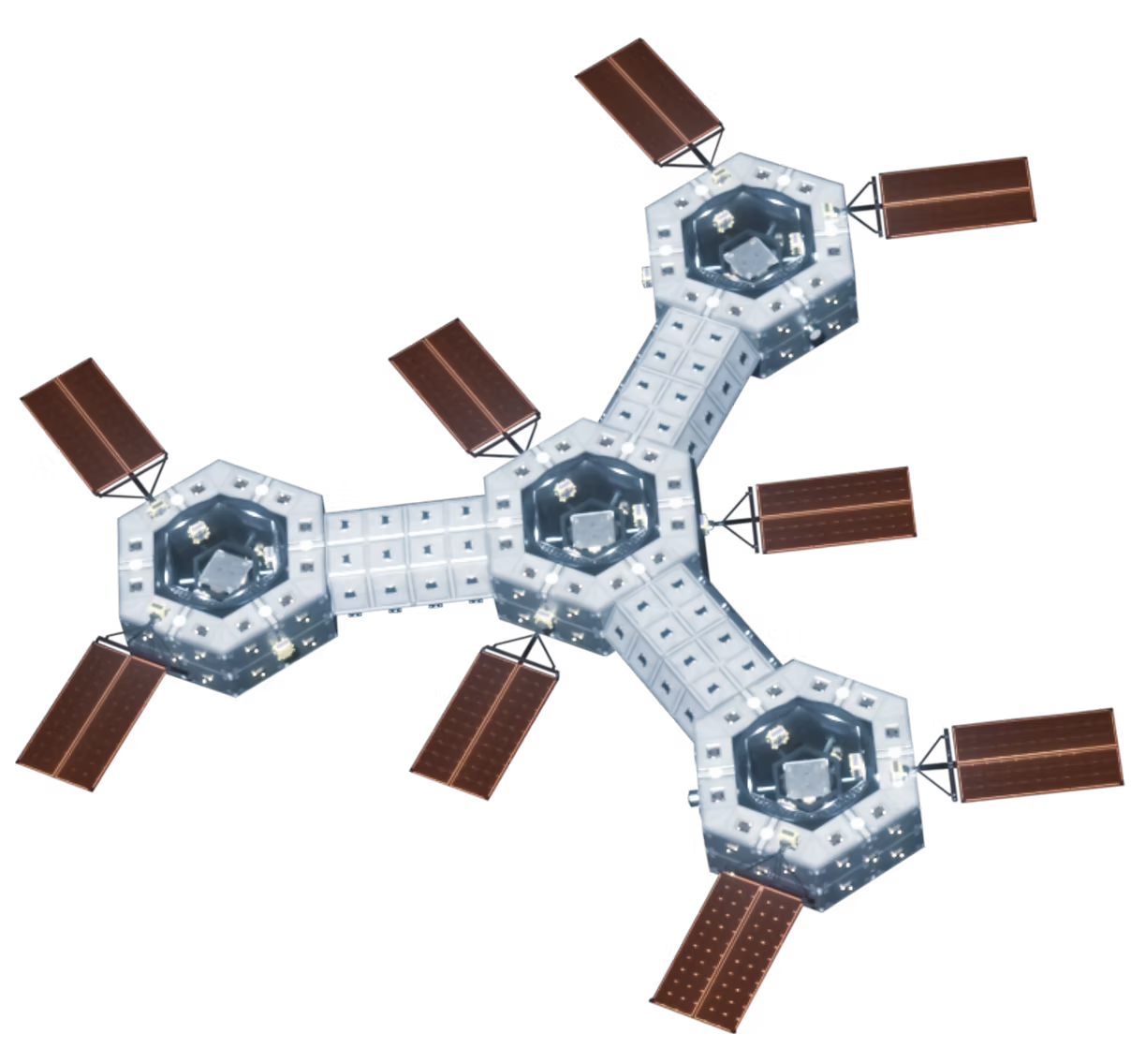
Arkisys space Port Module rendering. Image courtesy of Arkisys.
As Barnhart looks ahead, he says he is optimistic about the future of the space industry. He believes investment will continue to grow, fueled by government support and private-sector innovation. Arkisys, with its focus on reusable infrastructure and cutting-edge technologies like 3D printing, is well-positioned to lead the charge.
“If the general trend continues, the trajectory is positive. The excitement and hope is that this momentum will continue to grow, and we’ll be ready to ride that wave. With ambitious plans from Arkisys and the government, the next few years could mark a transformative space exploration and commercialization era,” concluded Barnhart.
Subscribe to Our Email Newsletter
Stay up-to-date on all the latest news from the 3D printing industry and receive information and offers from third party vendors.
Print Services
Upload your 3D Models and get them printed quickly and efficiently.













You May Also Like
3D Printing News Briefs, October 21, 2026: Digital Twins, AI CAD Service, AR Smart Glasses, & More
In today’s 3D Printing News Briefs, America Makes announced the winners of its MIAMI Project Call, and AM Europe released a new report. Artec 3D launched its new Artec Twins...
3D Printing News Briefs: October 17, 2026: Affordable Housing, Bone Implants, Rubber Gloves, & More
In this weekend’s 3D Printing News Briefs, we’re starting off with quality assurance in metal additive manufacturing (AM), a new 3D printer, and 3D printed housing. We’ll finish up with...
3D Printing News Briefs, October 14, 2026: Bolus, Aerospace Tooling, Water Filter, & More
In today’s 3D Printing News Briefs, we’re starting with medical news, as Myrava has received FDA 510(k) clearance for its 3D printed bolus. Moving on to aerospace and metals, AML3D...
Can India’s AM Push Help Make it a Viable Supplement to China?
Diversifying manufacturing supply chains to locales outside of China has nothing to do with actually cultivating “substitutes” to the Chinese economy. The real stakes are these: China is an irreplaceable...