Moving Beyond the Hypothetical: the Role 3D Printing Should Play in US Reshoring

Barely two months into President Trump’s second term, it’s already cliché to point out that chaos is the only constant thread running through all of the new administration’s policies. (Indeed, it had already been a cliché to point this out during Trump’s first term.) And chaos is most constant when it comes to the trade policies of Trump 2.0.
Now that we can all agree that chaos is the prevailing law of the land, the more interesting question — as any Freemason will tell you — becomes: what order, if any, will emerge from this chaos? Here, we at least have some indication from the administration as to what methods lie behind all its madness:
For instance, in response to a question from Fortune about a research note by Wedbush analyst Dan Ives claiming that Trump’s auto tariffs could cost US consumers up to $100 billion, the White House deputy press secretary, Kush Desai, commented, “America cannot just be an assembler of foreign-made parts—we must become a manufacturing powerhouse that dominates every step of the supply chain of industries that are critical for our national security and economic interests.”
Now, as I wrote recently about a characteristic mainstream media discussion that took place on “Real Time with Bill Maher” concerning the reshoring vision that the Trump administration is pushing, it is indeed fair to ask if the idea of “bringing manufacturing back to the US” isn’t just nostalgia for a past that’s never coming back. Other commenters have made more or less the same point that was made on “Real Time”, while a widely shared op-ed in the Los Angeles Times even went so far as to say that American manufacturing is “alive and stronger than ever”.
All of this commentary has its merits, while at the same time, ultimately, missing the mark. As I wrote in my post about “Real Time”, it should fall to voices from the US manufacturing sector to make the case for what a US industrial order that is truly new — not a historical relic — will look like.
Fortuitously, one of the most insightful voices in the additive manufacturing (AM) industry, Seurat’s Chief Product Officer, Michael Kenworthy, has made a crucial contribution to this discourse with a post entitled, “Fungible Capacity: The Key to Resilient Manufacturing for the Health and Safety of our Nation”. Virtually everyone in the AM industry has become familiar with the concept of “agile production”, a manufacturing enterprise’s ability to shift gears as quickly as possible to meet a business environment’s changing demands.
Fungible capacity refines the idea and pushes it to its limits, and does so in a way perfectly suited for the emerging business environment of the second Trump administration:
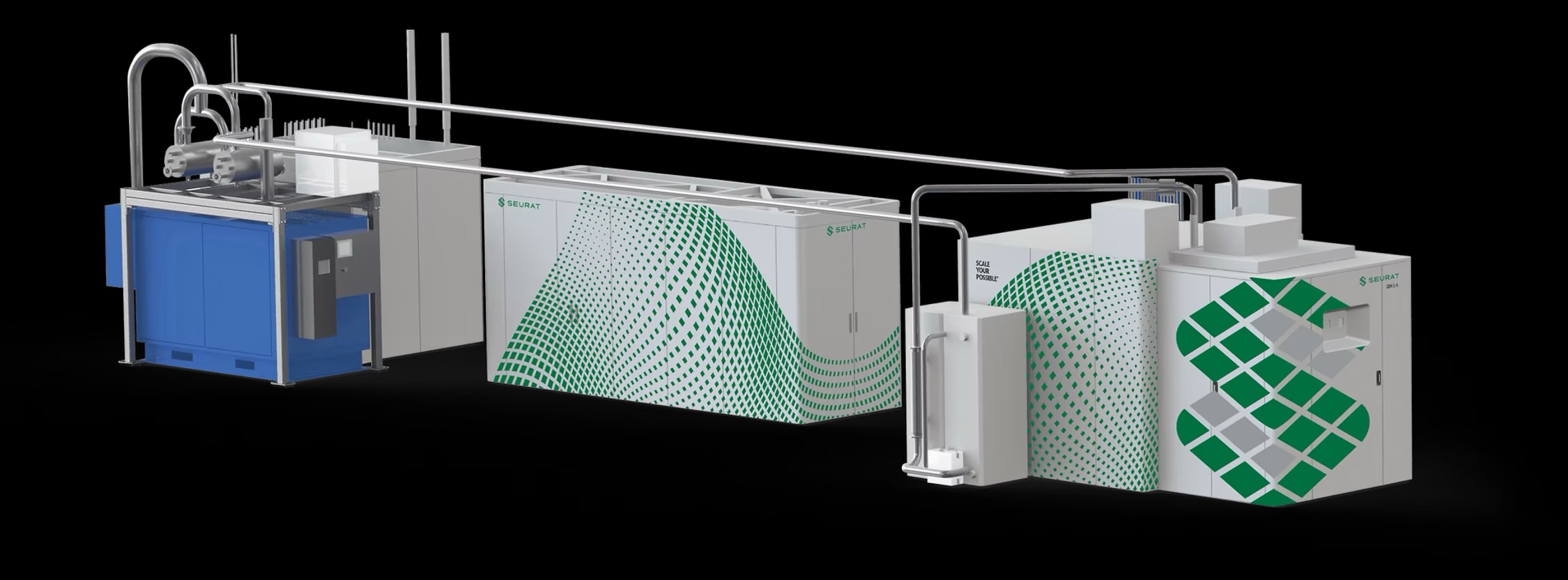
According to Kenworthy, fungible manufacturing capacity is “the ability to flexibly shift production to meet demand without costly retooling, supply bottlenecks, or long lead times”. Kenworthy explains fungible capacity in the context of Seurat’s proprietary Area Printing technology: “Seurat’s factories have unique capability to satisfy, at industrially relevant volumes, commercial needs like semiconductor manufacturing equipment or automotive components during the day and seamlessly respond to a defense demand signal and surge produce missile or drone components overnight.”
Not only is this the most proper approach to fitting AM within the broader US manufacturing landscape as printed parts at scale (and especially, printed metal parts at scale) become more commonplace, but it is also the beginning of the answer to why the reshoring of lost US manufacturing capacity is both necessary, as well as why it is a desirable outcome for the future of the US economy. As Kenworthy notes, “…[AM] isn’t just about making supply chains more resilient, it’s also about unleashing innovation.”
The future of manufacturing in the US isn’t about regaining the ability to produce the most things, whatever those things happen to be. It is about focusing on the highest-value products, while continuing to maximize productivity into the next generations, and simultaneously, making it the highest priority to nurture the innovative spirit of the newcomers to the manufacturing sector.
In this sense, while competing with China is certainly a part of the equation, it cannot be the whole story, or even the main theme of the story. Instead, the story has to be about resurrecting the optimism and sense of self-worth associated with making real things, not just in the US, but everywhere. To the extent that all of this is about competing with China, it’s not a competition for supremacy over the world’s power structures — much more so, it should be a competition to see who can effectively approach all of the world’s many problems with the most creativity.
Along those lines, there is a nice symbolism here to the fact that a deep-tech, high science firm like Seurat is named after a master of the fine arts. We have entered a no-man’s land era in which experimentalism, risk-taking, and learning by failing will all be skills just as prized as doing things “by the book” and following instructions.
Thus, we don’t know exactly what the next century of US manufacturing will look like — and that is precisely the point, to the extent that there is one point, of the chaos the Trump administration is unleashing. We are all going to find out together as the story unfolds. The versatile potential associated with AM-enabled fungible capacity can help ensure that we are prepared for as many different scenarios as possible, and empowered to solve as many of the problems that arise as we can.
Images courtesy of Seurat Technologies
Subscribe to Our Email Newsletter
Stay up-to-date on all the latest news from the 3D printing industry and receive information and offers from third party vendors.
Print Services
Upload your 3D Models and get them printed quickly and efficiently.













You May Also Like
AI Design and Point-of-Care Integration Headline ADDITIV Medical 2026
Medical additive manufacturing is expanding rapidly inside major healthcare institutions. In 2026 alone, hospital systems including Indiana University Health and Sheffield Teaching Hospitals launched dedicated point-of-care 3D printing facilities to...
GKN Aerospace’s UAV Demonstrator with 3D Printed Engine Avoids ITAR Regulations
The US CIA director recently made an unannounced visit to Moscow that has naturally raised much speculation, while the EU and NATO have now officially accused Russia of being behind...
The Business Case for 3D Printed Stents
A new 3D printed stent developed at New York University (NYU) does not look like the devices doctors typically use today. Instead of a simple tube, the prototype resembles a...
3D Printing Financials: 3D Systems, Prodways, and Align Build on Positive Momentum
The latest earnings from 3D Systems (NYSE: DDD), Prodways (EPA: ALPWG), and Align Technology (Nasdaq: ALGN) show that the 3D printing market continues to move forward. Some businesses are growing...