Made-in-America Rugged 3D Printer Launched by Chicago Additive, Backed by NAVWAR

Chicago Additive, an end-to-end additive manufacturing (AM) solutions company based in Northwest Indiana, has announced the pre-launch of its AMOS 3D printer. This ruggedized FDM desktop printer was originally developed by a team at the Naval Information Warfare Center (NIWC) Pacific in San Diego. In March 2025, the Department of the Navy leased a co-exclusive patent license, “Advanced Manufacturing Operational Apparatus, System, and Method”, to Chicago Additive, enabling the company to begin producing the AMOS at its two dedicated manufacturing facilities in Indiana.
Chicago Additive was founded in 2024 as a spin-out from Project R3D, a company that similarly offers consulting services in addition to producing two lines of no-frills, high-speed desktop and large-format 3D printers. Chicago Additive collaborated with NIWC Pacific on the R&D that led up to the commercialization of the AMOS line, which currently includes three models: AMOS 200, 300, and 500.
According to the company, via its two Indiana facilities, it’s currently capable of producing 2,500 AMOS units annually. Chicago Additive has begun making the AMOS 300 and will send out the first test units to select customers in the first two weeks after launch, with fulfillment of initial orders anticipated to start as soon as the first week of June. The company plans to release the AMOS 200 and AMOS 500 by next quarter.
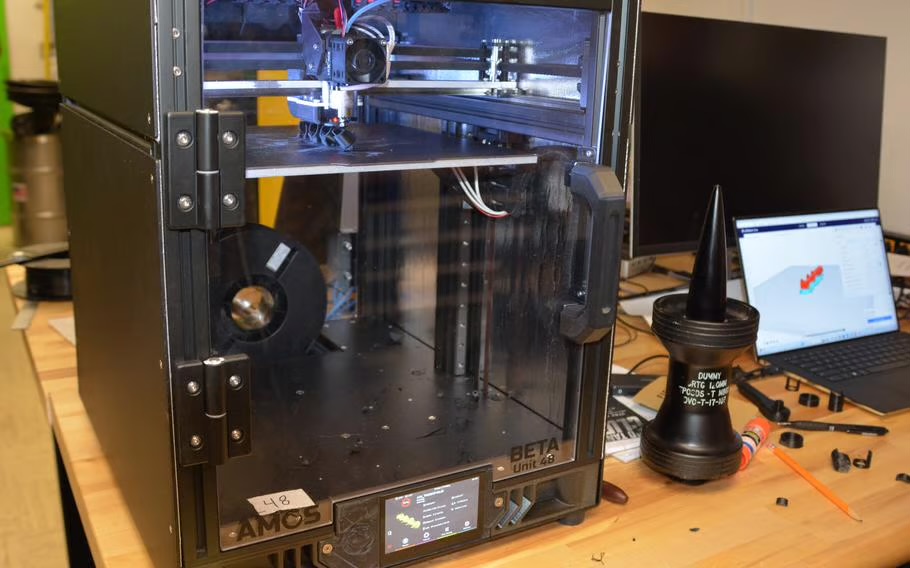
AMOS desktop 3D printer in action.
In a press release about Chicago Additive’s commercial launch of the AMOS line of ruggedized desktop 3D printers, the company’s founder, Joseph Podgorski, said, “After 19 months of collaboration with Spencer [from NIWC Pacific], we’re ready to put the AMOS into the hands of those who need it. I want to thank everyone at NIWC Pacific who helped shape the AMOS into what it is today, as well as the tech transition team for making the licensing process as smooth as possible.”
In a LinkedIn post from the end of last year, the machine’s inventor, NIWC Pacific Technical Project Manager Spencer Koroly, said, “…time to print is critical to accelerating innovating by allowing creators to rapidly cycle through ideas. Designing AMOS to be an extremely fast turn key 3D printers was a goal of mine from the start.”
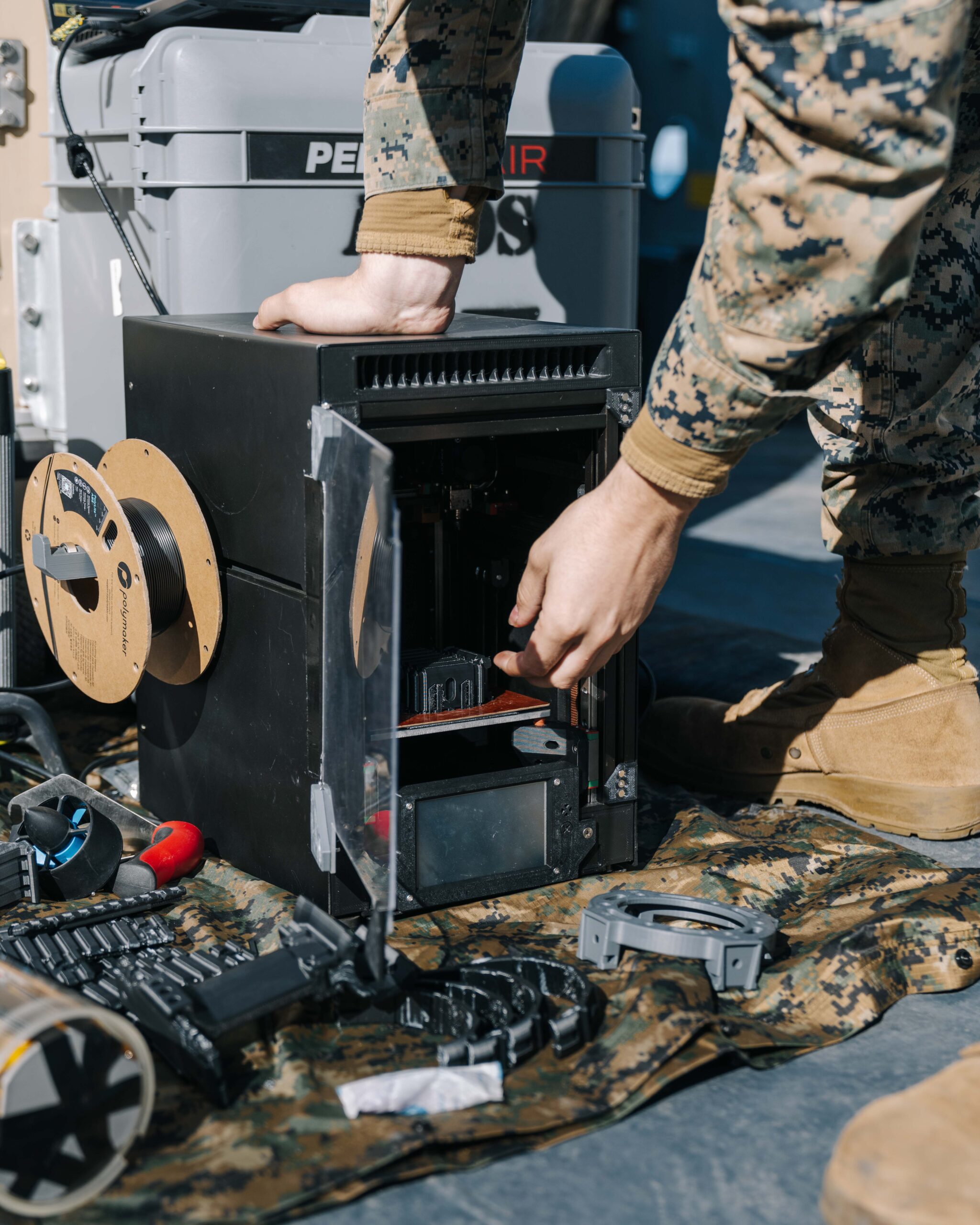
A US service member sets up an AMOS 3D printer in the field.
In the last couple of months, the US Army has been increasingly vocal about its work in assessing its capacity to ramp up drone production within the organic industrial base (OIB), the totality of publicly-owned DoD facilities capable of manufacturing and repairing defense hardware. While this development has not been solely related to deployable production units, it has been a central focus of certain relevant projects.
Now, the DoD has its own public-private partnership that can directly support the ramp-up of frontline production of drones, as well as any other components feasibly manufacturable at the desktop scale. In that sense, more than just a way to print parts, the AMOS fulfills the DoD’s strategic demand to use the build-up of domestic manufacturing capacity as a deterrent.
The project is already a success, insofar as it demonstrates that DoD can identify a need, seed a solution that addresses that need, and commercialize that solution within the span of a few years. If the project proves its effectiveness, we can expect several similar projects across the whole AM value chain to follow in its wake. It may even help establish a model whereby the OIB can more easily outsource its inventions and innovations to DoD-approved companies manufacturing in the US and/or allied nations.
Images courtesy of Chicago Additive
Subscribe to Our Email Newsletter
Stay up-to-date on all the latest news from the 3D printing industry and receive information and offers from third party vendors.
Print Services
Upload your 3D Models and get them printed quickly and efficiently.













You May Also Like
The Manufacturing Race Behind the Drone Revolution
We are in the middle of a major manufacturing shift focused on the production speed and payload capacity of uncrewed aerial systems (UAS), or drones. A recent Manufacturing Dive article...
ADDMAN to Buy Up to $10.8M in Nickel 718 Powder from 6K Additive Over 30 Months
After years of buildup, we’re finally starting to see what the US metal additive manufacturing (AM) market could look like at scale. To be sure, it’s still not quite there,...
Metal AM in a Multipolar World, Part 2: How PBF and DED Could Change by 2035
The first decades of PBF development were heavily shaped by machine capability: more power, more lasers, larger build volumes, better recoating, and improved process monitoring. These developments will continue, but...
Advanced Manufacturing at IMTS 2026: 3D Printing and AI and Drones, Oh My!
Last week’s International Manufacturing Technology Snow (IMTS) in Chicago welcomed over 90,000 attendees to the jungle that is McCormick Place. With over 1.17 million square feet of exhibit space, and...