Caracol’s Robotic LFAM Used to Fabricate 3D Printed Installation for Milan Design Week


This year’s Milan Design Week just wrapped up a few days ago, and it’s one of those events I would love to attend someday. Almost every time, there are 3D printed pieces and installations on display at the event, from fashion to furniture, and this year was no different. Italian firm Caracol, known for its robotic large-format additive manufacturing (LFAM) solutions, showcased a 3D printed sailboat hull at the 2022 edition. This year, its technology was used to help fabricate an immersive, living design installation, called PORTAL, that explores the future of sustainable furniture design and manufacturing through circular production models, AI-assisted tools, and robotic AM.
The eye-catching installation was brought to life via a collaboration between Caracol, 3D printed furniture production company Decibel and British industrial designer Charles Birshaw, and Vizcom, which develops AI-powered creative tools that rapidly transform sketches into high-fidelity animations, renders, and 3D models. Other partners included Balena, Airtech, and KCL, and together the creative team developed PORTAL, which combined robotic AM, circular materials, and AI to lower costs and waste, and move beyond the constraints of conventional manufacturing.
“PORTAL is about breaking down barriers—between concept and creation, continents and collaborators. With Vizcom and Caracol, we’re showing what’s possible when designers are empowered by access to technology,” said Adam Hecht, Co-Founder of Decibel.
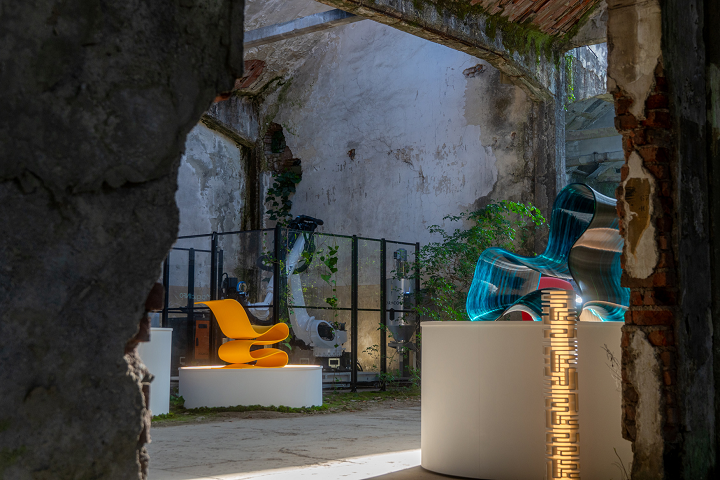
In what Caracol described as a “striking juxtaposition,” PORTAL was set up at exhibition concept Alcova, within the abandoned SNIA factory, “a raw, post-industrial space now overtaken by nature.” It was a great artistic choice: the architectural yet fluid-looking chairs looked great in this wild, natural spot. But on a deeper level, the installation and its placement evoke a future where products are high-tech, but also designed to go back into the earth.
The installation features ten original chairs, each of which were developed by top global designers, such as Birshaw and Deniz Aktay (awarded as Vizcom Competition Winner), using Vizom’s AI-powered design tools.
“We’re proud to collaborate with Decibel to show how AI can enhance—not replace—creativity. PORTAL is a glimpse into a world where design moves at the speed of thought and becomes reality in days, not months,” explained Jordan Taylor, CEO of Vizcom.
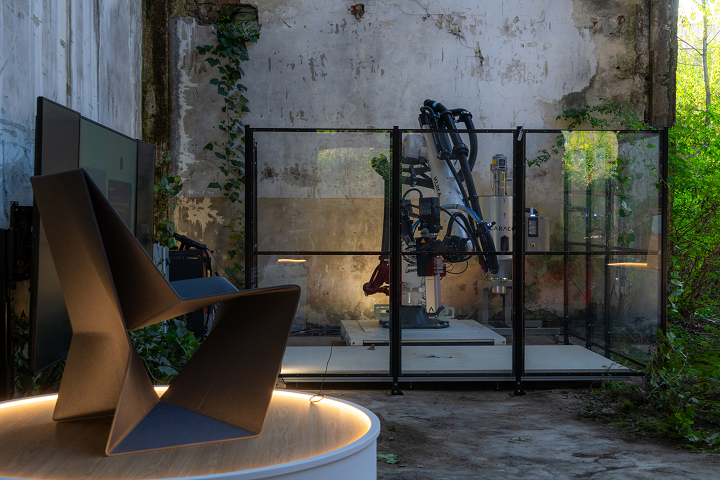
CRYSTAL Chair next to Caracol’s HeronAM
Once the designs were complete, the chairs were fabricated in Italy and the U.S. with Caracol’s proprietary HeronAM platform. This robotic system can use sustainable and recycled materials to efficiently and precisely print large-scale, complex geometries, with little environmental impact.
Francesco De Stefano, CEO of Caracol, said, “Our technology enables localized, on-demand production with total design freedom and drastically reduced waste. We’re proud to support Decibel’s creative vision and help bring their ideas to life.”
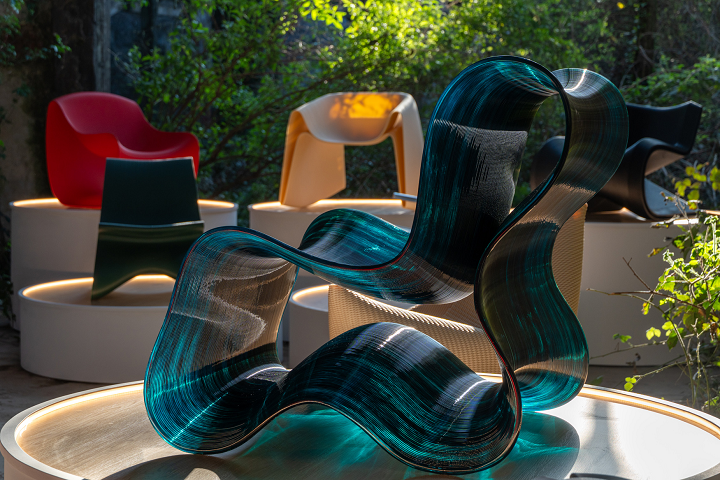
CLOUD Chair
The ten chairs in the collection are sculptural as well as functional, though I don’t know how comfortable they are. I always wonder that about 3D printed furniture—the pieces always look out-of-this-world amazing, but not like something I’d want to kick back in for an afternoon to enjoy a good book and a cup of coffee. My favorites from the PORTAL installation are the MONARK Chair, which was designed by Karim Rashid; the KAVE Chair by Andrew Schainker; and the CONTOUR Collection by Birshaw, “inspired by the grace of draped textile over permanent structure.” I like these three best because they look like the most comfortable out of the bunch. However, I do also appreciate the beautiful CLOUD Chair by Willo, with its flowing design that “takes you back to those carefree days of childhood, finding shapes in the clouds.”
At Alcova during Milan Design Week, visitors were able to see Caracol’s HeronAM hard at work during daily live 3D printing sessions, including real-time production of the winning design from Vizcom’s global AI furniture design competition.
Images courtesy of Decibel
Subscribe to Our Email Newsletter
Stay up-to-date on all the latest news from the 3D printing industry and receive information and offers from third party vendors.
Print Services
Upload your 3D Models and get them printed quickly and efficiently.













You May Also Like
50,000 Orders and Counting: EPlus3D & Chinese AM Services Provider Are Scaling Liquid Cooling Solutions for AI Servers
An under-appreciated story driving the additive manufacturing (AM) industry this year has been the divergence between what’s driving the market in China and what’s driving it everywhere else. Let’s start...
Additive Manufacturing Has a Major Growth Opportunity; Trust Will Decide Who Captures It
After years of overpromising, the next phase of AM growth will be won by companies that consistently deliver what they say. When I entered additive manufacturing in 2014, after 15...
Seven Trends Reveal What’s Next for 3D Printing at TCT Shenzhen 2026
TCT Shenzhen 2026 opened on October 14 in Hall 15 of the Shenzhen World Exhibition & Convention Center in Bao’an, and ran through October 16. The event brought together equipment...
AM Investment Strategies 2026 Sets the Stage for AMS 2027
AM Investment Strategies 2026 Nov. 5 · 12 p.m. ET · Free online event RESERVE YOUR SPOT ↗ A one-hour online discussion featuring some of the biggest names in 3D...