Now, the firm has partnered with Canadian aluminum powder firm Equispheres to make LPBF printing with aluminum possible. Of course, you could already 3D Print with aluminum, but the loose powder is potentially explosive. Generally, all powders from flour on down are explosive. Additionally, LPBF printers can potentially catch fire, which is not exactly a wonderful thing, and worse yet, on an oil platform. Now, both firms say that they’ve made 3D printing everywhere a lot more likely.
The combination of what they label as ¨Equispheres non-explosive powder¨ and Fieldmade’s NOMAD3 container are said to make aluminum everywhere possible. Equispheres NExP-1 powder is said to build quickly and lead to repeatable part production. The powder is dust-free and conforms to ASTM E1226 dust cloud explosion norms. The powder is the, still rather exotic, AlSi10Mg variant, which is said to have ¨high layer thickness processing rates, melt pool stability and consistent melting behavior to improve system performance and the mechanical properties of finished parts.¨
Previously, work by the University of Southern Denmark concluded that ¨Maximum Explosion Pressure testing resulted in no pressure rise for NExP-1, earning it an st0 classification that certifies its non-explosive nature, compared to 6×10² kPa for traditional AlSi10Mg.¨ Work by Aconity and Dyndrite on the powder saw 8 times faster print times and a reduction in the cost of 80%, along with a 62% reduction in surface roughness at 240 µm layers. Using nLight or something similar could boost productivity even more.

Fieldmade CTO Svein A. Hjelmtveit said,
“There has always been demand for aluminum parts in the field. By collaborating with Equispheres, we are now able to meet that demand. Equispheres NExP-1 non-explosive powder simplifies the transport and operation of the NOMAD®03 system while optimizing performance, giving customers portability, speed and superior quality without the need for specialized handling, storage or extensive post-processing.”
While Equispheres Chief Operating Officer Sascha Rudolph added,
“The NOMAD03 system is a game-changer for any remote operating environment that requires a rapid supply of spare parts. Instead of waiting for weeks for replacements to arrive, aluminum parts can be produced onsite in a few hours, often at a lower cost, using technologies that aren’t currently accessible for remote operations. We’re excited to collaborate with Fieldmade in breaking down the barriers for Additive Manufacturing while opening up a whole new landscape for the industry.”
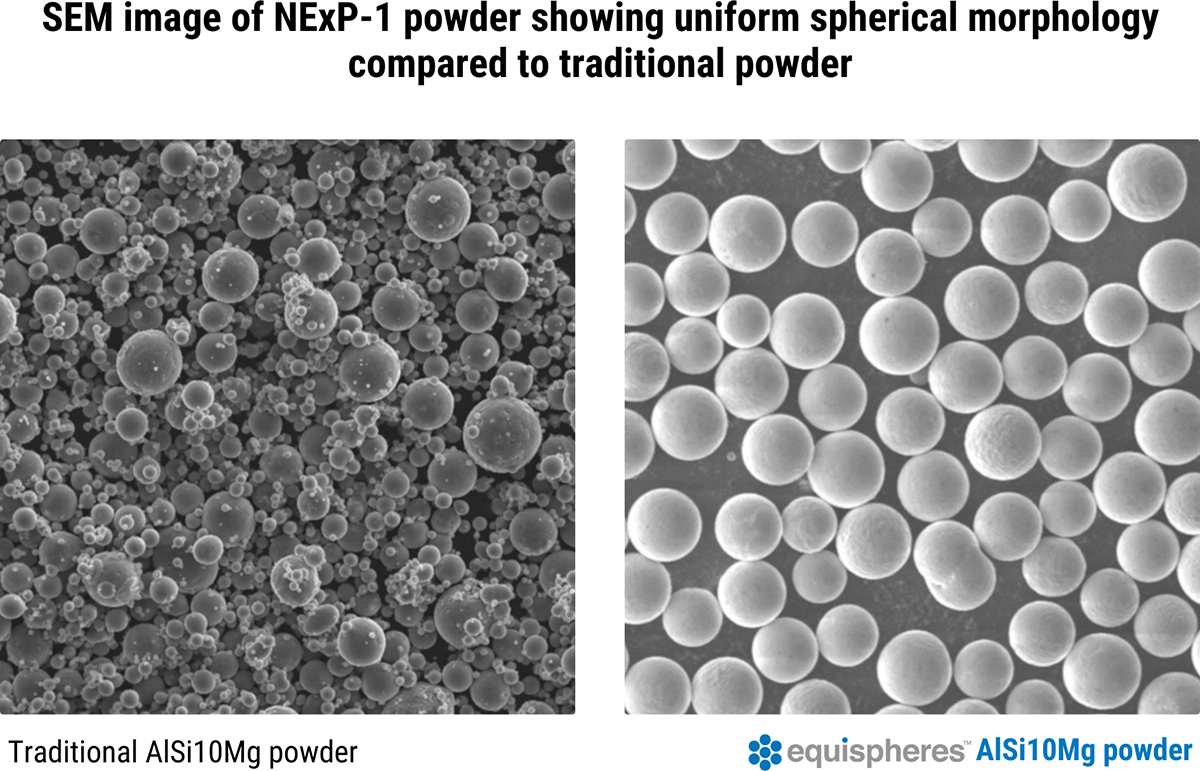
SEM image of NExP-1 powder showing uniform spherical morphology compared to traditional powder. Image courtesy of Equispheres.
Meanwhile, the NOMAD03 is a rugged container that can be used all around the world. Additionally, Fieldmade will help you learn and implement additive. Point of need 3D printing represents a huge potential market for additive. Turning this potential into reality will still be very difficult, however. Many people are focusing on in-layer monitoring, QA (quality assurance) generally, making powder or 3D printing as a service. Fieldmade is in a much better business. It is essentially the only company creating a complete solution for energy and defense customers.
Behind the scenes, it is investing in the hard day-to-day stuff to make a printer work anywhere. Every day, it distances itself a little bit from anyone else who wants to try to mount an LPBF machine inside of a container. That is a really defensible, sensible business. If they are the gold standard in 3D printing anywhere, would you pay less for a Chinese-made container or another company with less track record? If you’re at a military FOB (Forward Operating Base) or a remote site processing millions of dollars in natural gas a day, I would contend that you would not. I love Fieldmade as a business and think that they’re really going to extend additive considerably. At the same time, they will build an excellent, sustainable business for themselves.