RAPID + TCT 2025: Transforming Healthcare with Additive Manufacturing



RAPID + TCT, North America’s largest event for additive manufacturing (AM), is set to return to Detroit this April, bringing together experts from across the medical and manufacturing fields. The Healthcare Track at this year’s conference will showcase how AM is revolutionizing patient care, medical devices, and surgical planning, with industry leaders discussing cutting-edge applications and research.
According to the “Market Trends and Opportunities in Medical Devices; Prosthetics, Dental, Audiology” report from AM Research, the 3D-printed medical device market is projected to grow at a 12% compound annual growth rate over the next decade, increasing from $5 billion in 2024 to $16.5 billion in 2034. With this in mind, the RAPID + TCT Healthcare Track is not to miss, as it will feature a diverse range of topics, from hospital-based 3D printing to biocompatibility advancements.
One of the standout sessions is “Trials and Tribulations of Implementing a Quality Management System at the Point-of-Care” (April 8, 10:30 – 11:00 AM), led by Peter Liacouras of Walter Reed National Military Medical Center. This discussion will focus on the challenges of ensuring regulatory compliance and standardization when using AM for patient-specific solutions in clinical settings.
On April 9, “The Future of Automation: How Scripting and AI Will Impact Medtech” (11:00 – 11:30 AM), presented by Adam Wong of Materialise, will explore the intersection of AI and AM in the medical field, highlighting how automation can streamline the development of complex, customized medical devices. I am particularly interested in this topic, given the increased role of AI as a means of making AM more immediately accessible.
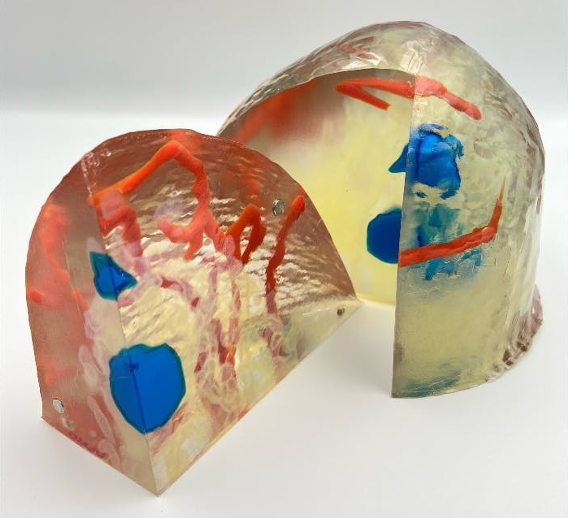
3D printed anatomical model from Ricoh. Image courtesy of Ricoh.
For those interested in surgical innovation, “The Use of 3D-printed Anatomical Models in Breast Cancer Surgery and Surgeon Collaboration” (April 8, 2:30 – 3:00 PM) with Maggie Lashutka of Ricoh USA will demonstrate how patient-specific models are improving surgical outcomes and facilitating communication between specialists.
The conference will also highlight “Point-of-care Manufacturing: The HAMMER Engineering Research Center Approach” (April 10, 11:00 – 11:30 AM), presented by David Dean of The Ohio State University, focusing on how localized AM production can provide patient-specific implants and devices with reduced lead times.
The RAPID + TCT Healthcare Track offers a unique opportunity to explore the latest advancements in medical 3D printing, bioprinting, and patient-specific device manufacturing. With sessions covering regulatory challenges, material innovations, and AI-driven automation, this year’s conference will be a hub for healthcare professionals, researchers, and industry leaders driving the future of personalized medicine.
For more information and to register for RAPID + TCT, visit RAPID + TCT’s official website.
Subscribe to Our Email Newsletter
Stay up-to-date on all the latest news from the 3D printing industry and receive information and offers from third party vendors.
Print Services
Upload your 3D Models and get them printed quickly and efficiently.













You May Also Like
3D Printing News Briefs, June 18, 2026: Reseller, Relocation, Metal Space Powder, & More
We’ll start with business news in today’s 3D Printing News Briefs, as XJet appointed a value-added reseller in Germany, BIO INX is expanding its presence in the Italian market, and...
Scientists Use BMF to 3D Print Seal Whiskers That Track Prey Long After It’s Gone
Seals use their whiskers to hunt. Not Navy Seals, although they may in some way also, but this article is about lowercase seals. Not Seal the musician either; as far...
Researchers Combine AI and Bioprinting to Create Tiny Blood Vessel Networks
If 2026 has a theme in bioprinting, it may be blood vessels. Researchers can already print incredibly sophisticated tissues. The harder part is keeping those tissues alive. Without a network...
University of Arkansas Researchers Test Metal 3D Printing in a Mars-Like Atmosphere
If humans eventually establish a long-term presence on Mars, they will face a major manufacturing challenge almost immediately. Tools will break. Parts will wear out. Equipment will need repairs. But...