Additive Manufacturing’s Opportunity: The Agile Solution to the US Manufacturing Crunch

The US manufacturing sector is bracing for what could be a perfect storm of supply shortages and surging demand. This ‘storm’, driven by reshoring efforts, potential tariffs, and ongoing manufacturing labor challenges, might just set the stage for additive manufacturing (AM) service bureaus (SBs) and contract manufacturers (CMs) to step into the spotlight.
The Big Picture: A Labor Crunch Meets Rising Demand
The labor shortage in US manufacturing is no secret. Deloitte estimates there are over 800,000 unfilled manufacturing jobs—a gap that could grow in the coming years as an aging workforce retires and younger generations gravitate toward tech-centric careers.

At the same time, the demand side of the equation is poised for a potential surge. If tariffs or reshoring incentives are introduced under the incoming administration, companies may need to ramp up domestic production quickly.
The challenge? Building traditional manufacturing capacity—new foundries, assembly lines, and supply chains—takes years and millions in capital investment. By the time a new plant is operational, the policy landscape could shift, leaving companies with stranded assets.
As a side note re US working visas: Visa holders play a role in filling critical advanced manufacturing and engineering roles. However, even without a potential reduction in the number of visa holders, the labor shortage is already real and significant. The pressing reality is that US manufacturing needs solutions that can scale quickly.
Enter Additive Manufacturing: The Agile Contender
This is where AM comes in. Unlike traditional manufacturing, which requires significant lead time for tooling, setup, and ramp-up, AM offers unparalleled flexibility. Need a prototype tomorrow? Done. A small-to-medium production run in a week? No problem. And because AM is inherently less labor-intensive, it can overcome some of the pain points associated with the current labor crunch.
For example, a metal AM machine can churn out complex end-use-parts with minimal operator intervention, reducing the need for extensive human resources. And while there’s still a skills gap in operating and maintaining AM systems, it’s narrower than what’s required to scale traditional manufacturing infrastructure.
AM Service Providers: The Right Fit
The beneficiaries of this shift could be AM SBs and CMs. Many of these players already have the equipment, expertise, and capacity to meet rising demand—today. While large manufacturers might hesitate to invest in AM due to high upfront costs or uncertainty around long-term demand, service providers are positioned to act as a “just-in-time” solution for companies caught off guard by supply chain disruptions or policy shifts.
Consider this: an AM service provider with excess capacity can start producing parts for a new client tomorrow morning. No need for the client to purchase machines, train staff, or wait for months of setup. For industries with rapidly changing needs, this agility is invaluable.
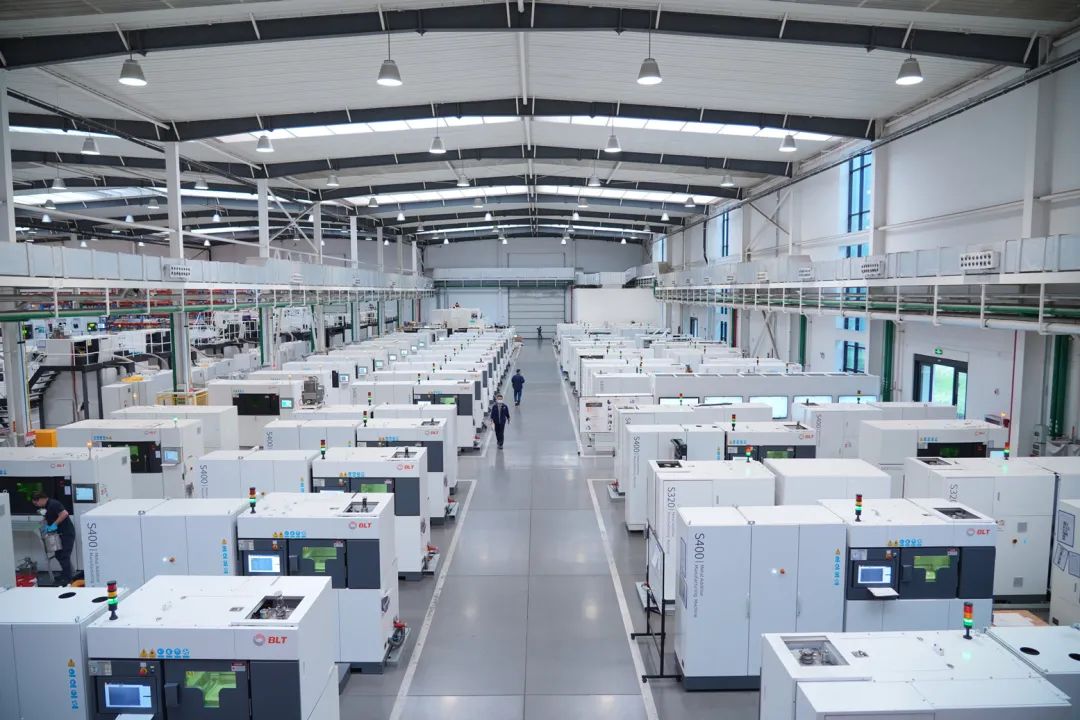
BLT’s super factory plan included hosting over 700 metal 3D printers [Image Courtesy: BLT].
Playing the Long Game
While AM service providers stand to benefit in the short-to-medium term, their success could also accelerate the broader adoption of AM as a mainstream manufacturing solution. By showcasing what’s possible with their existing infrastructure, they’re effectively giving potential customers a free trial of the future of manufacturing. Some of those customers might eventually bring AM capabilities in-house, but others could decide it’s more cost-effective to outsource, especially if the policy landscape remains unpredictable.
The Opportunity: Smart Moves for a Fast-Changing World
For AM service providers, this is a moment to seize. With demand potentially scaling faster than traditional manufacturers can adapt, AM service providers have an opportunity to fill a critical gap and establish themselves as reliable partners. For manufacturers considering their options, the choice is clear: why sink millions into capex for a production line that might be obsolete in four years when you can tap into the agility of AM service providers?
In a world where demand spikes can happen overnight, and policy shifts can rewrite the rules of the game, agility is priceless. AM might not be the answer to every challenge in US manufacturing, but for now, it looks like the right tool for a very specific—and urgent—job.
Tali Rosman will participate in-person at Additive Manufacturing Strategies in New York City, Feb 4-6, 2025.
Feature image courtesy of ADDMAN.
Subscribe to Our Email Newsletter
Stay up-to-date on all the latest news from the 3D printing industry and receive information and offers from third party vendors.
Print Services
Upload your 3D Models and get them printed quickly and efficiently.













You May Also Like
3D Printing News Briefs, October 10, 2026: Drones, WAAM, Ceramics, & More
We have a packed 3D Printing News Briefs for you this weekend! First, America Makes celebrated the recent National Manufacturing Day with 3D printed drones, and then it’s on to...
10 Years of Multi Jet Fusion: Onsite at HP’s Vancouver, Washington Facility
At this year’s RAPID event in Boston, HP Additive Manufacturing Solutions celebrated ten years in the additive manufacturing (AM) market. The company ushered in the milestone with several innovations, including...
PharmaTher Plans U.S. Network to 3D Print Medicines on Demand
3D printing medicines has often been tied to the idea of personalization, basically making a pill in the right dose, shape, or drug combination for a patient. PharmaTher is now...
3D Printing News Briefs, September 17, 2026: 3D Printed Boat, UAS Development, & More
We’ll start with maritime manufacturing in this week’s 3D Printing News Briefs, and continue on to defense 3D printing. We’ll end with funding for Tripo AI. Read on for all...