
BMW Receives Full-automated Sand Core 3D Printing Line from Laempe

Laempe Mössner Sinto GmbH has introduced a fully automated, high-volume 3D printing line for sand core production, now operational at BMW Group’s Landshut foundry in Bavaria. This development marks a significant milestone in automotive manufacturing, as Laempe, in partnership with BMW and R. Scheuchl GmbH, advances the industrial application of additive manufacturing (AM) for casting components.

Overhead view of an automated sand core production line from Laempe.
Laempe Mössner Sinto GmbH, founded in 1980 by Dipl.-Ing Hans-Joachim Laempe, offers a comprehensive portfolio that spans core shooters, sand mixers, gassing units, automation systems, and innovative technologies like sand binder jetting 3D printers. With approximately 300 employees and a strategic partnership with Japan’s Sinto Group since 2015, Laempe maintains a strong global presence supported by a network of representatives and subsidiaries in key markets worldwide. At GIFA 2023, Laempe Mössner Sinto showcased its Laempe Core Printer (LCP), an in-house developed sand binder jetting 3D printer designed specifically for inorganic binder systems. As part of its comprehensive portfolio of core-making solutions, the LCP highlights Laempe’s position as the only company in core production technology to span the entire value chain, from traditional core shooters to 3D printing.
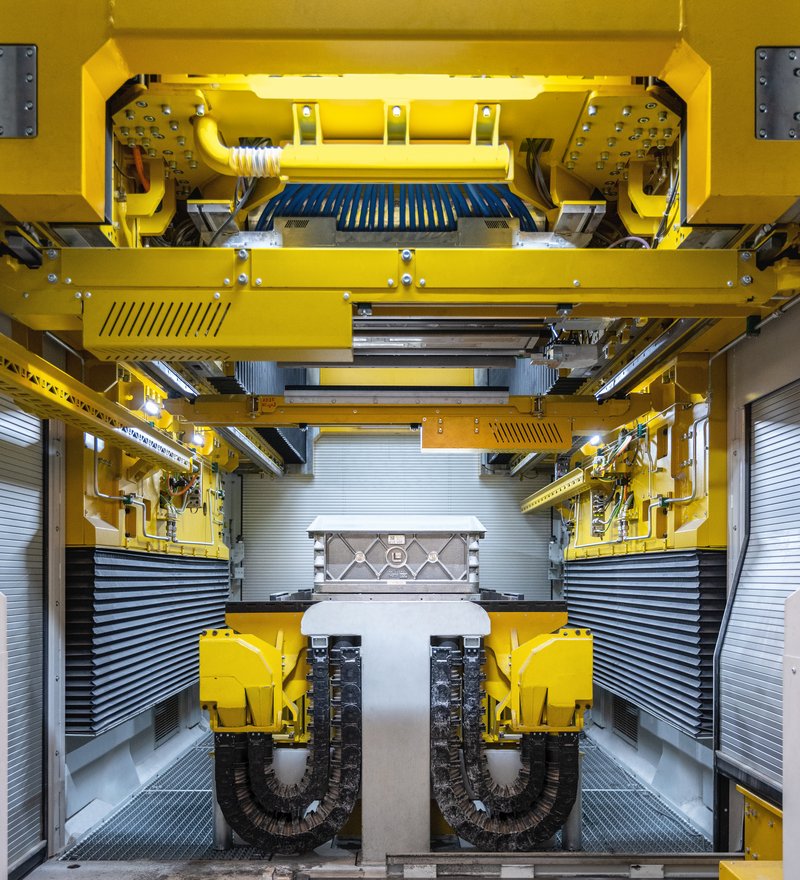
BMW is using the Laempe 3D printing line to produce molds for its new six-cylinder engine generation. The system integrates six high-speed, bidirectional 3D sand printers, complete with automated raw material handling, printing, cleaning, and quality assurance processes, including 3D measurement and core removal. Developed in Schopfheim, manufactured in Barleben, and in series production since 2016, this system caters to foundries needing high-volume, precision manufacturing solutions.
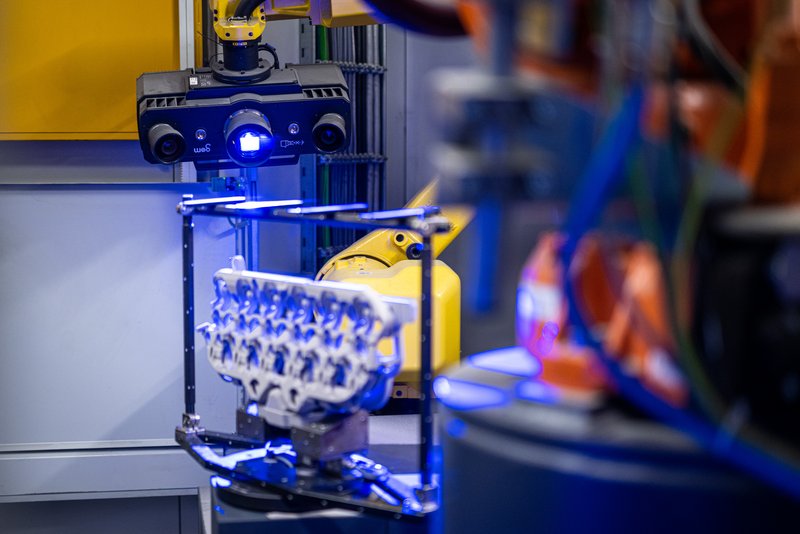
Automated inspection within the Laempe sand 3D printing system.
Laempe’s new system aligns with broader trends in the automotive industry, where AM is enabling the transition to advanced casting techniques. Companies such as voxeljet and Loramendi have pioneered similar initiatives, with voxeljet’s VX1300-X printer automating the production of sand cores at BMW’s Landshut plant for cylinder heads. By automating traditionally labor-intensive processes like raw material preparation and post-processing, voxeljet’s setup demonstrated the economic viability of high-volume sand core 3D printing. These innovations support goals such as optimizing engine designs for fuel efficiency and emissions reduction—objectives echoed in Laempe’s collaboration with BMW.
The modular design of Laempe’s printers allows foundries to scale from standalone units to fully automated systems at competitive costs. Furthermore, its open-material platform gives customers flexibility in raw material sourcing—a significant advantage in an industry often constrained by proprietary supply chains.

Inside of a Laempe sand core 3D printing system.
The significance of 3D printed sand molds and cores extends beyond BMW. Tesla and General Motors have also leveraged sand AM to innovate vehicle manufacturing. Tesla, for instance, uses 3D printed sand molds to accelerate prototyping cycles and reduce costs, a key component of its “unboxed” manufacturing strategy. Similarly, GM’s acquisition of Tooling & Equipment International (TEI) highlights the strategic importance of AM in gigacasting, where large, single-piece aluminum parts are cast using massive machines.
Laempe’s hybrid approach—offering both traditional core shooting and additive core production—provides unmatched flexibility for foundries. This hybrid model, combined with options such as pay-per-part production through its INACORE joint venture, reflects an understanding of the varied needs of automotive manufacturers transitioning to AM.
As AM becomes more deeply integrated into high-volume automotive production, innovations like Laempe’s are likely to inspire broader adoption across industries. The ability to seamlessly switch between traditional and additive techniques, while maintaining cost efficiency and process stability, ensures that Laempe’s technology will remain relevant as manufacturing requirements evolve.
The question now is how other players in the AM industry will respond to Laempe’s advances. With automotive giants investing heavily in sand AM for gigacasting and other applications, companies such as voxeljet and Desktop Metal may face increased competition—or opportunities for collaboration—in a market poised for rapid growth.
All images courtesy of Laempe.
Subscribe to Our Email Newsletter
Stay up-to-date on all the latest news from the 3D printing industry and receive information and offers from third party vendors.
Print Services
Upload your 3D Models and get them printed quickly and efficiently.












You May Also Like
Oerlikon Adds ATLIX’s xBUILD 5000, Plans More for 2027
Oerlikon has installed a new ATLIX xBUILD 5000 metal 3D printer at its facility in Huntersville, North Carolina, marking the first production deployment of the system worldwide. The machine will...
The Manufacturing Race Behind the Drone Revolution
We are in the middle of a major manufacturing shift focused on the production speed and payload capacity of uncrewed aerial systems (UAS), or drones. A recent Manufacturing Dive article...
Stratasys vs. Bambu Lab: Why Europe and the U.S. Reached Different Results, Part II
Editor’s note: This is Part 2 of a two-part series by Xu Fanglei examining the technology and patent issues behind the Stratasys-Bambu Lab dispute. Part 1 looked at the $27.6...
3D Printing News Briefs, October 1, 2026: Defense, Enclosures, & More
In today’s 3D Printing News Briefs, we’re starting with defense news, first from Massivit and then from AML3D. Then we’ll move on to U.S. manufacturing of a new large-format LPBF...

























































