Solukon’s New Two-Ton Cleaner Lands First Customer in AMCM

A new system is pushing the boundaries of what’s possible in depowdering for metal 3D printing, tackling components that weigh over two tons and have intricate designs. Unveiled at Formnext 2024, the SFM-AT1500-S, developed by Solukon, is capable of handling parts up to 2,100 kg (roughly 4,630 pounds), addressing the challenges of cleaning some of the largest and most complex 3D printed metal components. Now, Solukon has announced AMCM as one of the first customers for this groundbreaking machine.
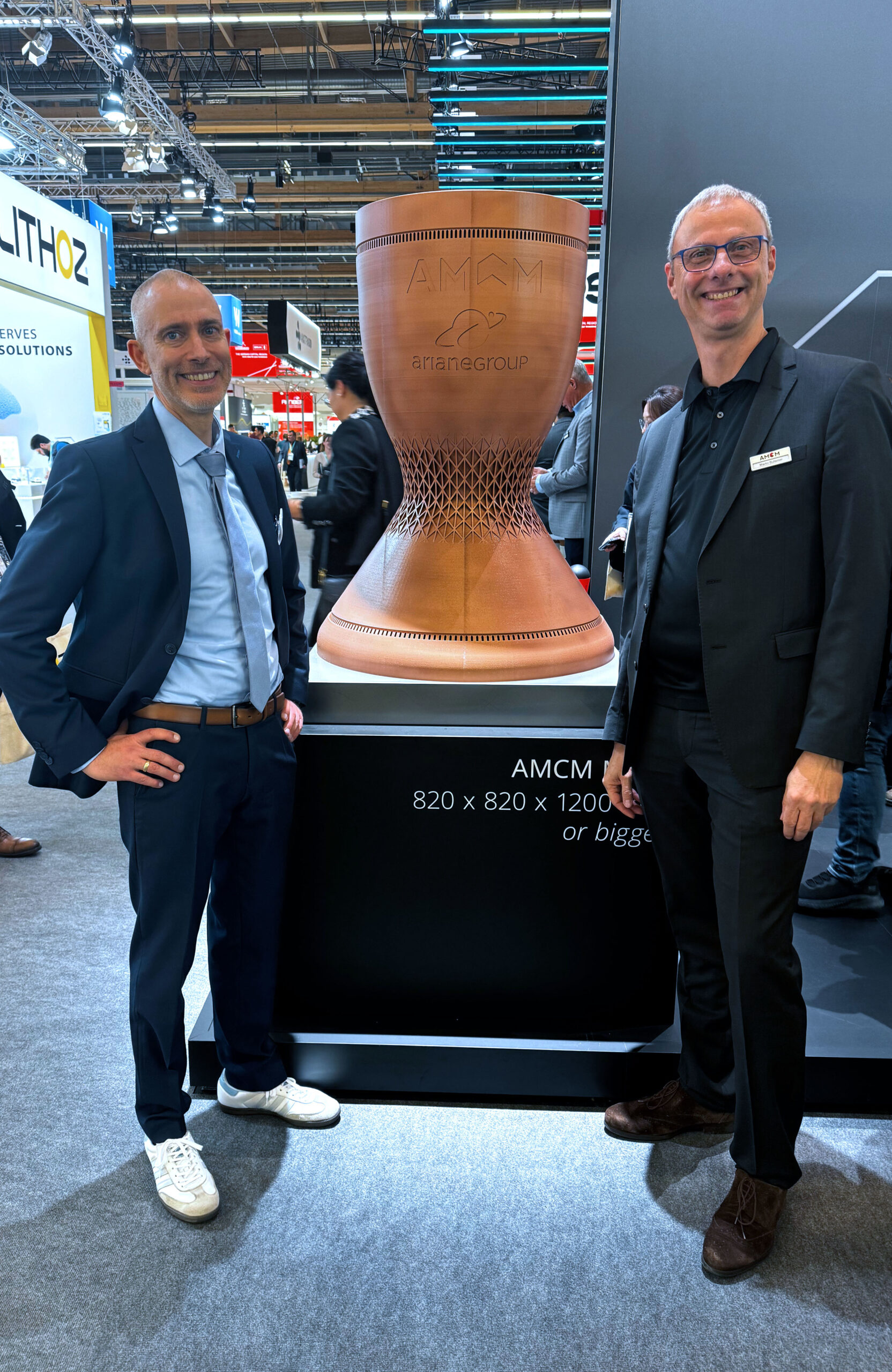
The SFM-AT1500-S can accommodate a component such as this copper rocket engine in the middle. Image courtesy of Solukon.
Solukon says the machine is designed to handle tricky internal powder removal and fit into tight spaces in manufacturing sites. Its compact build means no external platforms or stairs for loading are needed, making it easier to use in smaller facilities while dealing with the challenges of cleaning complex structures.
Created to handle extra-large and heavy 3D printed metal components, this system promises to accommodate parts up to 600 x 600 x 1,500 mm or 820 x 820 x 1,300 mm in size.
AMCM, a machine manufacturer and subsidiary of EOS based in Starnberg, Germany, worked closely with Solukon to help design the SFM-AT1500-S depowdering system. AMCM needed the system to handle parts made by its M 8K printer, which can produce extra-large components up to 820 x 820 x 1,200 mm. With a build volume four times larger than its predecessor, the M 4K, and the ability to handle up to five tons of powder, the M 8K incorporates EOS’s technology to improve quality assurance and process monitoring.
In fact, this M 8K was developed with a national grant to support ArianeGroup’s Ariane 6 program. It was specifically created to 3D print large and complex parts like rocket engine combustion chambers for ArianeGroup’s Prometheus rocket engine—an ongoing European Space Agency (ESA) development effort begun in 2017 to create a reusable methane-fueled rocket engine. Now, by collaborating with Solukon, AMCM ensured that the depowdering system would meet the demanding requirements of cleaning these massive and intricate components.
Described as a perfect fit for AMCM’s M 8K machine, the SFM-AT1500-S depowdering system is expected to streamline the post-processing of ArianeGroup’s Prometheus rocket engine. While AMCM is scheduled to deliver its first 3D printed combustion chambers in copper alloy, the company has prior experience producing similar components. Using its M 4K system, AMCM successfully manufactured combustion chambers and injectors for liquid rocket engines featuring intricate regenerative cooling channels.
One of the key features of the SFM-AT1500-S is its proprietary SPR-Pathfinder software, which simplifies the depowdering process. The software reads the CAD file of a part and calculates the best way to remove leftover powder, so there’s no need for manual programming. This automated approach saves time, lowers costs, and minimizes errors, making sure even the most complex internal structures are totally cleaned.
“SPR-Pathfinder is a tool that every customer would certainly like to have, and so do we. The software is indispensable for complex components because the exact movement pattern for very complex geometries cannot be generated using human imagination alone. The software eliminates the need for any human programming effort,” says Martin Bullemer, Managing Director of AMCM.
While traditional depowdering methods can be time-consuming and may not effectively remove powder from complex geometries, SFM-AT1500-S addresses these challenges. Traditional methods often struggle with intricate internal designs, like lattice structures or narrow channels, where powder gets trapped. Factors like static electricity, surface roughness, or even compaction during printing make it harder to clear residual powder.
For example, in the aerospace industry, turbine blades or heat exchangers often include fine internal channels for airflow. If leftover powder remains trapped, it can block airflow or weaken the part under stress, compromising the structural integrity under intense vibration and G-forces, eventually leading to a potential part failure. Similarly, in medical applications, residual powder trapped in the porous structures of implants designed to promote bone growth can cause contamination or reduce the implant’s performance.
Instead, by automating this process and accommodating larger components, Solukon’s new system ensures production efficiency and product reliability.
Aside from aerospace and medicine, this machine can also be used in other industries like defense and transportation, where large-scale metal parts are common. What’s more, this ability to clean larger components opens new possibilities for designing and manufacturing more complex and efficient structures that were previously unattainable.
Subscribe to Our Email Newsletter
Stay up-to-date on all the latest news from the 3D printing industry and receive information and offers from third party vendors.
Print Services
Upload your 3D Models and get them printed quickly and efficiently.











You May Also Like
Amnovis Expands to the US
Belgian firm Amnovis is a scalable partner for orthopedic innovations. From design to production and regulatory, you can rely on them to take your innovation to market. Coupled with deep...
Scaling 3D Printing Takes More Than You Think; HP’s Webinar Looks at Making It Work Long Term
3D printing is no longer new. In fact, most manufacturers already know what it is, where it fits, and what it can do. But knowing the technology and actually scaling...
Astrobotic Tests Rocket Engine Made with Elementum 3D Materials
Astrobotic has completed a series of hot-fire tests for its Chakram rotating detonation rocket engine, with additive manufacturing (AM) playing an important role in how the engine was built. The...
The Additive Chicken Coop, Part I: Million Dollar Petri Dishes
After decades of tinkering with our individual technologies, billions were poured into speculative claims and optimism. Now the attention is gone, and sometimes it can seem like we’re surrounded by...