Astrobotic Tests Rocket Engine Made with Elementum 3D Materials

Astrobotic has completed a series of hot-fire tests for its Chakram rotating detonation rocket engine, with additive manufacturing (AM) playing an important role in how the engine was built. The company conducted the tests at NASA Marshall Space Flight Center, where two prototypes ran across eight tests totaling 470 seconds, including a 300-second continuous burn that may be the longest of its kind to date. Of course, the performance stands out, but what really matters here is how the engine was built.
Astrobotic used a metal 3D printing process called PermiAM, Elementum 3D‘s proprietary approach for controlling porosity inside parts, which lets engineers adjust how dense or porous different areas are during printing. That means a single component can combine dense regions for strength with more porous sections for cooling and fluid flow, which is especially useful for applications like propulsion and thermal management.
That matters for rocket engines. Heat and fluid flow are hard to control, and traditional manufacturing usually requires multiple parts, complex internal channels, and assembly steps. With 3D printing, those features can be built directly into one component. Here, controlling porosity inside the metal helps handle heat, improve stability, and boost efficiency, which are three of the biggest challenges in advanced rocket engines.
Why Rotating Detonation Engines Are Different
The engine Astrobotic tested is not a conventional rocket engine. Rotating detonation rocket engines use supersonic waves that travel around a ring-shaped chamber to burn fuel. As the company explains, this approach can extract more energy from the same amount of propellant, potentially improving efficiency by up to 15%.
At the same time, these engines are harder to design and build. They face issues with stability, heat, and durability. That is where AM becomes more important. 3D printed metal components make it easier to build complex internal structures and manage heat, helping solve problems that are difficult with traditional methods.

Astrobotic’s Peregrine Lunar Lander is encapsulated with ULA’s Vulcan rocket. Image courtesy of Astrobotic.
During testing, each engine produced more than 4,000 pounds of thrust and reached stable operating conditions. Astrobotic reported no visible damage to the hardware after the test campaign. However, the company plans to continue developing the engine, with future work focused on cooling, throttling, and reducing mass. The technology could eventually be used in systems like lunar landers and in-space vehicles.
This work is part of the broader push to return to the Moon. Programs like NASA’s Artemis are focused on building a long-term presence beyond Earth, and that will need more efficient and reliable propulsion systems. Advances like this, especially when combined with new manufacturing approaches, could help make those missions easier over time.
Astrobotic’s work on propulsion ties directly into that goal. The company is preparing for its next major mission, the Griffin-1 lunar lander, which is targeting a launch no earlier than July 2026 as part of NASA’s Commercial Lunar Payload Services program. The lander is designed to carry scientific instruments, rovers, and commercial payloads to the Moon’s south pole, a key area for future exploration.
Looking ahead, Astrobotic is planning additional missions beyond Griffin-1, including new landers and spacecraft systems aimed at supporting a growing lunar economy. In that context, technologies like 3D printed propulsion and in-space manufacturing are not side projects. They are part of a larger effort to make space systems lighter, more efficient, and easier to build.
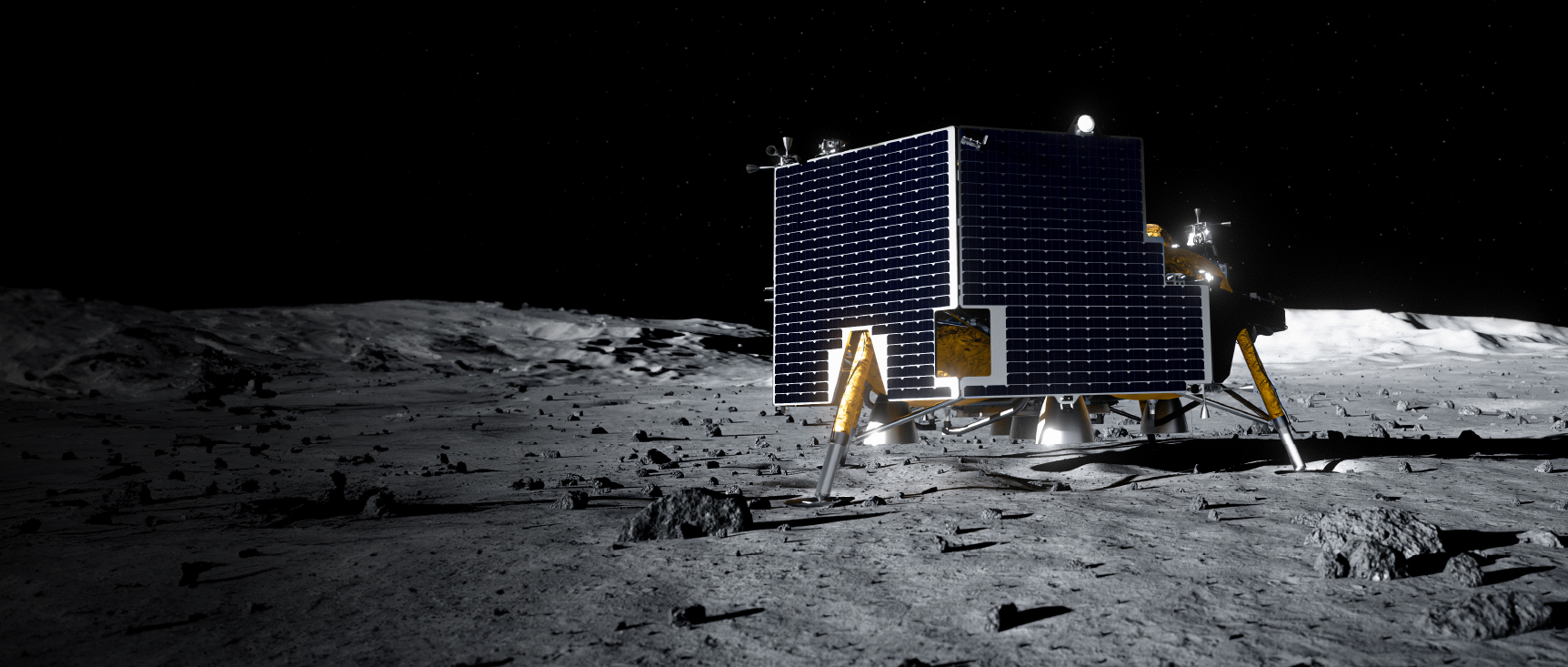
A rendering of Astrobotic’s Griffin lunar lander on the surface of the Moon. Image courtesy of Astrobotic.
What’s more, this is not the first time Astrobotic has worked with 3D printing. The company has been using AM across several areas. Through its acquisition of Masten Space Systems, Astrobotic gained access to work on a 3D printed aluminum rocket engine, showing early interest in additively manufactured propulsion hardware. It is also involved in projects like MOONRISE, which aims to 3D print structures directly on the Moon using lunar dust. The idea is to build landing pads, roads, and other infrastructure without having to bring materials from Earth.
Over time, this points to a bigger goal, which is using 3D printing not just to build spacecraft, but to manufacture parts and structures off-Earth. It shows that Astrobotic is using 3D printing where it matters most, especially in tough environments.
Subscribe to Our Email Newsletter
Stay up-to-date on all the latest news from the 3D printing industry and receive information and offers from third party vendors.
Print Services
Upload your 3D Models and get them printed quickly and efficiently.













You May Also Like
Solukon Goes Big with New SFM-AT850 Depowdering System
Solukon has released the SFM-AT850 depowdering system. The German depowdering specialist has updated its product line, and this machine replaces the SFM-AT800-S and SFM-AT1000-S. Rather than many small parts, this...
The Hidden Economics of Powder Bed 3D Printing: Closing the Loop in Powder Management
Automation is a very topical thing in additive manufacturing at the moment. With renewed scale, some clients are fervently looking to automate production. Other business cases only make sense with...
Oerlikon Adds ATLIX’s xBUILD 5000, Plans More for 2027
Oerlikon has installed a new ATLIX xBUILD 5000 metal 3D printer at its facility in Huntersville, North Carolina, marking the first production deployment of the system worldwide. The machine will...
The Science Lab You Can 3D Print
Researchers at Sweden’s Umeå University have shown how desktop 3D printers can be used to make lab equipment, giving scientists a cheaper way to build tools for their research. The...