US Army Researchers Explore Frozen Construction via 3D Printed Ice “Dollhouse”

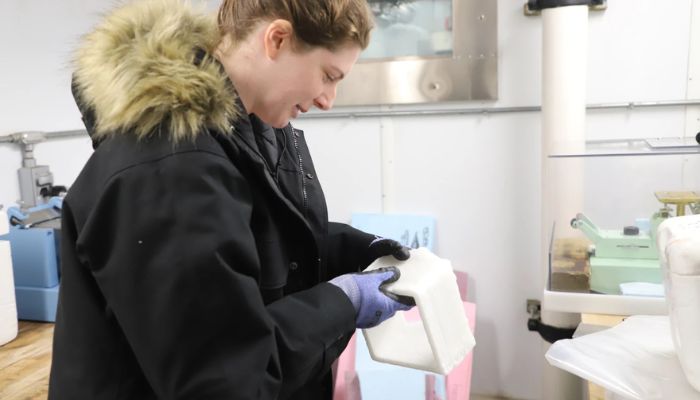
A team of US Army researchers from the Engineer Research and Development Center (ERDC) has used a modified ceramic 3D printer to construct a toaster-sized structure made from liquid nitrogen. The successful demonstration of ice additive manufacturing (AM) was accomplished at New Hampshire’s Cold Regions Research and Engineering Laboratory (CRREL), towards the objective of assessing the potential of deploying ice as a construction material.
Exploration into 3D printed ice is still relatively scant, but projects from several different institutions, involving a variety of methods, have popped up over the years. Members of the CRREL team have previously published results of research into an ice bridge constructed with spray deposition in the journal Cold Regions Science and Technology.
The approach that the CRREL researchers have developed combines water with tiny cellulose fibers that reinforce the final object. Having completed what they refer to as a “dollhouse-sized” structure — which took seven hours to print — the team now plans to leverage the same principles to build a “doghouse-sized” ice structure with a larger printer.

In a press release, Kiera Thompson Towell, one of the material engineers who worked on the project, said, “We sought to utilize ice and snow as abundant natural resources in these regions that can be leveraged for construction of expeditionary structures, those that are temporary. Developing a method for 3D printing using ice and snow would allow for automated construction of various customizable structures depending on location and need, while reducing the amount of construction materials that would need to be transported to those regions.”
Towell told Lexi Krupp, a reporter for Vermont Public, that the primary challenge with ice 3D printing is, “Having it be liquid enough that it can flow through your nozzle, and then having it be solid enough that once it’s extruded, it hold its shape before it freezes.”
While the Army researchers are interested in using 3D printed ice as a construction material in remote, cold areas, the first thing I thought of when I saw this story was the potential for 3D printed ice as a tool for data center cooling. There is rising interest in cryogenic applications for data center cooling, and in fact a 2021 research paper describes the use of liquid nitrogen AM to cool high powered GPUs.
On the other hand, liquid nitrogen is costly and dangerous, severely limiting its scalability for the data center market. By utilizing water and pulp, the novel technique that the CRREL team has come up with could accomplish the same goals at a lower cost, and with much less environmental impact.
Additionally, the same rationale driving the team to explore ice as a construction material — providing assistance to remote, cold regions — would be relevant for the same reasons in a data center context. It’s easy to imagine this research branching out into the exploration of its applicability for small modular data centers in areas like Alaska.
Images courtesy of US Army Engineers/DVIDS
Subscribe to Our Email Newsletter
Stay up-to-date on all the latest news from the 3D printing industry and receive information and offers from third party vendors.
Print Services
Upload your 3D Models and get them printed quickly and efficiently.













You May Also Like
3DPOD 316: Beehive’s Gordie Follin on 3D Printed Engines and More
Gordie Folin had deep experience in engineering at Pratt & Whitney, GE, and GE Aviation before becoming the Chief Product Officer at Beehive Industries. Among his achievements, he served as the...
3DPOD 315: Dirk Simon, from BASF to Farsoon to FKM, and now Square New Business
Dirk Simon had already spent years in the chemicals industry before joining and pioneering BASF‘s 3D printing effort. We get to hear how that firm looked at 3D printing and...
Printing Money Episode 42: Q2 2026 Public Markets 3D Printing Earnings Analysis with Troy Jensen, Cantor
Welcome to Printing Money Episode 42. Troy Jensen (Managing Director, Cantor) returns, joining Danny Piper (Managing Partner, NewCap) to review Q2 2026 publicly traded 3DP/AM company earnings reports. Troy’s quarterly...
3DPOD 314: Debinding, Sintering, and Metal Binder Jetting with Stefan Joens, Elnik Systems and DSH Technologies
Stefan Joens of Elnik Systems sells ovens. Their debind and sintering equipment powers a lot of high-volume binder jet and MIM production. We learn about Elnik and its origins. But...