Rocket Lab to Acquire Restructured Laser Communications Provider Mynaric AG


Rocket Lab USA, the Long Beach-based, end-to-end space services company that specializes in producing rockets with additive manufacturing (AM), has announced plans to acquire Mynaric AG, a German provider laser optical communications terminals. Early last month, Mynaric announced that it would be filing for the German equivalent of Chapter 11 bankruptcy, a move that led to the company’s notice of delisting from the Nasdaq.
The pending acquisition, worth $75 million, is dependent on Mynaric’s completion of its restructuring plan, which Mynaric currently expects to happen sometime in the second quarter of 2025. Rocket Lab’s interest in acquiring Mynaric is driven to a significant extent by the fact that the latter is an existing subcontractor for the former, with Mynaric providing its CONDOR Mk3 optical communication terminals for Rocket Lab’s $515 million Space Development Agency (SDA) contract.
Mynaric has faced ongoing production issues, largely related to supply chain disruptions, which in August, 2024 caused the company to drastically reduce its 2024 revenue guidance. Nevertheless, over the years, the company has received key government contracts from major players in the space industry, including L3Harris and Northrop Grumman, in addition to Rocket Lab.
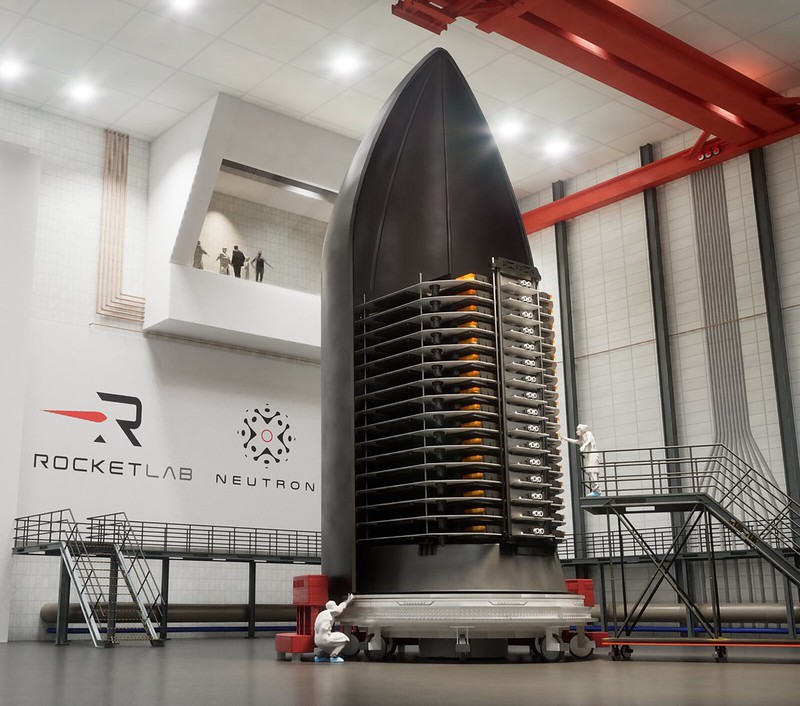
Image courtesy of Rocket Lab
In a press release about Rocket Lab’s planned acquisition of Mynaric AG, the founder and CEO of Rocket Lab, Sir Peter Beck, said, “We have been very clear about this strategic direction for several years now — Rocket Lab is pursuing every part of the space value chain. We launch our own rockets, we build satellites in constellation volumes, and now we’re closing in on the final steps and most valuable part of the space economy — operating our own constellations to provide data and services from space using our newly announced Flatellite spacecraft. Mynaric has paved the way in developing laser technology. Their team and technologies will make a compelling addition to our satellite component portfolio and we look forward to making the technology available at scale for our own constellations and those of our customers.”
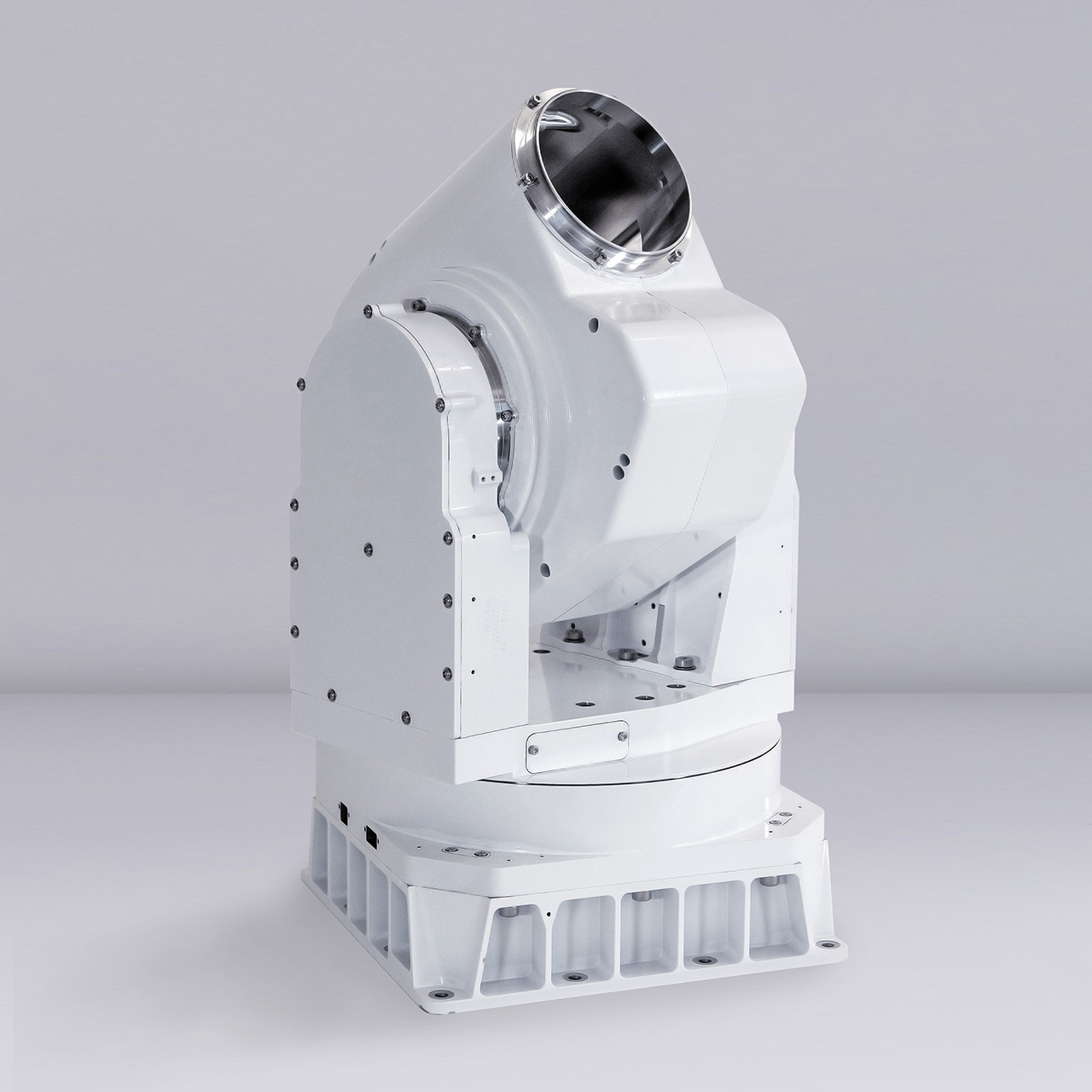
Image courtesy of Mynaric AG
Bolstered by its banner year in 2024 — which included record revenue and a 60 percent increase in launches of its Electron rocket — Rocket Lab has lately been making bold moves centered around maximizing its ability to grow its customer base. Along with the company’s pending acquisition of Mynaric, Rocket Lab also recently announced that it is working on a sea-based landing platform, “Return on Investment”, which it plans to roll out in 2026.
Given Mynaric’s production issues, contrasted against Rocket Lab’s increasingly impressive track record of meeting its deadlines, Rocket Lab would seem to be exactly the sort of buyer that can successfully bring Mynaric’s critical technologies to market at scale. The apparent sense of urgency in the space industry right now, evidence of which includes Eric Schmidt’s assumption of the CEO role at Relativity Space, illustrates how this area of the economy is poised to be one of the major flashpoints shaping geopolitical tensions over the next decade and beyond.
For better or worse, such flashpoints tend to signal strong potential for market penetration by the AM industry. And considering how pivotal AM already is to the health of the space industry, the opportunity here is likely to be particularly ripe.
Subscribe to Our Email Newsletter
Stay up-to-date on all the latest news from the 3D printing industry and receive information and offers from third party vendors.
Print Services
Upload your 3D Models and get them printed quickly and efficiently.













You May Also Like
The Drone Industry is Showing Where 3D Printing Delivers Real Value, AM Research Report Finds
The rapid rise of drones is creating one of the biggest opportunities for additive manufacturing (AM). Whether they’re used on battlefields, inspecting bridges or crops, or delivering supplies, drones need...
3D Printing News Briefs, June 27, 2026: Nanoscale 3D Printing, Defense Readiness, & More
We’re starting with a story about a grant for advanced nanoscale 3D printing in this weekend’s 3D Printing News Briefs, and then on to metal additive manufacturing (AM) for defense...
US Army Awards Continuous Composites 3D Printed Missile Component Contract
Despite the very loud, indignant claims from American defense officials that the US hasn’t depleted a significant portion of its munitions stockpiles, the US has depleted a significant portion of...
Rheinmetall Uses Ducting Made with Minifactory for Challenger 3 Tanks
Rheinmetall UK is using Minifactory Material Extusion as the primary production method for tank ducting on the Challenger 3 Main Battle Tank program. The Challenger 3 is the UK’s formidable...