Himed and Lithoz Launch Center for Bioceramics 3D Printing


Himed, a US manufacturer of bioceramic materials, and ceramics 3D printing leader Lithoz have announced a joint venture meant to combine their respective areas of expertise—the Bioceramics Center of Excellence (BCoE) at Himed’s headquarters in New York. This center aims to advance R&D in bioceramics for medical device manufacturers by integrating advanced analytical services to expedite rapid prototyping processes.
Since its founding in 1991, Himed has been dedicated to biomaterial coating characterization, starting with hydroxyapatite coatings and apatitic abrasives. Himed’s New York research and production facility provides raw biomaterials and customizable biocompatible coating and texturing solutions for use in medical devices, dental and orthopedic implants, prosthetics, and laboratory applications. The company’s MATRIX systems offer macro and micro surface texturing and bioactive coatings for improved osseointegration, while the high-volume production cell provides Type III color anodization for biocompatible implants. Additionally, Himed offers contract R&D services, providing analytical services and materials testing to support the development of new processes and products in biomaterial applications.
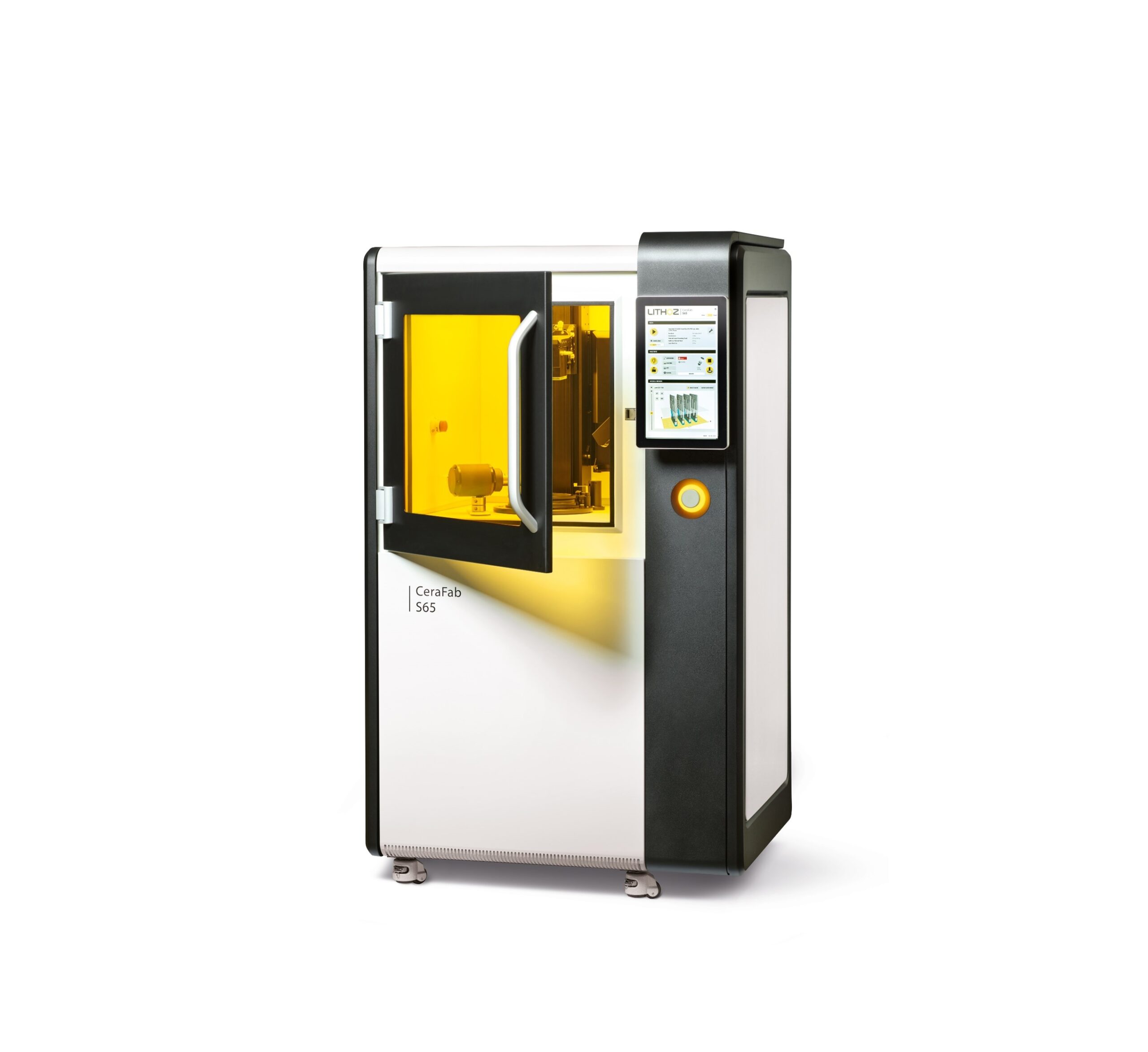
Lithoz CeraFab S65. Image courtesy of Lithoz.
With this in mind, the company’s partnership with Lithoz is a logical next step. The BCoE will extend Himed’s capabilities into rapid prototyping, leveraging Lithoz’s lithography-based ceramic manufacturing (LCM) technology. The center will offer a range of services, including design support and optimization, SEM imaging, material analysis and characterization, biomaterial customization, and bioceramic 3D printing using the Lithoz CeraFab S65 Medical printer.
“Lithoz’s technology is unlike anything else out there — they’ve solved some meaningful challenges in this field, and their printers can take you from concept all the way through production. That’s going to open up new avenues for invention in implant design,” says Dana Barnard, CEO of Himed.
Dr. Johannes Homa, CEO of Lithoz, says, “This new Bioceramics Center of Excellence will open up a new chapter in 3D-printed medical applications for North America! We are excited to be the technology partner enabling Himed’s bioceramic innovation – with the combination of Himed’s experience and Lithoz technology, new applications will certainly be enabled which are currently unthinkable.”
This development follows a strategic partnership announced last year between Lithoz and Himed, focusing on designing new slurries for Lithoz’s ceramic medical-grade 3D printers. The partnership is primed to take advantage of increased opportunity in healthcare and dental applications—especially implants—driven by increased life expectancy. In turn, the global bioceramic industry is projected to reach $10.2 billion by 2028, according to the partners. Similarly, the “Market Trends and Opportunities in Medical Devices; Prosthetics, Dental, Audiology,” report from Additive Manufacturing Research projects the 3D printed medical device market to reach $16.5 Billion by 2034.
“Before investing in a medical 3D printer,” explains Himed President Craig Rosenblum, “companies can effectively lease time on one, along with the support and materials expertise of Himed’s engineers and scientists supporting them from concept through optimization.”
The strategy Rosenblum mentions is typical of the additive industry, with many printer manufacturers relying on service facilities to introduce new clients to this advanced production technology as a gateway to potentially purchasing a system for use in-house. As a matter of fact, DyeMansion just announced the implementation of the same model but for post-processing of polymer 3D printed parts.
Subscribe to Our Email Newsletter
Stay up-to-date on all the latest news from the 3D printing industry and receive information and offers from third party vendors.
Print Services
Upload your 3D Models and get them printed quickly and efficiently.












You May Also Like
3D Printing News Briefs, June 13, 2026: Management Changes, Project Calls, & Wheelchairs
We’ll kick this weekend’s 3D Printing News Briefs off with some advisory board and management changes, and then move on to project call news. We’ll end with some heartwarming stories...
Researchers Combine AI and Bioprinting to Create Tiny Blood Vessel Networks
If 2026 has a theme in bioprinting, it may be blood vessels. Researchers can already print incredibly sophisticated tissues. The harder part is keeping those tissues alive. Without a network...
University of Arkansas Researchers Test Metal 3D Printing in a Mars-Like Atmosphere
If humans eventually establish a long-term presence on Mars, they will face a major manufacturing challenge almost immediately. Tools will break. Parts will wear out. Equipment will need repairs. But...
UT Researchers Use 3D Printing to Develop “Tabletop EUV Lithography” Process
Photolithography, the semiconductor manufacturing process whereby lasers transfer patterns onto chemical layers coating a substrate, is one of the most amazing industrial processes humanity has ever created. It is also...