GE Additive Transforms into Colibrium Additive in New Brand Move

One of the largest and most compelling companies in the 3D printing industry, GE Additive, has undergone a rebrand. Now, known as Colibrium Additive, the company and its new name are reflective of the broader changes taking place not only at GE but also in the additive manufacturing (AM) industry.
GE Aerospace’s Propulsion & Additive Technologies (PAT) division, GE Additive was established in 2016 as the result of the conglomerate’s acquisition of laser and electron powder bed fusion (PBF) companies Concept Laser and Arcam, respectively. While those two technologies continue to support GE Aerospace’s manufacturing of engine parts, the division has since developed its own metal binder jet AM process that is currently deployed with a number of large customers, including Wabtec and Cummins, among others.
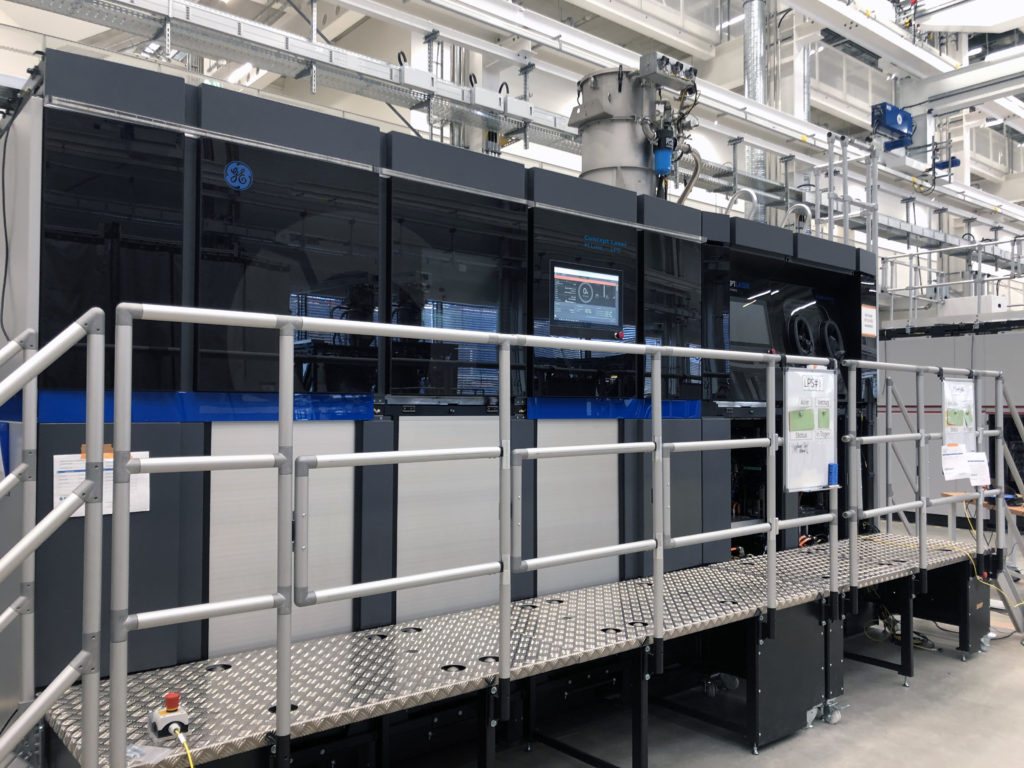
Colibrium Additive’s M Line Factory. (Image credit: Wilm Visuals for Colibrium Additive.)
Now, the division is hitting refresh with a new name and brand. With Colibrium as a portmanteau of the words “collaborative” and “equilibrium,” the legacy brand names “Concept Laser” and “Arcam EBM” will be retired. Meanwhile, AP&C, Colibrium Additive’s Montreal, Canada-based powder business, will retain its name but feature a new color palette, modified logo and new attribution line: “a Colibrium Additive business.”
“While we are changing our name, we maintain our unwavering focus on our customers, quality, and reliability. We will continue to lead the additive manufacturing industry from the front and positively disrupt it,” said Alexander Schmitz, CEO of Colibrium Additive.
All of this is taking place as GE itself undergoes a transformation from one conglomerate into three separate businesses: GE Aerospace, GE HealthCare, and GE Vernova, all of which have new logos with altered colors and, more importantly, are publicly traded as independent companies. Similar to Colibrium, Vernova’s name, too, is a combination of two different words: “verde” for “green” and “nova” for new.”
This operation, which Siemens also underwent, could be deemed a “reverse keiretsu.” In opposition to the Japanese keiretsu model, in which multiple, distinct companies collaborate over shared business interests to form a larger entity, GE has divided itself into separate entities with overlapping interests.
“We were ready for a change. GE becoming three standalone companies provided an ideal opportunity to review our corporate identity,” said Shaun Wootton, head of communications at Colibrium Additive. “Our new name and brand identity are both modern and dynamic. Both were designed to reflect our focus and company values, the pace of change in the additive industry, while accruing to GE Aerospace’s overall brand identity,” he added.
Just as GE is changing, so too is the 3D printing sector as a whole. As we’ve learned from numerous conversations with industry experts, keen AM players are focusing less and less on the additive nature of their manufacturing processes and more on 3D printing as simply another production tool. Rather than distract customers from the novel, yet potentially complex nature of AM technology, service providers and machine manufacturers are focusing on the end result of delivering parts and solutions to clients. In this way, Colibrium is representative of this change.
At the same time, there is an even larger change occurring in industrial society at large. Efforts to re-, near-, and friendshore as much as possible are underway that would see an unprecedented transformation in the ways that countries manufacture and trade goods. This sea change will be largely performed with Industry 4.0 technologies, including 3D printing.
Beginning May 1, 2024, Colibrium will execute its “A New Future” marketing campaign that will run throughout the year. More about the brand can be learned from its new website, as well as through trade shows such as the upcoming RAPID + TCT.
Subscribe to Our Email Newsletter
Stay up-to-date on all the latest news from the 3D printing industry and receive information and offers from third party vendors.
Print Services
Upload your 3D Models and get them printed quickly and efficiently.











You May Also Like
From Material Maturity to Fleet Execution: What Comes Next for Additive Manufacturing in the U.S. Navy
Additive manufacturing is steadily moving from experimental use toward routine application in U.S. Navy shipbuilding, sustainment, and much more. In recent years, the Navy, working through its Maritime Industrial Base...
Industrial Additive Manufacturing Reaches Its Most Important Inflection Point
Additive manufacturing is entering the most consequential period in its evolution. After years of experimentation and uneven adoption, the industry is showing renewed momentum, shaped by supply-chain pressures, and a...
Scaling Beyond 10 Printers: When Support Becomes a Bottleneck
The leap to industrial-scale 3D printing is a support problem, not a hardware problem. A 3D print farm is a centralized facility that uses a large number of 3D printers...
Reshoring Requires Rules of Engagement
Reshoring manufacturing in the U.S. is a stated national priority. Policymakers, industry leaders, and defense planners agree that domestic production capacity is essential for economic resilience, national security, and long-term...