UltiMaker Takes on Industrial Market with Factor 4 3D Printer

UltiMaker has announced its newest industrial 3D printer: The Factor 4. Unveiled officially at the HANNOVER MESSE trade show today, the Factor 4 is being positioned as a new flagship solution for light industrial applications. “There is untapped potential in the light industrial market, and we believe that Factor 4 will enable customers to further explore the application possibilities in this space,” said Ultimaker CEO Michiel Alting von Geusau.
Designed with an eye towards fulfilling the most pressing needs of UltiMaker’s customer base, the Factor 4 was engineered to support industrial users printing process-critical components and fixtures to keep their production lines flowing smoothly.
The Look
The Guts
Looking to expand the capability of end-users, the Factor 4 features an evolution of Ultimaker’s print core technology that facilitates printing up to 340°C. 60° hotter than the S7, this greatly expands the number of materials available to Factor 4 users.
“The quality control and additional sensor technology meet rigorous industry standards. Factor 4 enhances our possibilities for new applications with the widest range of high-performance materials,” said Johannes Karl, Head of Customer 3D Solutions at Krones.
An enhanced suite of on-board sensors provides real-time print monitoring and data collection. The Factor 4 generates a report after every print, allowing the unit to be seamlessly folded into workflows as a tool for ensuring part quality and consistency.

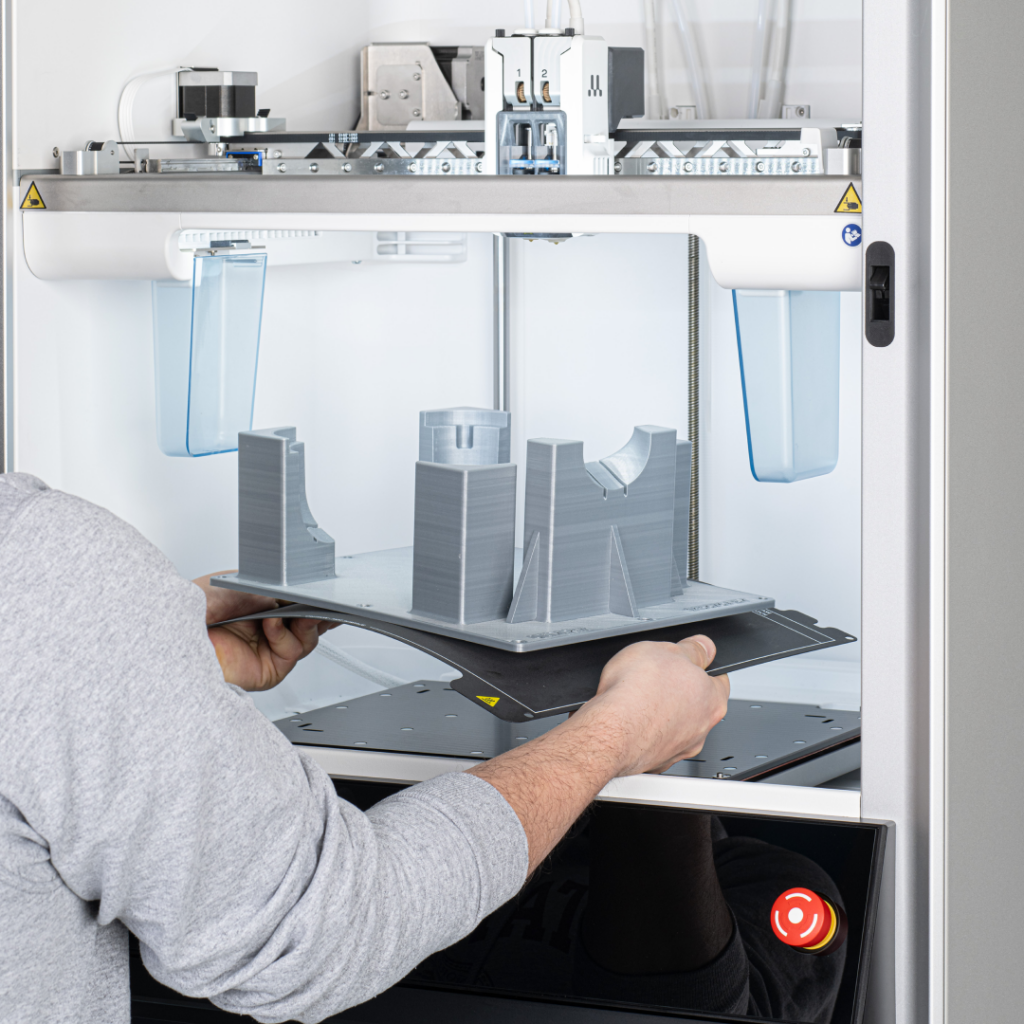
In order to enable quick service to customers and minimal downside to their production lines, Ultimaker’s engineers also designed the Factor 4 to be easy to repair. Modularity was a key design feature. Almost all of the unit’s internal components are easy to access underneath its rear panel. Replacement components will be available as “modules” that can be quickly shipped worldwide.

Additionally, it includes a HEPA filter, essential for processing fumes and particles in material extrusion 3D printing, as well as a low-moisture material handling system which supports up to six spools of filament, keeping them in optimal condition with humidity levels maintained below 15%.
A New Material for Industry
While the Factor 4 will arrive on the market sporting compatibility with one of the largest materials portfolios available, its release is also paired with a brand new material developed by Ultimaker: PPS CF. Polyphenylene Sulfide Carbon Fiber was engineered to produce cost effective replacements to metallic and PEEK parts. Boasting a flame and heat retardant composition, along with chemical resistance, PPS CF is geared towards prototyping and tooling applications in automotive, railway and aerospace industries.

The Market
PEEK, PEKK, and PEI (ULTEM), are key for 3D printing critical parts for the aerospace, defense, oil and gas, and, in some cases, medical sectors. Worth noting is that this system only reaches a build temperature of 70°, below the glass transition temperature of these materials, so it is not quite in line with Stratasys’s industrial material extrusion machines. Stratasys has been facing heavy competition from other high temp material extrusion machines like Roboze, AON3D, 3DGence, INTAMSYS, 3DXTECH, and others. So, this is the first printer that shows much of an attempt by Stratasys, which owns 45.6% of UltiMaker, to take on those foes with a lower cost, high temperature machine.
Additionally, Ultimaker (pre-merger) has always been a go-to brand for prototyping, jigs, fixtures, and other non-critical parts for major manufacturers, such as Volkswagen. However, the company’s development has generally lagged behind competitors. So, while Ultimaker could almost always deliver very well-made, easy-to-use machines, other firms came out with new products at a much faster rate. The Factor 4 is essentially an attempt to revitalize the company’s product line, with MakerBot printers now dedicated to the educational market and Ultimaker now firmly dedicated to engineering and production. In other words, rather than take on Bambu Lab with its speed and price, UltiMaker is continuing to focus up-market. There’s still the possibility that a Bambu-style machine will be released, but for now, UltiMaker is still facing higher-end competitors.
Subscribe to Our Email Newsletter
Stay up-to-date on all the latest news from the 3D printing industry and receive information and offers from third party vendors.
Print Services
Upload your 3D Models and get them printed quickly and efficiently.











You May Also Like
AM Demand Signals: Global Grid Resilience
We’re one year and a few days removed from the DeepSeek meltdown that rocked U.S. equity markets, not to mention the de facto U.S. AI brain trust, with fears that...
Critical Alloy Powder Manufacturing: CAPP Prioritizes AM Feedstocks and Advances U.S. Materials Leadership
Scaling additive manufacturing (AM) supply chains, particularly for metal powder-based processes, depends on the economic viability of products. The development of critical high-temperature metal alloys in powder form requires customer...
3DPOD 290: 3D Printing Since 1993 with Rajeev Kulkarni, Axtra3D
Rajeev Kulkarni was an early 3D Systems employee. He would spend 29 years at 3D Systems and was their VP of Corporate Strategy, CPO Printer Products, Manager of their Desktop...
The AM Adoption Problem No One Models
Through its short history, Additive Manufacturing has been presented to the investment community as a classic high growth technology story. Manufacturing is a multi-trillion-dollar market. Even a small percentage looks...