Iris van Herpen’s Dreamlike Designs Are Coming to Brooklyn Museum


Starting May 16, 2026, the Brooklyn Museum will host the North American debut of Iris van Herpen‘s Sculpting the Senses, a major exhibition that brings together more than 140 of the designer’s most striking couture pieces. The exhibition includes dresses inspired by water, air, coral reefs, and space.
Van Herpen is known for pushing fashion far beyond just fabric and thread. She blends handmade couture techniques with cutting-edge technology, including 3D printing, new materials, and scientific ideas pulled from fields like biology, physics, and astronomy. The result is clothing that feels like it’s alive, moving, and reacting to the body in surprising ways.
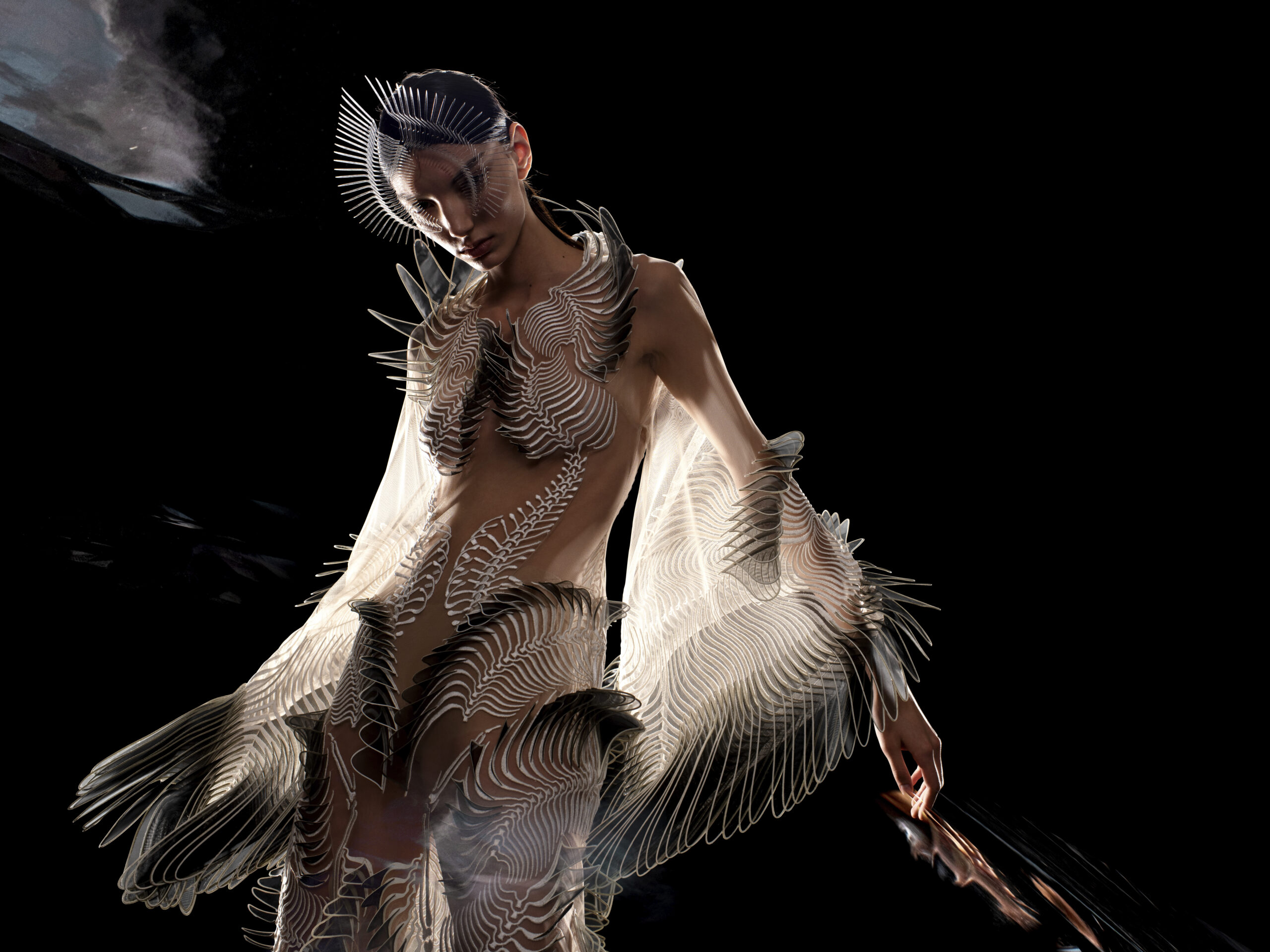
Iris van Herpen’s Labyrinthine Kimono Dress, from the Sensory Seas collection, 2020. Glass organza, crepe, tulle, and Mylar. Image courtesy of David Ụzọchukwu.
At the Brooklyn Museum, the exhibition will take visitors on a journey, “starting deep under the ocean and stretching all the way into the universe.” Along the way, it explores big ideas, like how the body moves, how we sense sound and light, how nature is built, and how humans fit into a changing world. Each section focuses on a theme, from water and motion to skeletons, space, and interconnected natural systems.
What makes Sculpting the Senses especially amazing is that Van Herpen’s designs will be shown along with contemporary artworks, design objects, and real scientific specimens like coral, fossils, and skeletons. In fact, these are the same kinds of structures and patterns that inspire her work, making it easier to see how science turns into fashion.
The exhibition also shows how Van Herpen works. The museum has recreated a studio space that lets visitors see the work behind her couture.
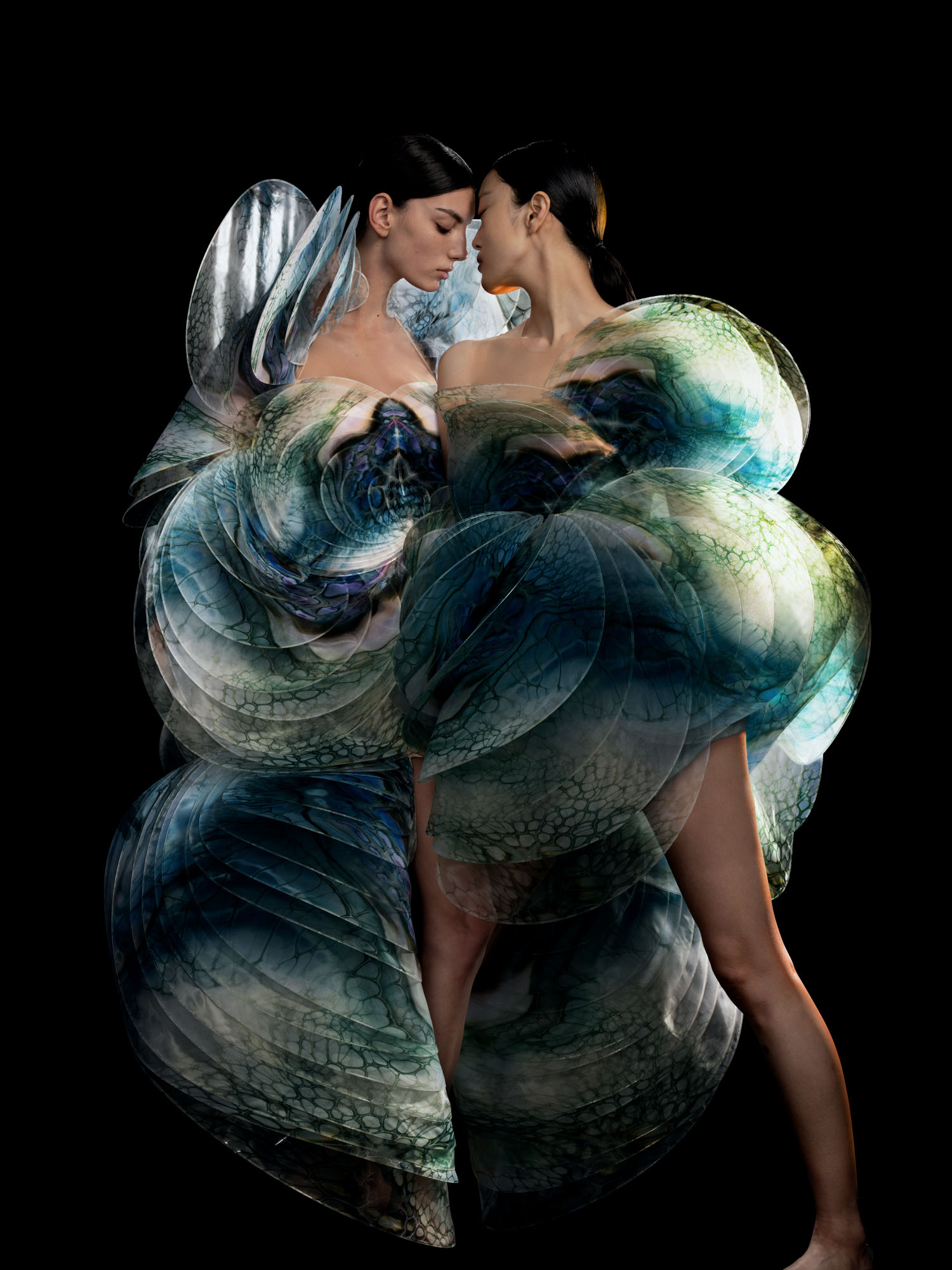
Iris van Herpen’s Sensory Seas Dress, from the Sensory Seas collection, 2020. PETG and glass organza. Image courtesy of David Ụzọchukwu.
Originally launched in Paris in 2023, the exhibition has already traveled the world, stopping in Australia, Singapore, and the Netherlands. Its arrival in Brooklyn marks Van Herpen’s first major exhibition in New York, and opens during the Brooklyn Museum’s annual Artists Ball, where she’ll be honored.
However, Van Herpen’s work goes beyond museums. She was the first designer to send a 3D printed dress down the runway, back in 2010, and her sculptural designs have been worn by artists and performers including Beyoncé, Björk, Lady Gaga, and Naomi Campbell.
Instead of treating 3D printing as a novelty, the designer used it to explore shapes that could not be made by hand alone, which include delicate lattices, flowing structures, and forms that seem to grow naturally around the body in a way that was never seen before. Her early collaborations with architects, engineers, and artists helped turn printed plastics into flexible, wearable couture.
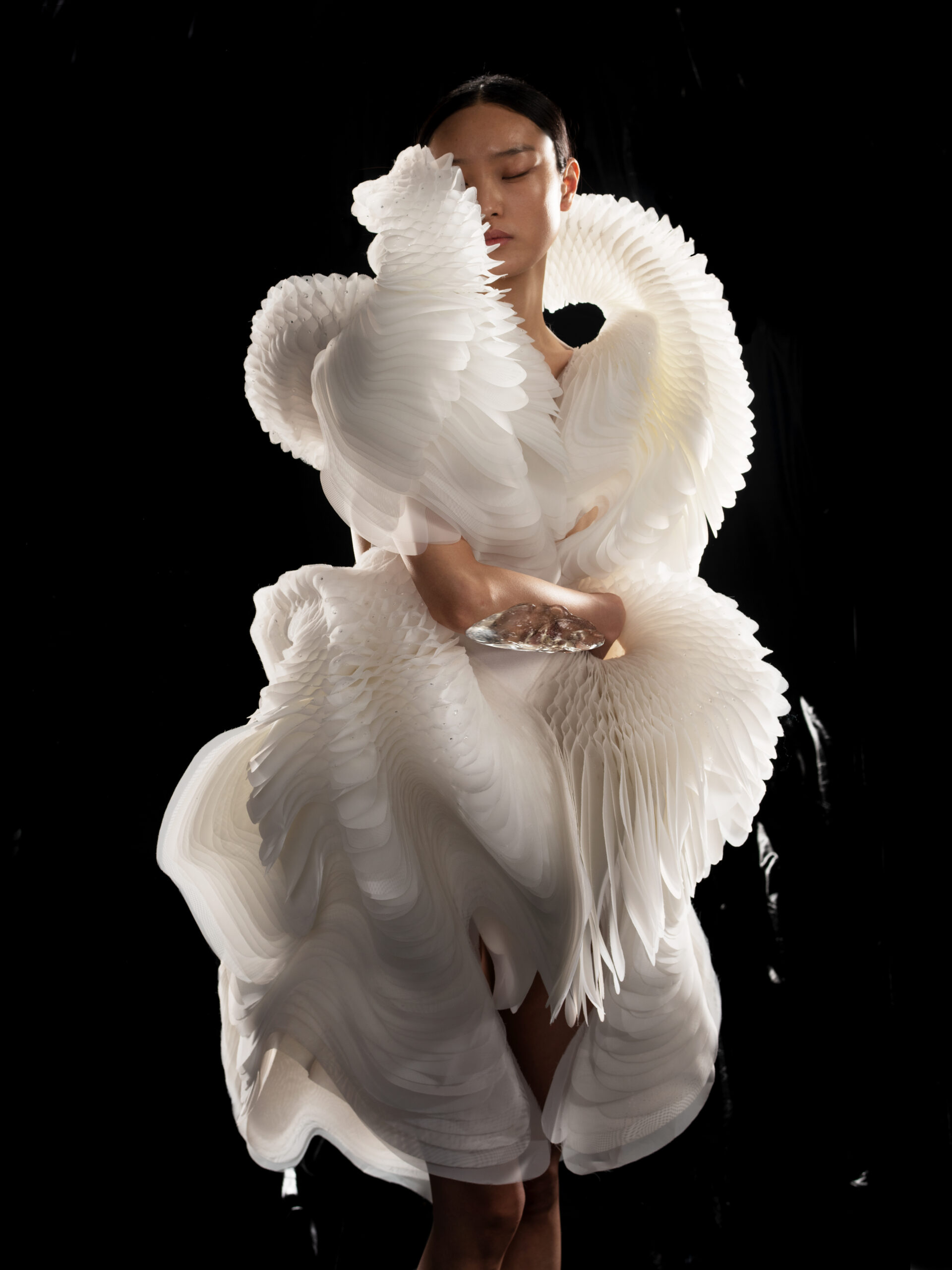
Iris van Herpen’s Morphogenesis dress, from the Sensory Seas collection, 2020. Laser-cut and screenprinted mesh, duchesse satin, and laser-cut Plexiglas. Image courtesy of David Ụzọchukwu.
Over the years, Van Herpen has kept using 3D printing in new ways, often mixing it with traditional handwork. Some pieces use printed structures inspired by bones or coral, while others combine 3D printed parts with fabrics like silk. So instead of replacing fashion craftsmanship, the technology works along with it. For Van Herpen, 3D printing makes it possible to create shapes that move, flow, and grow like forms found in nature, something fabric all by itself can’t always do.
Van Herpen works with professional 3D printing and digital fabrication tools. Early in her career, she used technologies like PolyJet printing to make very thin printed pieces, tiny, delicate elements that could then be attached to fabric.
Over time, she began mixing 3D printing with other techniques like laser cutting to build complex patterns and structures that would be almost impossible to make by hand.
For this exhibition, the focus is on nature, technology, and what fashion can become. That approach fits naturally at the Brooklyn Museum, which has a long history of major fashion exhibitions, including shows dedicated to designers like Jean Paul Gaultier, Christian Dior, and Thierry Mugler. The exhibition also reflects the museum’s roots as a place that connects art and science, while continuing its focus on highlighting women who are shaping creative fields today.
Subscribe to Our Email Newsletter
Stay up-to-date on all the latest news from the 3D printing industry and receive information and offers from third party vendors.
Print Services
Upload your 3D Models and get them printed quickly and efficiently.













You May Also Like
AM Investment Strategies 2026 Sets the Stage for AMS 2027
AM Investment Strategies 2026 Nov. 5 · 12 p.m. ET · Free online event RESERVE YOUR SPOT ↗ A one-hour online discussion featuring some of the biggest names in 3D...
With Its Latest $200M Round, ICON May Be Running Away With the 3D Printed Construction Market
I used to view ICON, the Austin-based additive construction (AC) firm, as one of a handful of companies that could realistically consider itself the leader of the 3D printed construction...
How Should Businesses Build New Business? Dirk Simon Weighs In — Part 1
Dirk Simon had deep experience in materials and chemistry before joining the 3D printing industry. Instrumental in BASF and Farsoon’s market introduction, Dirk has spent a lot of time thinking...
3D Printing Services Near $2.5B as AM Market Shifts Beyond Hardware
The additive manufacturing market may be growing again, but one of the more interesting numbers behind that recovery has little to do with selling 3D printers. AM services generated nearly...