Cloud Platform for Metal 3D Printing Developed by German-Chinese Consortium


As software plays an increasing role in the workflow for industrial additive manufacturing (AM), we’re seeing such software-driven workflows formalized into secure, end-to-end systems. Typically, the go-to example is that of Materialise, whose CO-AM platform aims to tackle every link on the AM production chain. However, new solutions are emerging, such as tools from Hexagon and, now, the ProCloud3D project, developed by a German-Chinese consortium led by the Chair of Digital Additive Production (DAP) at RWTH Aachen University.
ProCloud3D is meant to be a secure, cloud-based platform capable of real-time, encrypted transmission of production data for laser powder bed fusion (LPBF) for metal parts. Funded by Germany’s Federal Ministry of Education and Research (BMBF), the solution enables direct, layer-by-layer data transmission to service providers’ PBF machines, ensuring the data remains inviolable from external threats and manipulations while maintaining strict production quotas.
Interestingly, the idea of direct transmission of layer data to 3D printers isn’t entirely new, with some manufacturing execution systems streaming toolpaths directly to the machine. The latest example comes from Würth Additive’s Digital Inventory Services. In the case of ProCloud3D, a real-time slicer generates machine control code from construction job information. The platform’s architecture leverages the Open Vector Format (OVF), enhancing the flexibility in laser control and scan field management.
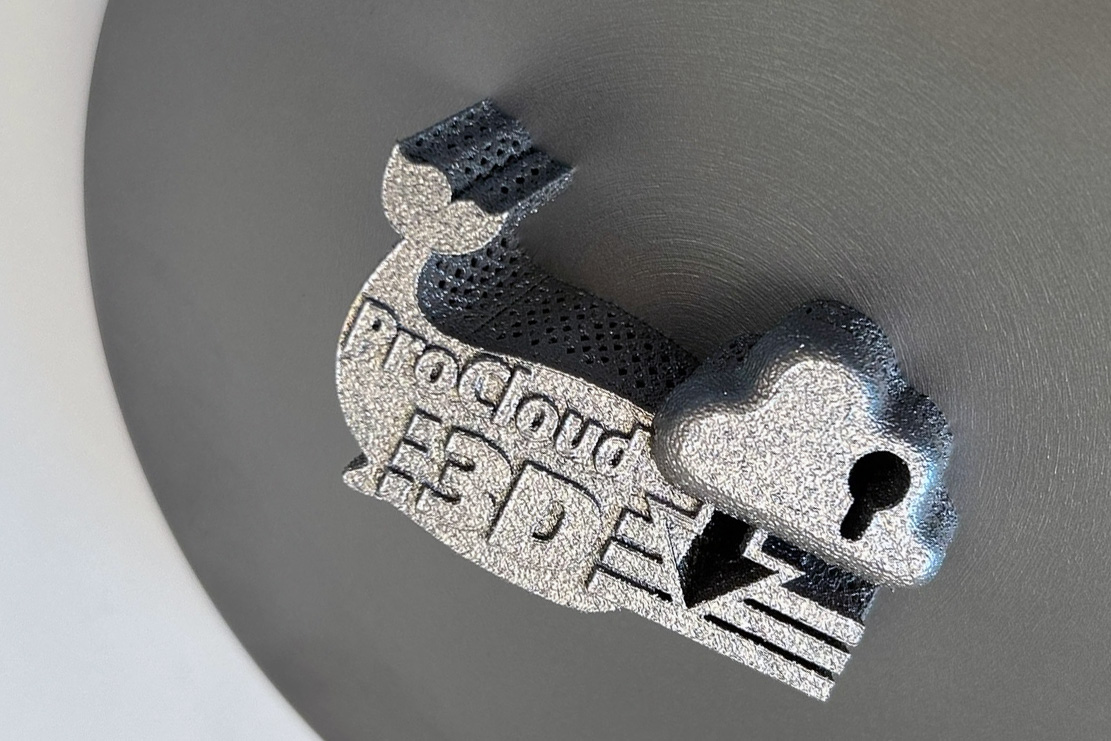
The culmination of the project was the successful manufacturing of a demonstrator through the secure stream, illustrating the platform’s efficacy and setting the stage for widespread adoption in decentralized additive manufacturing. The consortium behind ProCloud3D is an interesting one, made up of WIBU-Systems, Laser Melting Innovations (LMI), RWTH Aachen’s DAP, Beijing University of Technology, Xi’an Bright Laser Technologies (BLT), Nanjing 1001 Automation Technology Co, and Beijing Aerospace Smart Manufacturing Technology Development Company.
Because BLT has grown so rapidly, the Chinese LPBF manufacturer and service provider’s role underscore’s its expansion in Western markets. It is now at such a level that the German government is funding its efforts with local firms. Additionally, the collaboration seems set to enhance the use of AM by both Chinese and European aerospace industries, given the fact that Airbus is one of BLT’s most important customers. In other words, we can see the cross-pollination of the Chinese and European aerospace sectors by this consortium.
Another interesting detail is the fact that LMI makes the lower-cost LPBF systems that are sold by Würth Additive under the Kurtz Ersa brand, so there may very well be an overlap between Würth’s Digital Inventory Services and ProCloud3D. Even if there is not, the parallel approaches to file streaming suggest the emergence of a de facto standard for file security necessary for aerospace and likely defense 3D printing and distributed manufacturing as a whole.
Subscribe to Our Email Newsletter
Stay up-to-date on all the latest news from the 3D printing industry and receive information and offers from third party vendors.
Print Services
Upload your 3D Models and get them printed quickly and efficiently.













You May Also Like
SWISSto12 Closes $70 Million Series C Round
Swiss satellite manufacturer SWISSto12 has closed a $70 million Series C round. This follows $84.8 million that the company received from ESA and ESA member states, and previous rounds that...
Rocket Lab Buys Iridium in $8 Billion Deal, Creating a New SpaceX Rival
Rocket Lab is buying Iridium for $8 billion in a cash-and-stock deal worth $54 per share. Shareholders will receive $27 in cash plus additional Rocket Lab common stock. The company...
SWISSto12 and HPS/LSS Build Unfurling Antenna for Next-Gen Satellite
SWISSto12 is to work with HPS/LSS. High Performance Space Structure Systems and Large Space Structures are two separate firms that work together on large antenna reflectors. The two will work...
Japan’s Space Compass Corporation Buys a SWISSto12 Satellite
Japanese firm Space Compass Corporation has agreed to buy a SWISSTo12 GEO optical data relay satellite. The compact Hummingsat will be used for Space Compass’ optical data relay service. Space...