3D Printing Financials: Stratasys Navigates Through Economic Uncertainty, Steady Profits and Revenue


Stratasys (Nasdaq: SSYS) unveiled its financial results for the third quarter of 2023, revealing a mixed scenario amid a backdrop of significant merger and acquisition (M&A) activities with Nano Dimension (Nasdaq: NNDM), 3D Systems (NYSE: DDD) and Desktop Metal (NYSE: DM) that ultimately did not materialize into any deals.
In this quarter, Stratasys reported revenues of $162.1 million, which was essentially flat compared to the $162.2 million reported in the third period of 2022. This stable revenue performance is particularly important amid global economic uncertainties. When adjusted for constant currency and excluding the impacts from recent divestments like MakerBot and Stratasys Direct, the revenue was up 3.3%.
Resilience
A highlight of the quarter was the record-level recurring revenue from consumables, reflecting strong printer utilization. According to CEO Yoav Zeif, this aspect of the business is crucial as it indicates ongoing customer demand and engagement and a reliable, steady income stream, which is essential for the brand’s long-term sustainability.
“The results show that our customers recognize our unique combination of industry-leading polymer technologies, the broader set of polymer materials, a unified software platform across the portfolio, unmatched go-to-market capabilities, and excellent customer service. And we continue to invest and innovate to stay at the forefront of additive manufacturing while growing the business across our end-use segment,” explained Zeif during an earnings call with investors.
Despite the increasingly challenging environment for customer capital spending, Zeif indicated that Stratasys delivered results comparable to the year-ago period for revenues, non-GAAP margin, and adjusted EBITDA.
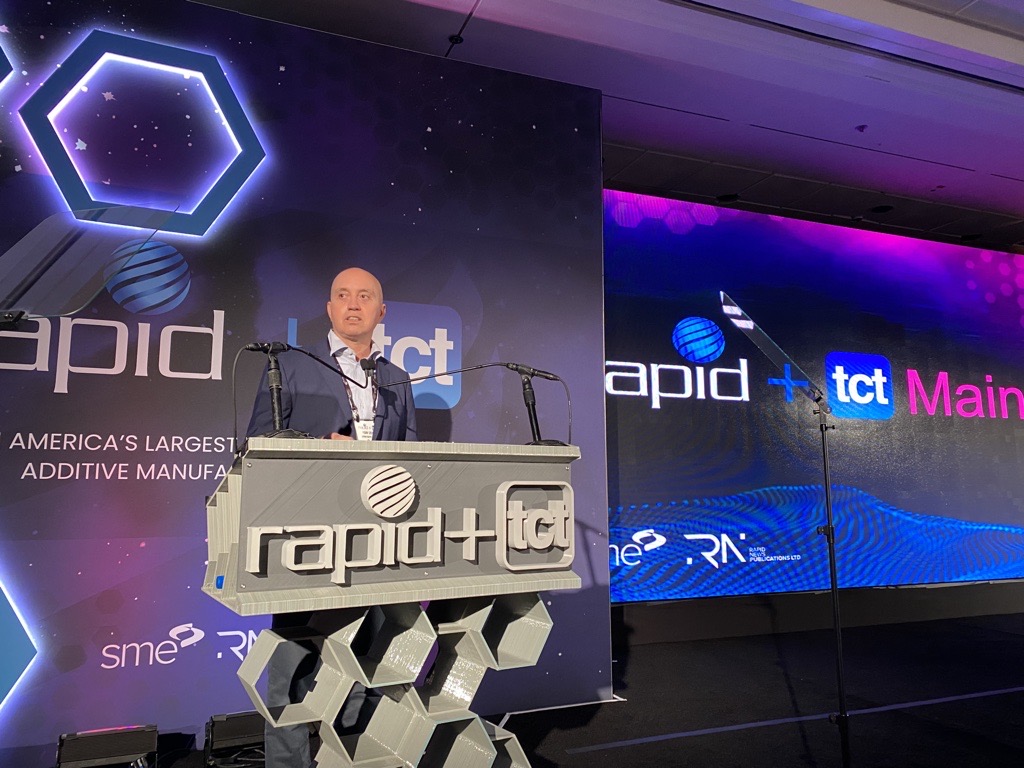 Stratasys CEO Dr. Yoav Zeif delivers opening remarks at the RAPID + TCT event 2021. Image courtesy of Stratasys via Twitter.
Adaptability
However, the quarter was not without its financial challenges. Stratasys faced a net loss of $47.3 million, or 68 cents per share. In contrast, the non-GAAP net income was $2.4 million, or 4 cents per share, marking the ninth consecutive quarter of adjusted profitability and in line with market expectations. This contradiction between GAAP and non-GAAP figures points to significant costs related to mergers and acquisitions, defense against a hostile tender offer, proxy contests, and related professional fees, explains the company.
Stratasys also updated its 2023 financial outlook, reflecting the impacts of divestitures and the uncertain macroeconomic climate. The revised revenue forecast is now between $620 million and $630 million, with gross margins expected to be between 48% and 49%. The company anticipates a net loss in the range of $117 million, or $1.70 per share, and $104 million, or $1.51 per share.
A significant development for the firm was the introduction of a new 3D printer, the F3300. Introduced at Formnext 2023, the machine is touted as being up to two times faster than other polymer filament printers currently available. The company also said the F3300 offers up to 45% cost per part reduction compared to existing solutions. It is loaded with sensors that will, over time, provide part and print data collection capabilities to support foreseeable usage around quality and predictable outcomes. Initially planned for commercial availability during the fourth quarter of 2023, Zeif said it will be available in the first half of next year. Toyota has already announced it will be the first F3300 customer.
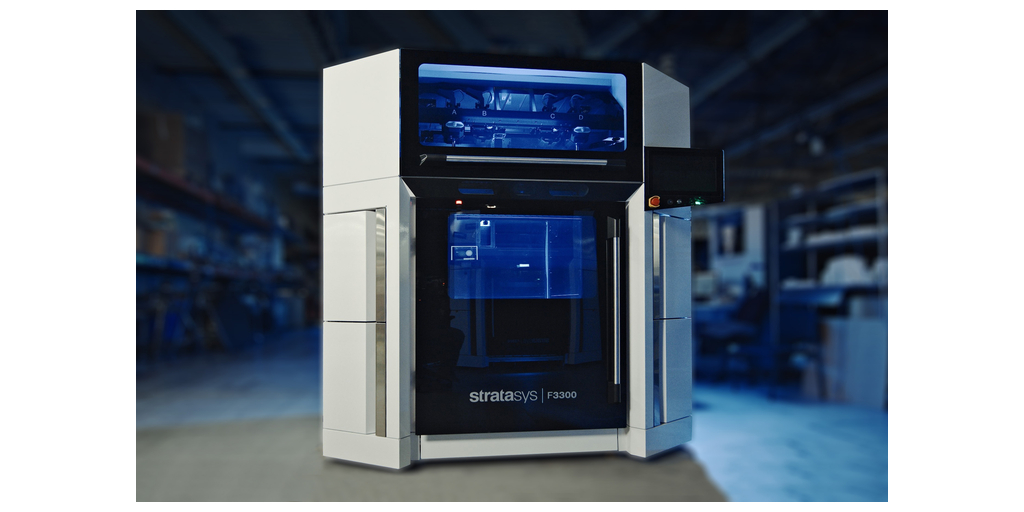 Stratasys F3300. Image courtesy of Stratasys.
“As a reminder, Stratasys invented FDM over 35 years ago. It is the world’s most popular 3D printing technology, and we lead across aerospace, automotive, and defense applications. This new F3300 platform was developed with tremendously valuable input from many of our customers over the last several years,” remarked Zeif.
Progress
Otherwise, Stratasys’ financial position remains robust, with $185 million in cash, equivalents, short-term deposits, and no debt. This solid financial footing is crucial as it allows the company to navigate current market challenges. It also “supports its ability to grow through a combination of organic investment and accretive acquisition opportunities” that will further the strategic objective to be the leading provider of additive manufacturing solutions, explained Zeif.
Stratasys has successfully achieved positive adjusted earnings per share for the ninth consecutive quarter, highlighting its financial health. According to its earnings report, this was accomplished by effectively managing non-GAAP operating expenses, which were kept flat as a percentage of revenue compared to the previous year, even as the company continued to invest for future growth.
In a strategic move to enhance profitability, Stratasys decided to discontinue two unprofitable parts of its business. This decision will likely reduce its earnings by about $5 million in 2023, but it is expected to improve its financial performance from 2024 onwards.
Overall, the third-quarter results demonstrate Stratasys’ ability to remain profitable, even when investing heavily in new projects is challenging. Stratasys had some additional costs associated with various M&A deals that didn’t go through and a large one-time gain last year that wasn’t repeated this year. Nevertheless, it still managed to earn $2.4 million in profits.
“Stratasys has consistently outperformed our sector on both financial metrics and business fundamentals. We have continued to accomplish this, even during the challenging business environment this year and the excessive M&A noise in our space. Our focus remains on maximizing shareholder value while being cognizant of the new term headwinds we expect the industry and macro headwinds will abate, returning us and the industry to a period of sustained growth and increased profitability,” concluded Zeif.
Subscribe to Our Email Newsletter
Stay up-to-date on all the latest news from the 3D printing industry and receive information and offers from third party vendors.
Print Services
Upload your 3D Models and get them printed quickly and efficiently.













You May Also Like
Printing Money Episode 39: Q1 2026 Public Markets 3D Printing Earnings Analysis with Troy Jensen, Cantor Fitzgerald
Welcome to Printing Money Episode 39, (or, “The one where they all went to market”). It’s that quarterly time, so Troy Jensen (Managing Director, Cantor Fitzgerald) joins Danny for a review...
Goldilocks’ Flywheel: Refractory Complex Concentrated Alloys (RCCAs) & The Race for the Future
Recently, Metalysis, Skyrora, and Thermo-Calc Solutions started to try to commercialize Tanbium. This alloy has been created for use in combustion chambers and rocket nozzles. Tanbium is a Refractory Complex...
Printing Money Episode 35: Notable VC and M&A Deals, with Arno Held and Alex Kingsbury
Welcome to Printing Money Episode 35 and let us be the last to wish you a happy new year. For this episode Danny is joined by Arno Held (Managing Partner,...
Snapmaker Secures Series B Backed by Xiaomi Founder’s Network and China’s Investment Elite
Desktop 3D printer manufacturer Snapmaker has gotten a series B round. The round is led by Hillhouse Ventures and Meituan. Cowin Capital and Orient Securities Capital dipped in for another round,...