Fabrisonic CEO Discusses New Ultrasonic Metal 3D Printer


Fabrisonic is an ultrasonic additive manufacturing (UAM) pioneer, which moved into a new facility in Lewis Center last winter, not far from its original home with EWI on the campus of Ohio State. I was able to catch up with President and CEO Mark Norfolk, who was able to discuss his company’s latest developments, including the release of a new metal 3D printer. Norfolk told me that, thanks to the new facility, the company now has much more capacity.
“We did order a bunch of our own machines, so we bought a bunch of parts to build more of our own machines. Unfortunately, two of the three have already been bought by customers before we can move them into the new facility, but it is a good problem to have,” he said.
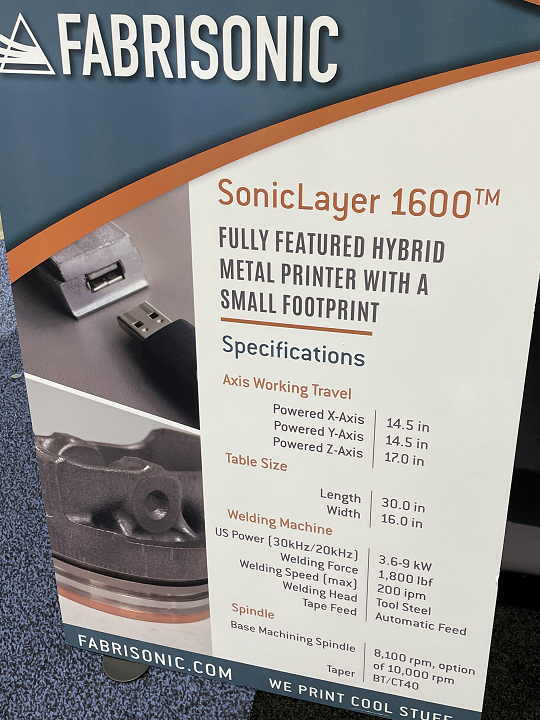 Fabrisonic’s most recent news, hwoever, was the launch of its new metal 3D printer, the versatile SonicLayer 1600. The all-purpose, hybrid manufacturing and fabrication platform offers both additive and subtractive technologies, a high-powered 9 kW head on a medium-sized CNC milling center frame, and a 14.5” x 14.5” x 17” build envelope.
“It’s the same capability of all of our other machines,” Norfolk told me. “So, we have the ability to weld dissimilar metals. We have the ability to embed electronics. It’s hybrid CNC plus additive. So, all that’s the same. What’s changed is the form factor.”
The new SonicLayer 1600 was created in response to customer demand for a more compact system. Fabrisonic offers larger machines, including one with a 6′ x 6′ bed, “and our customers were saying, these are too big. We need something smaller.” By making a smaller printer, the company is also enabling a lower cost.
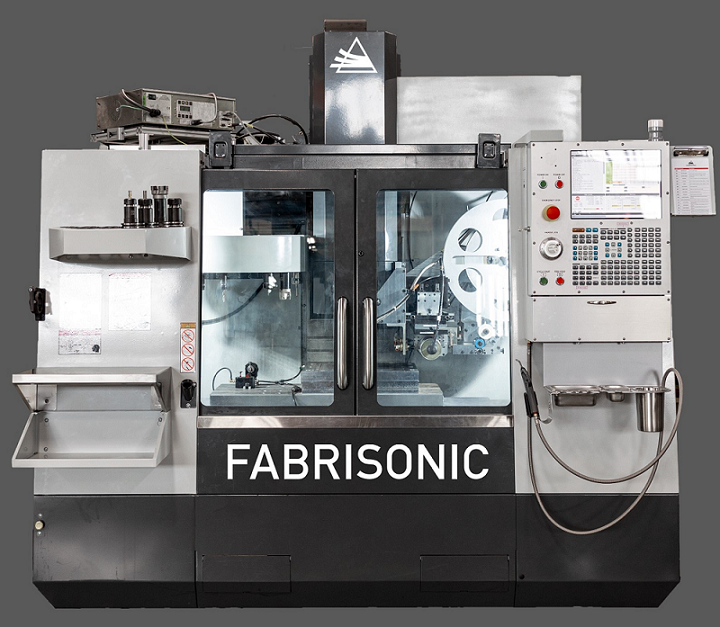
“This machine is off of a commercial mill from Haas, and takes the volume down to 14″ x 20″. So, it shrinks the size of the machine,” Norfolk continued. “Obviously that has an effect on cost, but also footprint.”
Many customers wanted a machine with Fabrisonic’s capabilities, but that could actually fit in the door of their own facilities. The new SonicLayer 1600 answers that need, with a smaller footprint but still what Fabrisonic calls an “ideal fabrication platform” for manufacturing operations producing devices and products with embedded sensors, dissimilar metals, and complex, smooth internal geometries and pathways.
“Our next size up, the SonicLayer 4000, weighs 25,000 pounds. So it’s a point well made and we’ve responded with a new series,” Norfolk said. “We have one of these in our shop. We’re building two more right now for customers.”
Fabrisonic is now taking orders for the new SonicLayer 1600.
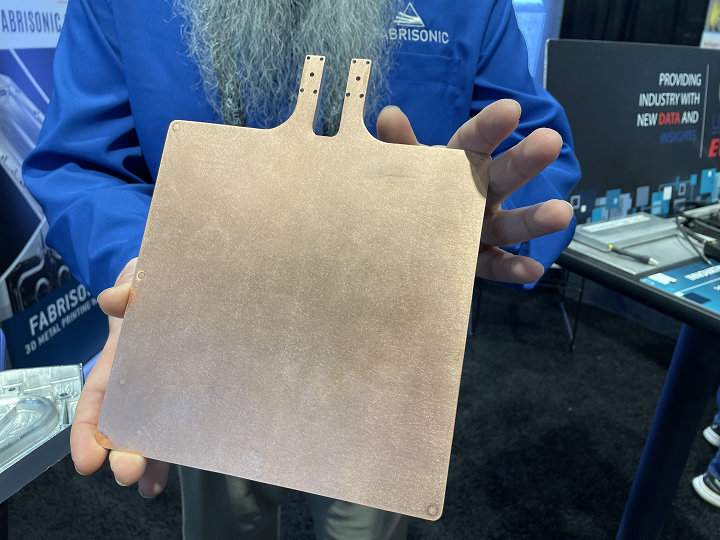
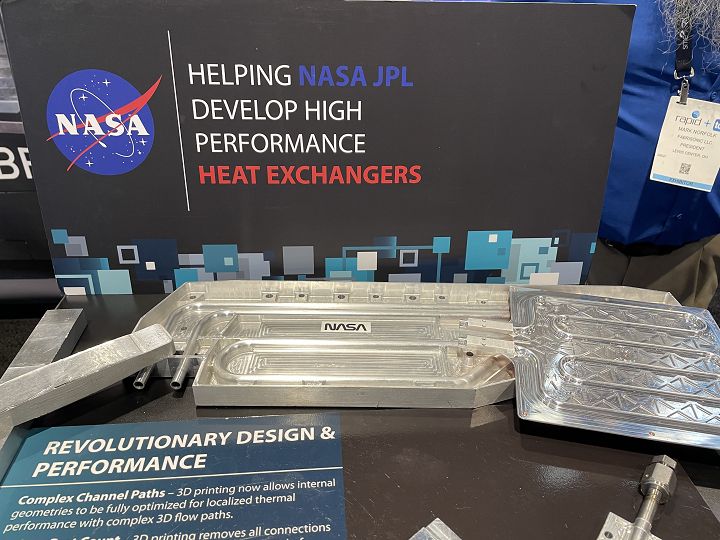
The company also prints multi-metal parts, using material like copper, for customers who need more lightweight parts.
“We get copper in certain locations so that we can wick that heat sideways very, very quickly,” Holding up a component from the booth, Norfolk said, “In this part, it’s only a single region of copper, but in some of our other flight hardware, we’ll have copper in three or four locations, and it’s really about getting the copper at the really hot spots.”
I asked if Fabrisonic had any exciting customers Norfolk could tell me about, and he replied that while the company does indeed have some, he can’t tell me about them just yet. For a company that frequently partners with NASA, I expected that answer, but I had to ask!
Subscribe to Our Email Newsletter
Stay up-to-date on all the latest news from the 3D printing industry and receive information and offers from third party vendors.
Print Services
Upload your 3D Models and get them printed quickly and efficiently.













You May Also Like
50,000 Orders and Counting: EPlus3D & Chinese AM Services Provider Are Scaling Liquid Cooling Solutions for AI Servers
An under-appreciated story driving the additive manufacturing (AM) industry this year has been the divergence between what’s driving the market in China and what’s driving it everywhere else. Let’s start...
Seven Trends Reveal What’s Next for 3D Printing at TCT Shenzhen 2026
TCT Shenzhen 2026 opened on October 14 in Hall 15 of the Shenzhen World Exhibition & Convention Center in Bao’an, and ran through October 16. The event brought together equipment...
With Increased Aerospace & Defense Focus, CORE Industrial Partners Buys More Manufacturing Firms
Private equity’s march into manufacturing continues with CORE Industrial Partners’ latest acquisitions. CORE purchased Fathom a few years ago, and later bought 3DXTECH LLC, Triton 3D LLC, and Gearbox3D. It...
Can India’s AM Push Help Make it a Viable Supplement to China?
Diversifying manufacturing supply chains to locales outside of China has nothing to do with actually cultivating “substitutes” to the Chinese economy. The real stakes are these: China is an irreplaceable...