Europe’s Largest 3D Printed Building to Be Built by PERI Group

COBOD, the world’s leading original equipment manufacturer (OEM) of additive construction (AC) platforms, announced that PERI Group is currently using the BOD2 system to construct Europe’s largest printed building: a data-management and cloud services center in Heidelberg, Germany. PERI Group, a leading global scaffolding supplier and principal investor in COBOD, has partnered with German real estate development firm KRAUS GRUPPE on the data center, which will be operated by Heidelberg IT Management GmbH & Co. KG.
When completed, the data center will be 6,600 square feet and stand at 30 feet high. The construction process began on March 31, 2023 and the current estimate is that it will be finished by the end of July 2023. According to COBOD, PERI Group expects to print the building’s walls at a rate of 4 square meters (about 43 square feet) per hour.
 Rendering courtesy of PERI Group and SSV Architekten
In a press release about Europe’s largest 3D printed building, Dr. Fabian Meyer-Brötz, managing director of PERI 3D Construction GmbH, said, “Based on parametric design, the special wall design used in the building documents the immense design freedom, that the COBOD BOD2 3D printer enables. We are very proud to be able to realize our largest building to date with this project.”
The founder and general manager of COBOD, Henrik Lund-Nielsen, commented, “In this unique project PERI is emphasizing two of the key benefits of 3D construction printing; speed of execution and design freedom. Because of this our technology is capable of carrying out everything from materials savings on windmill towers over low cost residential housing in Africa to architectural office type buildings in Germany.”
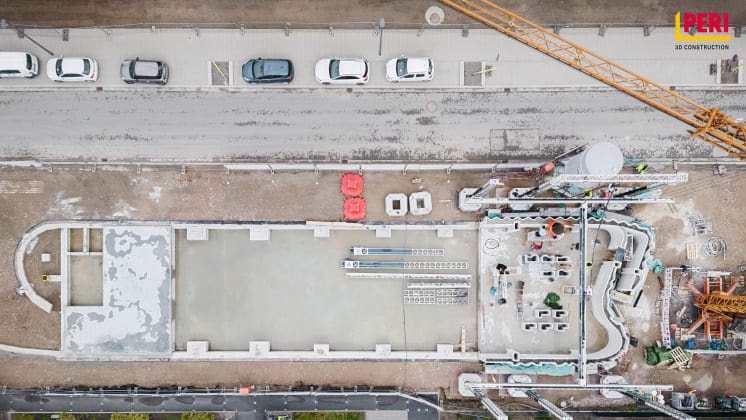 Drone shot courtesy of KRAUSS GRUPPE
Lund-Nielsen is justified in boasting about the diversity of the industries in which COBOD has established a foothold, as the company also represents such an overwhelming preponderance of the AC market. COBOD machines have been used on a striking 40 percent of all the 3D printed buildings currently in existence. Thus, the use of COBOD’s technology for such a variety of different purposes is no purely academic exercise, but instead signals real potential growth for the company in virtually every major source of future demand for the construction sector at-large.
In that context, PERI Group has picked a real winner here by focusing specifically on the data services sector. By now, anyone who pays moderate attention to the news is familiar with the supply chain issues that the entire tech world has been hamstrung by. However, this is not limited to lags in semiconductor deliveries.
 Rendering courtesy of PERI Group and SSV Architekten
In fact, the shortages stem just as much from issues more typically associated with the “old economy.” For instance, in August 2022, Intel announced that it will need 7,000 workers just to build its in-progress semiconductor plant in Ohio. That is no easy fix in an economy where labor shortages seem poised to be a long-term feature of the landscape.
I also mentioned this recently in a post about the shortage of quality megasites available for new fixed capital in the US, which could be another issue that COBOD’s technology might help address sooner rather than later. Automation won’t solve every problem, but it can certainly help transform many problems from impossible to merely difficult.
Subscribe to Our Email Newsletter
Stay up-to-date on all the latest news from the 3D printing industry and receive information and offers from third party vendors.
Print Services
Upload your 3D Models and get them printed quickly and efficiently.













You May Also Like
Kickstarter is Testing the Next Wave of Desktop 3D Printing
3D printers are raising serious money again…on Kickstarter, that is. Over the last few months, a new group of 3D printer campaigns has attracted millions of dollars and thousands of...
Stratasys vs. Bambu Lab: What’s Really Behind the $27.6M Patent Verdict?
Editor’s note: This is Part 1 of a two-part series by Xu Fanglei examining the technology and patent issues behind the Stratasys-Bambu Lab dispute. Part 1 looks at the U.S....
Bambu Lab and SUSAN FANG 3D Print for London Fashion Week
At London Fashion Week, some of the more unusual pieces on the runway came from 3D printers. Chinese fashion designer SUSAN FANG presented her Spring/Summer 2027 Air-Illusion collection at the...
Stratasys Wins $27.6M in Patent Case Against Bambu Lab; Bambu Challenges Verdict
Update, September 21, 2026: This article has been updated with a statement from Bambu Lab responding to the verdict, along with additional information about the company’s ongoing patent challenges against...