
Lockheed Martin & RedEye 3D Print 15 Foot Long Satellite Fuel Tank Simulator

Size is one of the major limiting factors within the 3D printing space. It has been difficult and extremely expensive for companies to produce 3D printed object of any substantial size. This seems to be slowly changing as  the technology matures to a point in which problems are being solved, almost on a daily basis.
In an incredible advancement within the large scale 3D printing space, Lockheed Martin’s Space Systems Company has teamed with RedEye, a Stratasys company, to 3D print two large fuel tank simulators for satellites. The purpose of the fuel tanks are to act as a prototype for the eventual tanks, which will be constructed at a later date. The 3D printed tanks will be used in form, fit, and function validation testing. The larger of the two 3D printed parts, created with RedEye’s fused deposition modeling technology, measures a staggering 15 feet in length, making it one of the larger objects ever created by this technology.
“With RedEye’s machine capacity and engineering support, we were able to successfully build these tank simulators in a fraction of the time and at a fraction of the cost,” said Andrew Bushell, senior manufacturing engineer at Lockheed Martin Space Systems Company.
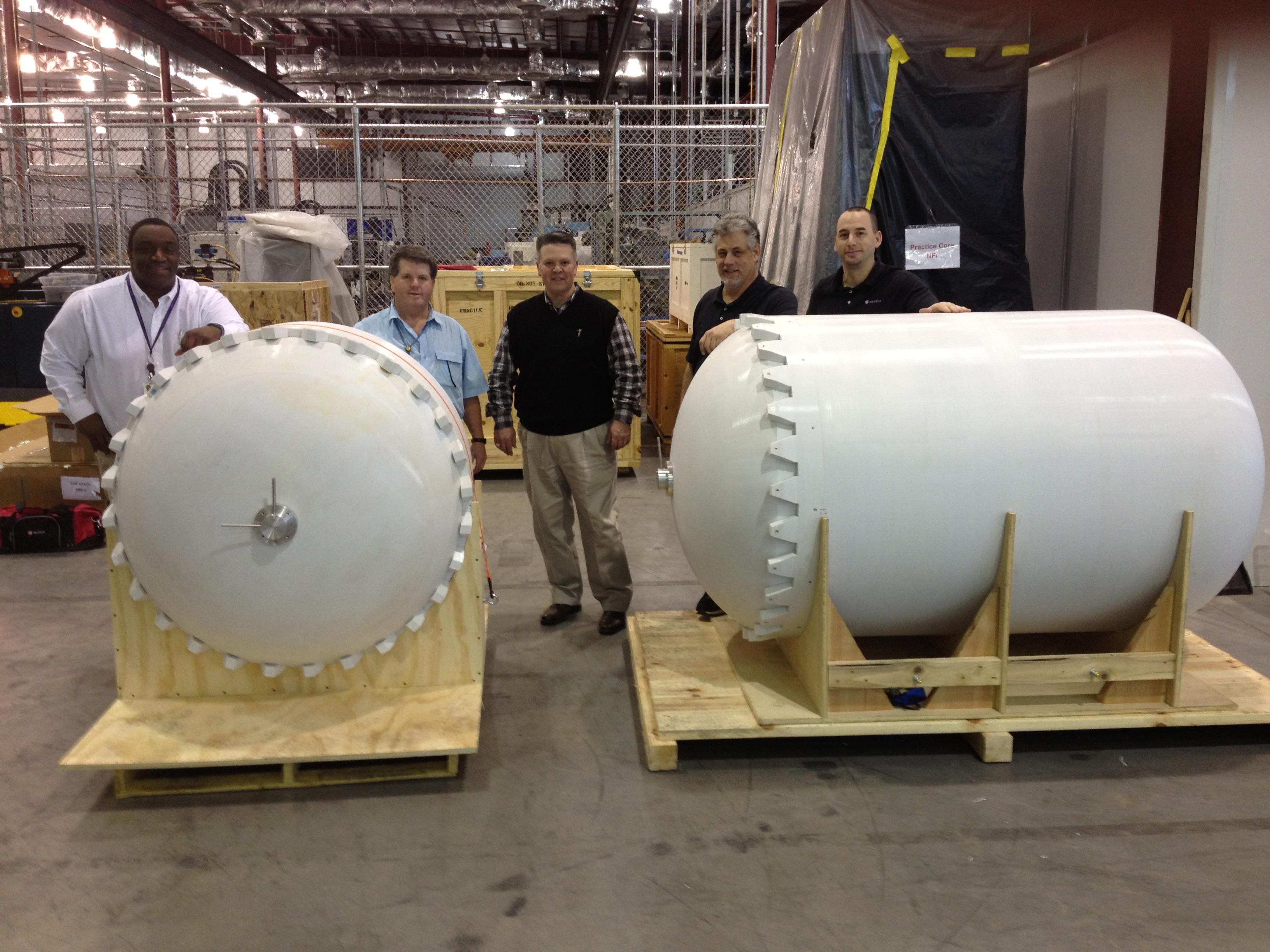
The 15 foot tank was built in 10 different pieces, and the smaller of the two tanks had to be constructed in six pieces. Together, both tanks took over two weeks to fully print, but saved Lockheed Martin an estimated 50% in costs, as compared to traditional machining of the parts. It has also saved the company a tremendous amount of time, allowing them to bring their new tank design to market faster, leading to a less stressful contract bid process.
“This project is unique in two ways – it marks the first aerospace fuel tank simulation produced through additive manufacturing and is one of the largest 3D printed parts ever built,” stated Joel Smith, strategic account manager for aerospace and defense at RedEye. “Our ability to accommodate such a large configuration and adapt to design challenges on the fly, demonstrates that there really is no limit to the problem-solving potential when you manufacture with 3D printing.”
Lockheed Martin has had a close relationship with RedEye since 2012, and has used their 3D printing technology on various projects over the last couple of years. They also have plans for further collaboration on 3D printing projects later this years. Discuss these amazing 3D printed fuel tanks at 3DPB.com. Check out the video below. The entire case study done by RedEye can be accessed here.
Subscribe to Our Email Newsletter
Stay up-to-date on all the latest news from the 3D printing industry and receive information and offers from third party vendors.
Print Services
Upload your 3D Models and get them printed quickly and efficiently.













You May Also Like
Kickstarter is Testing the Next Wave of Desktop 3D Printing
3D printers are raising serious money again…on Kickstarter, that is. Over the last few months, a new group of 3D printer campaigns has attracted millions of dollars and thousands of...
Stratasys vs. Bambu Lab: What’s Really Behind the $27.6M Patent Verdict?
Editor’s note: This is Part 1 of a two-part series by Xu Fanglei examining the technology and patent issues behind the Stratasys-Bambu Lab dispute. Part 1 looks at the U.S....
Bambu Lab and SUSAN FANG 3D Print for London Fashion Week
At London Fashion Week, some of the more unusual pieces on the runway came from 3D printers. Chinese fashion designer SUSAN FANG presented her Spring/Summer 2027 Air-Illusion collection at the...
Stratasys Wins $27.6M in Patent Case Against Bambu Lab; Bambu Challenges Verdict
Update, September 21, 2026: This article has been updated with a statement from Bambu Lab responding to the verdict, along with additional information about the company’s ongoing patent challenges against...
























































